In a small town in the Democratic Republic of the Congo, a man stares at a hand-bound book in disbelief. Inside are the pages of his own story.
“I’ve been poor my whole life,” he says. “I’ve been cheated out of a lot of things. But look, there’s a book about me.”
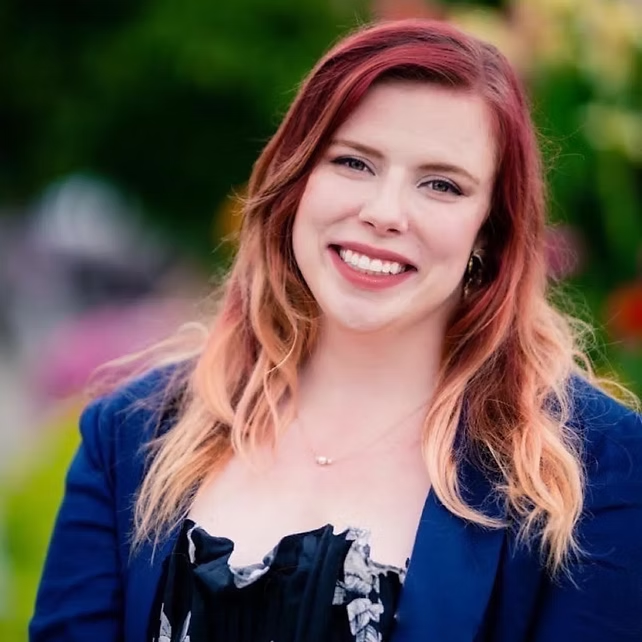
For filmmaker and former Brigham Young University creative writing professor Margaret Blair Young, moments like this emphasize the power of storytelling. Throughout her career, Young has used stories to restore voices that history has overlooked—stories that heal, foster understanding, and illuminate faith.
Young’s work documenting the history of Black members of The Church of Jesus Christ of Latter-day Saints began in 1998. “I had written quite a few books,” she recalls, “but I wanted to do something that really mattered.”
After praying for guidance and receiving a blessing from her husband that confirmed her spiritual promptings, she latched onto this idea: “Why don’t I write stories of Black Mormon pioneers?”
Soon afterward, she met Darius Gray under what she calls “pretty miraculous circumstances.” Gray is a journalist, businessman, and expert in Black Latter-day Saint history. He’s been actively engaged in human rights and civil rights causes for decades.
“I actually had a cassette tape recording of him in my purse because I had ordered it while doing research,” Young recalls.
When the two connected, Young had already written about one hundred pages. After reading the manuscript, Gray recognized the importance of the work. He looked over it and said, “Let’s do this together.”
Young and Gray delved into history and wrote a trilogy of novels, Standing on the Promises, about the lives of early Black Latter-day Saints. When the pair began, these stories were largely undocumented. Even after publication, they continued to uncover new information that corrected earlier assumptions.
“It’s a history that wasn’t terribly well known,” Young explains, likening the research required to that of three PhD dissertations.
Confronting Racism in Church History
Young’s work led to the documentary Nobody Knows: The Untold Story of Black Mormons, which explores the experiences of Black Church members before and after the 1978 revelation extending priesthood and temple blessings to all worthy male members.
“We could say things that Church leaders couldn’t necessarily say and really hit the complexities and the depths of the issues head on.”
Before the documentary’s release, Young and her collaborators showed it to the Church History Department and several General Authorities. The project was well received.
Young’s determination to address such complexities stems from personal experience. She first confronted racism directly at fourteen when her seminary teacher used a racial slur in class.
“I had a really visceral reaction to it.” She dropped out of seminary because of the incident. “That kind of [intensified] my own realization that we had a problem we needed to deal with.”
Sharing Jane Manning James’s Story
Young turned to creative work to confront the problem. She wrote the play I Am Jane about early pioneer Jane Manning James. When it was performed in Springville, Utah, around 2001, the production sold out and drew audiences from across the state. Many said they’d needed to hear Jane’s story, especially her petitions to President John Taylor asking about temple blessings. Young’s play captures the spirit of Jane’s appeal: If this was truly the “fullness of times,” and the promises to Abraham meant all people could be blessed, where was her blessing?
Jane’s faith and courage invited audiences to open their hearts and recognize Christ in every person they encounter.
In October 2020, President Russell M. Nelson called on members to “lead out in abandoning attitudes and actions of prejudice.” For Young, that work begins with recognizing when conversations are built on racist assumptions or when history is minimized or ignored.
Meaningful change, she believes, begins within individuals. Too often, conversations about racism end quickly, dismissed with a clever comment or meme. Real growth begins with humility and willingness to examine one’s own heart. The point is not condemnation but to allow God to reveal attitudes that might otherwise remain invisible.
“Ask the Lord to help you discern where [racist views] are and how you can clear them out.”
For Young, confronting prejudice is not separate from faith. It’s a central part of it. Latter-day Saints have a unique foundation for combating racism in the Book of Mormon, which repeatedly emphasizes unity and equality.
“There were no ‘ites’ among them. That should be the foundation for everything we do.”
A New Calling In the Congo
Young’s work eventually expanded beyond American history. “Darius was… the one who told me a whole lot about Africa.”
At the time, she and her husband were serving in an MTC branch where missionaries were learning to speak French. Through those missionaries—many of whom were preparing to serve in Africa—she began corresponding with individuals in the Democratic Republic of the Congo.
“Cinema had died about forty years ago in the Congo,” she explains. Government corruption and economic collapse left once-beautiful areas abandoned and in ruins. Yet she believes film offers a path toward renewal. “Cinema allows us to present new narratives.”
At first, Young thought they would be “making a movie that happened to be set in the Congo, but was maybe filmed somewhere else.” Instead, they discovered they were meant to support a Congolese team in reviving the country’s cinema industry.
Following the Work
Young realized that individualized storytelling could bring even more meaning to the community. When the team traveled to a remote town, the Congolese film director discovered his great-aunt living there. His mother had lost her own mother in childbirth, and this aunt had cared for her.
His great-aunt wept throughout their meeting. Because they spoke different languages, a translator helped them communicate. The following year, the team returned with his mother so the two could reunite.
Experiences like these confirm the stories of the Congolese people are waiting to be told. Young believes these stories carry a sacred weight, revealing the true character of a nation often portrayed only as a tragedy. She feels called to help share a broader vision of the Congo—one that reveals its beauty and reminds people that its citizens are “our brothers and sisters,” and that “we should strive to have ‘no ‘ites’ among us in our hearts.”
Young’s team collected oral histories from residents eager to share their experiences.
“We would bind the books using whatever materials they could find—cardboard, fabric…” With a generator powering the printer, Young helped students produce books featuring their own photographs.
The long-term vision was to create a library made up entirely of local stories. Many had lived through the devastating war that ended in 2003. “Some of the stories are horrifying, but they matter.”
Finding Her Path
Looking back, Young does not describe her path as carefully planned. She says it unfolded simply by being willing to begin.
“I don’t know that you’d want to follow the way I do things because I’m a little bit crazy,” she laughs. But her approach has always been rooted in openness, paying attention to ideas that feel meaningful, and acting on them before the full path is visible.
“If you’re not moving, not much will happen.” Her advice is to pray about what kind of work might bring good into the world, then begin. “Be open to anything. Trust that when you start doing something that is truly meant to edify and bring greater light into the world, it will be sustained.”
For Young, the work has always been about helping people see one another more clearly and remembering that every life holds a story worth telling.
This article is based on a Called to Create podcast aired season 1, episode 11. To hear the full podcast, click here.