• Skip to main content
  • Skip to primary sidebar
  • Skip to footer

LDSPMA

Empowering Latter-day Saints to spread light and truth by connecting them at the intersection of faith, creativity, and professional skill

  • Conference
    • The 2026 LDSPMA Annual Conference
    • Conference Registration
    • 2026 LDSPMA Anthology Submissions
    • Theme Contests
    • Exhibit, Advertise, or Sell at the LDSPMA Conference
    • Partner with LDSPMA
    • FAQs
    • Volunteer at the LDSPMA Conference
    • Past Conferences
      • 2025 Conference
        • Sessions
        • Workshops
        • Awards Gala
        • Internship Fair
        • LDSPMA’s Got (Secret) Talent!
      • 2024 Conference
        • Sessions
        • Workshops
        • ZIFF Networking Dinner
        • Schedule
  • Membership
    • Email Sign Up (Free)
    • LDSPMA NextGen
    • University Chapters
    • Facebook Group
    • NextGen Youth Facebook Group
  • Programs
    • Monthly Zoom Discussions (Free)
    • Mentoring Program
    • Master Classes (2026)
  • Podcast
    • Watch
    • Listen
      • Listen on Apple Podcasts
      • Listen on Spotify
      • Listen on Buzzsprout
    • Called to Create Conversations
  • Articles
    • All Articles
    • Faith & Mindset
      • Gospel Principles
      • Creativity
      • Productivity
    • Craft Skills
      • Writing
      • Media, Film & Theater
      • Podcasting & Speaking
      • Music
      • Fine Art
    • Professional Skills
      • Editing
      • Publishing
      • Business
      • Cultural Diversity
      • Marketing
    • Write for Us
  • Awards
    • 2026 Award Nominations
    • Praiseworthy Awards
    • Spark Awards
    • Lifetime Achievement Awards
    • Past Award Winners
    • Apply to Be an Awards Judge
    • Mali McKenzie Award
  • About
    • Mission
      • LDSPMA in the Media
      • Success Stories
      • Viewpoint on LDSPMA
    • LDSPMA Leadership
    • Volunteers
      • Volunteer Year-Round
      • Volunteer at the LDSPMA Conference
      • Mali McKenzie Award Nominations
      • Apply to Be a Presenter
      • Apply to Be an Awards Judge
      • Resources for Current Volunteers
    • Policies
    • Contact US
  • Support LDSPMA
    • Donate
    • Volunteer
    • Partner with LDSPMA
    • Shop LDSPMA

research

3 Ways to Research the Genre You’re Writing

July 24, 2026 By LDSPMA Leave a Comment

If you are a writer, chances are you hope to get some readers—and a lot of them. Of course, gaining a reader following involves many steps, but one of the very first comes down to knowing who your readers will be—even before you’ve started writing.

Successful writers know their readers. They are familiar with their readers’ particular desires regarding plotline, character development, tropes, etc. And successful writers write books that fulfill their readers’ wants while also adding unique and thrilling angles.

But, you might ask, why write the same as what has already been written? Why not break the rules of the genre or create my own?

It all comes down to reader expectation. If a reader is expecting one thing and receives another, you can bet that they won’t be pleased when they close the book. Let’s say I pick up a book that claims to be a cozy romance, but the love interest leaves in the end. A tragedy is not what I was expecting, and my (negative) review of the book would reflect that.

Furthermore, if readers don’t know what to expect in the first place, they likely won’t even open the book. Most readers know what genres they like and will be looking for books that fall into those genres. If there’s not a clear genre represented, very few will pick the book up. This is why New Adult Fiction is struggling to gain hold—merely because readers (and writers) haven’t yet nailed down what it entails.

Thus, fulfilling reader expectations is a large part of creating a successful story.

To pull the appropriate readers in, you must know the main qualities of your book’s genre and employ similar structural elements and techniques. So, how do you find out what your reader expectations are? Here are three steps to research your planned genre.

1. Read at least five books in your genre—or, better yet, your subgenre.

Once you have your great idea for a story, it’s time to start reading. Research what genre your idea falls under and then check out as many books in that genre as you can. The more specific you can nail down your genre, the better. For example, instead of just reading five books in science fiction, find five books in your subgenre of science fiction, whether that be time travel, alien invasion, space opera, or any of the other many subgenres.

If I were to write a post-apocalyptic dystopia, one subgenre out of the long list of sci-fi subgenres, I would read books like these:

  • The Giver by Lois Lowry
  • The Hunger Games by Suzanne Collins
  • Atom Bomb Baby by Brandon Gillespie
  • Divergent by Veronica Roth
  • 1984 by George Orwell

As you compare the five books you’ve chosen, write down common traits you notice between all of them, such as the tropes that appear over and over (e.g., a hero with a sidekick or love at first sight), the pacing of the plot (e.g., how long it takes to build up the story or get through the climax), or the resolution at the end (e.g., happy ending or cliffhanger).

You can also learn from the differences between the books you read. How did each book make itself unique? Did those unique aspects still stick to genre expectations? If they didn’t, was there a purpose or message behind any step out of expectations?

The more books you can read in your subgenre, the better, but five should give a starting scope for your genre.

2. Read the three most recent bestsellers in your book’s genre.

Now that you’ve read five general books in your genre, you have a good idea of plot and character expectations. Next, focus on reading the most recent bestsellers of that genre. Find the top three and sit down to take notes.

To continue studying post-apocalyptic dystopia, I might choose the current bestsellers on Amazon:

  • Sponsored Apocalypse by Blaise Corvin
  • First Necromancer by Coldfang89
  • Walk the Vanished Earth by Erin Swan

Just like you did in the first exercise, note what similarities these three books have as well as what differences. Do you see anything noticeable between the new releases compared to the books that you read before?

Reading three recent bestsellers will give you the most insight into what readers want right now. Trends change quickly, and what may have been popular for a genre ten years ago could be out of style today. Pay attention to the tropes used, characters depicted, and storyline developments. 

Consider the vampire character over the past fifteen years. After Twilight came out, vampires became huge in romance (not thrillers). Eventually, though, the vampire craze started to fizzle out, and a new shift in how vampires are portrayed is putting them back in genres other than romance.

Changes in the market can happen fast, and making sure your book keeps up with the current bookscape will make it much more likely for a publisher or buyer to pick it up. Even better, you may be able to predict what readers will want in the next few years. For example, AI has been an interesting subject in many sci-fi books, but now that it’s in the real world, it will likely start showing up in all sorts of genres outside of science fiction.

3. Read a classic and compare it with a new release.

Finally, as a last exercise, you can choose two books to compare: one from the classics of your genre—a book that has withstood the test of time and is considered worthy of literary critique—and a new release of your choosing (preferably one with high ratings). 

Of my chosen genre, here are two that I might compare:

  • Fahrenheit 451 by Ray Bradbury
  • The Extinction Trials by A.G. Riddle

It’s highly likely that you will notice significant differences in the writing style of the two books, which can give you an idea of how to incorporate both a timeless feel to your story as well as a new and trendy tone. Mark down the aspects of the classic story that you think still stand as strong, worthy elements of your genre, and then list ways the newest book either adds to those elements or involves new writing tools.

After such a thorough study of your readers’ expectations, you can now write or revise your book, knowing that you are fully prepared with the knowledge of your genre. Pulling common themes from all of the books you have read and incorporating those themes into your story will ensure that your readers stay satisfied as they read your unique and inspiring tale.After such a thorough study of your readers’ expectations, you can now write or revise your book, knowing that you are fully prepared with the knowledge of your genre. Pulling common themes from all of the books you have read and incorporating those themes into your story will ensure that your readers stay satisfied as they read your unique and inspiring tale.

We would like to thank Christina Crosland and our friends at Ever Editing for allowing us to share this article with you. To read the other great articles they’ve written, click here.

A headshot of Christina Crosland.

Christina Crosland

Editor

Christina’s editing experience started as an academic writing tutor over ten years ago. Since then, she’s helped both nonfiction and fiction writers with developmental edits, line edits, copyedits, proofreads, typesetting, and cover design. She’s been published in international magazines and has edited for a world-wide organization. She has a BA in humanities with an emphasis in foreign literature and a minor in editing. She loves being right-brained, homeschooling her daughters, and cuddling with her cats.

    Filed Under: Articles, Craft Skills, Creativity, Marketing, Professional Skills, Publishing, Writing Tagged With: audience, authors, comparable titles, genre, marketing, research, Writing

    Why and How to Recognize AI Writing

    February 28, 2026 By LDSPMA 1 Comment

    Can you really spot AI writing? Here are the subtle clues to look for.

    One of the biggest topics being debated in the writing world is how to approach or handle AI in writing. On one hand, AI can be an incredibly helpful tool for authors. It can help brainstorm, organize research, spark ideas, explore alternative verbiage, help you remember how to use a certain phrase—all things that most people agree can boost the writing process in a great way. 

    On the other hand, there are many fears about AI writing becoming a replacement for real writing—whether that means writers relying on AI or AI replacing humans altogether. 

    The key is to use AI responsibly and not let it replace your own voice. Readers can tell when AI has been used too freely, even if they don’t immediately recognize what’s off. When people copy and paste whole paragraphs of AI-generated content, that’s when inaccuracies, fabricated sources, awkward phrasing, or overly formal styles are noticeable. 

    Why Should Writers Learn to Recognize AI Writing?

    Why is it important for writers and readers to recognize AI writing? Here are a few reasons:

    To Stop Misinformation

    AI can and has spread inaccurate facts and information in the publishing industry.

    Imagine following a top summer reading list published by multiple newspapers only to realize that 10 of the 15 books were just made up by AI and, worst of all, were attributed to real authors. That actually happened in May 2025 in newspapers like the Chicago Sun-Times and The Philadelphia Inquirer. Notably, the fake reading list was published just two months after the Chicago Sun-Times had announced that 20% of its staff had accepted buyouts as the paper dealt “with fiscal hardship.” Naturally, subscribers were outraged, and the situation sparked debates online about publishing standards and credibility in a time when AI is being used more and more.

    Now imagine browsing books on Amazon, finding an intriguing one with numerous positive reviews, only to realize the reviews seem to be written by AI. And maybe the book itself is AI-generated. That is all too common now.

    AI-written “companion” books (summaries, workbooks, and guides of legitimate books) are also becoming a widespread problem on Amazon. These low-quality books are designed to piggyback on the success of new, human-written books by using nearly identical titles and the original author’s own name. By the time these books are caught and taken down, damage has already been done in the form of stolen sales, ruined reputations, and confused readers.

    Recognizing AI writing helps writers judge the trustworthiness of certain sources and ensure the accuracy of references. This is especially important for authors of nonfiction books.

    Generative AI chatbots are designed to be very agreeable, and their responses to prompts sound very authoritative and convincing, even when they are completely wrong. Many writers—or, unfortunately, their readers—are finding that AI boldly cites sources that don’t exist, attributes fake quotes to characters, or proclaims wrong details as truth. Authors, reporters, and lawyers who have relied on AI to assist them in writing have taken public hits to their reputations for publishing incorrect information. Learning to spot AI writing can help authors choose credible and real sources. 

    To Protect the Revision Process

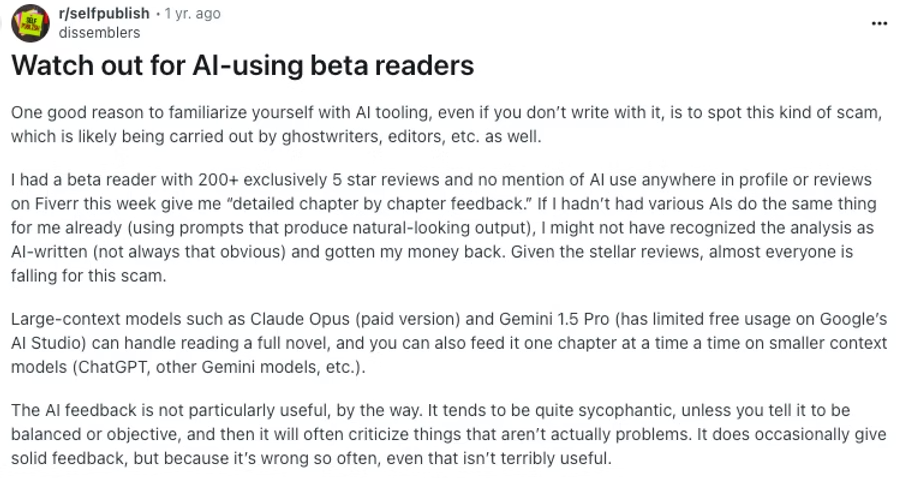
    Some authors have paid for beta reading services only to discover later that the “feedback” was produced entirely by AI. The so-called beta readers confidently referenced sentences and ideas that didn’t exist anywhere in the manuscript, leaving the authors with wasted time and money, not to mention reduced confidence in the revision process.

    Being aware of AI writing could help authors—especially those self-publishing—put safeguards in place to find beta readers who won’t use AI and to spot AI-generated feedback.

    Some ways authors can carefully vet beta readers include reading detailed client reviews instead of relying on five-star ratings, utilizing reputable author circles for recommendations, and exchanging a small sample at first. Authors can also request examples of the reviewer’s work, use AI content detectors (imperfect as they currently are) as a preliminary screening tool, and request to pay for services after the feedback is received. For more on this topic, see 7 Ways Writers Can Prevent Beta Readers From Submitting AI-Generated Feedback.

    Occasionally checking out publishing forums, such as r/selfpublish, is a great way to stay informed on recent trends and pitfalls in the publishing industry.

    To Preserve Creative Writing

    From deciding to engage with a lengthy post on Reddit to picking a book, readers want to read content that is original, nuanced, relatable, and real. Aka, the kind of content that comes from lived experience.

    Almost every piece of published creative writing comes with an unspoken agreement between writer and reader: that it is written by another person. We care that care has been put into the media we consume and become invested in.

    AI can suggest ideas, but it struggles to form cohesive storylines or maintain consistent character and plot threads. Writers who can see these shortcomings can better appreciate the skill they bring to their own work.

    How Can Writers Recognize AI Writing?

    When it comes to AI writing, there are no hard and fast methods to determine if a piece of text is, in fact, AI. AI-detection software is getting better, but so is AI. The only indisputable way to tell if someone is using AI models, like ChatGPT, Copilot, and Gemini, in their writing is if they forget to cut out their prompt.

    But the more AI-generated content is used in online discourse, social media, emails, and even creative works, the better we are getting at identifying it. This is because people are wired to recognize faulty patterns, inconsistent tones, and unnatural expressions. That’s why the concept of the uncanny valley—when something looks or sounds almost human, but feels slightly off—is a thing we pick up on fast.

    You can also identify multiple clues found in AI writing patterns that indicate the writing likely wasn’t written by a human. If you see a few of these clues in what you’re reading, be wary of the source.

    First Clue: A Dramatic Change

    The best clue might ultimately be familiarity. If a person’s writing style shifts dramatically within the same piece of content, or if they use more complex vocabulary or grammatical phrases than usual, it stands out. A sudden shift in tone, style, verbiage, etc., is something to take note of.

    Second Clue: Frequent Em Dashes

    A common attribute of AI-generated writing is its frequent use of em dashes. It is no surprise that AI favors em dashes, since AI models are trained on real human writing. And writers love em dashes!

    Em dashes are some of the most versatile punctuation—they can function like a colon, semicolon, parentheses, or even comma. Those of us who love to write probably use em dashes on an hourly basis; however, the general public does not—especially on social media.

    Because em dashes are easily identifiable, a piece of informal content like social media posts or articles that are filled with them may be an early indicator that AI was used, because humans likely wouldn’t use em dashes in these contexts as much.

    Third Clue: Overly Formal and Structured

    Remember the structured paragraph essay format you were taught in school? Introduction (broad overview and thesis statement), body paragraphs (supporting details and transition phrases), and conclusion (restatement of introduction). That structure was designed to teach students how to organize their thoughts clearly and is still used in professional reports, proposals, and academic-adjacent writing. But in everyday situations, few people write this way. AI, on the other hand, often does.

    AI tends to default to professional or academic language. It favors grammatically perfect sentences with predictable connectors like “furthermore,” “in addition,” or “it’s not x but y.” While these phrases aren’t wrong, their overuse can make the writing feel stiff, robotic, and overly polished. The issue is when this formula shows up in places where writing is usually more flexible, like emails, social media, casual articles, or creative writing. The rigid structure of the formula throws the casual tone off.

    In short, if the writing feels like it came out of a textbook or a standardized test—especially in places where a looser or more conversational tone would make sense—it might be AI.

    Fourth Clue: Surface-Level Substance

    AI-generated writing tends to lack substance. This is partly because AI is trained to predict what sounds plausible or typical, not what’s nuanced or new. As a result, its writing often resembles marketing copy: agreeable and inoffensive. But unlike marketing copy, which is typically concise and snappy, AI-generated writing tends to be verbose and overly relies on metaphors to explain simple concepts. You’ll notice familiar buzzwords, vague clichés, and an overall upbeat tone that avoids conflict or complexity.

    In sum, it’s writing that wants to please everyone.

    Fifth Clue: No Mistakes/Too Perfect

    We’ve all encountered the red or blue lines that show up under our misspelled words or incorrectly formatted phrases. And what are the programs that mark our mistakes powered by? AI. So it makes sense that AI-generated writing rarely contains typos, misspellings, or incorrect grammar.

    But flawless grammar and punctuation just isn’t part of the writing process, especially in early drafts. And flawless content is often not the goal in the first place. People bend grammar to sound more natural or to make a point or to simply be creative. We start messy and then revise. We leave a sentence fragment for emphasis. AI can’t make those intentional deviations effectively.

    So, when you encounter flawless and overly professional or stiff text on places like social media, that may be an indication of AI.

    Authors can use AI to support their work, but they must do so responsibly—for their readers and themselves.

    These are all helpful clues—but that’s all they are. Even when several signs point toward AI, there’s still plenty of room for doubt. Writers who use em dashes and ensure their writing is error-free shouldn’t feel afraid that their work will be confused with AI. Unless you have hard evidence, it’s best to assume the writing came from a human.

    Make AI a tool, not a replacement. At the end of the day, readers love, value, cherish, connect with, and pay for books written by humans.

    This article was written by Amy Guan and was republished with permission from Ever Editing.

    A headshot of Amy Guan

    Amy Guan

    Co-Owner and Managing Partner, Ever Editing

    I edit because I love it. I love plotting outlines, treading through unfamiliar topics, and discovering misplaced modifiers. Editing is an adventure, and I wouldn’t give it up for anything. I love playing video games (open world only), eating whatever my husband grabs from the clearance section at Asian Mart, and being taken on walks by my two big dogs. I have a BA in English and a minor in editing.

      Filed Under: Articles, Craft Skills, Creativity, Faith & Mindset, Productivity, Professional Skills, Publishing, Uncategorized, Writing Tagged With: AI, artifical intelligence, Publishing, research, Writing

      Writing with Faith: An Interview with LDS Author Gale Sears

      November 27, 2025 By Kami Pehrson Leave a Comment

      Gale Sears’ path to becoming an acclaimed LDS historical fiction author began with writing screenplays. She earned a bachelor’s degree in playwriting from BYU and a master’s degree in theater from the University of Minnesota. For decades, Gale’s creative life revolved around the stage—acting, directing, and crafting stories for live audiences.

      “I didn’t start writing novels until I was almost 50,” she shares, yet storytelling had always been part of her nature. “When I was about seven or eight years old, just after I’d learned about words, we had a little shed out in our backyard in Lake Tahoe, where I grew up. It was a magical place. I’d go out there with paper and pencil and write stories.”

      Exploring Different Genres

      The transition from playwriting to novel writing came naturally. “I had a story in my head that I thought would be a very cool play, but it was kind of epic, and it didn’t fit the genre,” Gale explains. “So, I started jotting down thoughts and a skeletal outline of chapters for a book, which I’d never thought of before because my mind always thought in terms of plays. I had to learn a different writing process because plays are composed of dialogue, but novels must include descriptions of place and setting.”

      That story became Autumn Sky, the first book in a trilogy published by Covenant Communications.

      Writing as a Divine Calling

      For Gale, writing is a sacred practice, centered on divine guidance. “I pray constantly. I have no ego when I’m writing my books. I believe that EGO stands for Edging God Out, and I’m not ever going to do that. When I dedicate my work and consecrate it to His purposes, I must include Him in the process.”

      The Spirit guides Gale throughout her process. “It’s as if I’m walking along and all of a sudden, I stumble, and something makes me pause. I stop and say, ‘Okay, something’s wrong here. Either I’m pushing it too much, or I’m not telling the right story, or I’m not going in the right direction.’ That’s how I know.”

      The Power of Research

      This spiritual foundation shapes every aspect of Gale’s work, especially her research approach. She is tenacious about accuracy. “If you’re going to write historical fiction, it needs to be true to the history,” she emphasizes.

      For The Silence of God, which explores communism and Christianity in revolutionary Russia, she immersed herself in Russian history and communist theory. “I wanted to tell the story of what a society looks like when they rip God out of their lives,” she explains. She thought she’d have to create a fictional Orthodox Christian family—until she experienced what she calls a “God wink.”

      “I thought to myself, I’m never going to find an LDS Russian family back in that time,” she recalls. “Well, I was at the Church History Library and found this article about the Lindelof family—the one and only LDS family in Russia during the Bolshevik Revolution.” This moment of divine serendipity became central to the novel.

      For Letters in the Jade Dragon Box, set in China under Mao Tse-Tung, she studied Chinese culture and government systems. The book juxtaposes Mao’s communist regime with the gospel as experienced by early Latter-day Saints in Hong Kong.

      Belonging to Heaven draws from George Q. Cannon’s actual journal entries about his mission to Hawaii, exploring his relationship with Jonathan Napela, one of the first Hawaiian converts to the Church.

      Her novella, Brilliant, required research into autism, Indian culture, mathematics, and Eastern philosophy to authentically portray its protagonist—a young autistic college professor from India. Gale met with Indian families and individuals who understand autism and reviewed autobiographies to ensure accuracy.

      But Gale doesn’t just rely on books. She travels to the locations she writes about—Italy, Russia, Hawaii—with her husband, George, acting as photographer and videographer. She interviews people from the cultures she depicts and visits ethnic markets.

      “I’ll go up to people and say, ‘Do you have a minute? Can we talk about Indian food?’ or whatever I need to learn,” Gale explains. “Most of the time, people are gracious and thrilled to help.”

      “It’s so important in historical fiction that readers feel as though they’re there,” she says. Whether it’s the food her characters eat, the clothes they wear, or the streets they walk, Gale ensures every sensory detail rings true. Each book ends with an extensive bibliography and notes explaining the historical context. “I stick to the facts as much as possible, but if I need to deviate because of the story, I let readers know.”

      Blending Faith and Story

      When depicting conversations about faith, Gale uses a subtle touch. “I want to tell the story of God’s Saints in a way that all my readers can appreciate, and weave in Christ’s teachings without beating people over the head with the gospel.”

      For example, in The Silence of God, the LDS character Agnes discusses the law of consecration with her Bolshevik friend, Natasha, while chopping cabbage for borscht. The exchange feels natural rather than preachy. “You can push doctrinal discussions too far to where readers feel like they’re in a Sunday school room, or you can just put a little flavor of it,” Gale explains. “You have to honor your readers and trust that they’re smart enough to interpret the story through their own lens.”

      This approach has connected with readers beyond the LDS community. “I have a lot of readers who are not LDS who appreciate the structure of the story and how I involve Christ in it,” she says. Universal themes of faith, courage, sacrifice, and family resonate across religious boundaries.

      Writing Process and Craft

      Despite her theatrical background’s emphasis on structure, Gale describes herself as “pretty much a pantser.” However, she acknowledges the value of structure, particularly in historical fiction, where “the journey has to go through certain historical processes.”

      “Normally, I start with a character,” she explains. “Then I ask, ‘What is this character’s journey?’ With historical fiction, that journey is kind of mapped out for me.”

      Character development comes through revelatory moments. In Letters in the Jade Dragon Box, the protagonist, Chen Wen-Shan, receives a box from her grandfather containing paintings and letters. This catalyst unfolds her family’s story under Mao’s regime.

      Advice for Aspiring Writers

      For young LDS creators and writers, Gale offers perspective gained from her unique journey:

      • Don’t worry about starting late or about success, fame, or money. Just stay true to the story you’re called to tell.
      • Focus on impact, not numbers. If your book only touches 10 people, that’s wonderful. If it only touches your family and they love it, that’s wonderful too. Remember, it’s a success just to get your story down on paper…Well done, you!
      • Remember the importance of the individual reader’s testimony. You’re planting a gospel seed, and you may not see it grow, but someday the Lord will use it. Eternity is long.
      • Write stories that inspire. For example, if you’re writing fantasy, you can still include the quest for good against evil. Your character’s struggles and triumph can encourage and lift a young person who’s questioning their abilities and whether life is worth the effort.
      • Consecrate your work. “When I dedicate my books to the Lord, I say, ‘Lord, take this little offering that I’m making and do with it what you want.’ I might not have a huge readership, but that’s not my path, and I don’t really mind.”    

      A Legacy of Faith

      Gale’s work now extends beyond novels. Her children’s book, Christmas for a Dollar, based on her father’s experiences during the Great Depression after losing his mother and contracting polio, has been adapted into a Christmas movie.

      No matter what form her writing takes, Gale ensures it is an act of discipleship. She reminds fellow writers that life is a tapestry, and we’re only seeing the back side. In seasons of trial, the threads look tangled. But eventually, God will turn that tapestry around, and we will see His divine design. Until then, authors can help readers through difficult times by writing good stories that show them there is light ahead.

      “These stories, these people’s lives—what a blessing it is for me to be able to share them,” Gale reflects. “And hopefully, prayerfully, the stories will resonate with someone and help them and strengthen them. That’s what I want.” 

      Headshot of Kami Pehrson.

      Kami Pehrson

      Kami Pehrson lives with her husband and five teenage children in Stansbury Park, Utah. She recently finished her master’s degree in English and creative writing and has written three novels—but is still trying to figure out what to do with them. She loves editing, reading, and playing word games on her phone. She also enjoys listening to audiobooks while half-heartedly doing Pilates in the living room.


        Filed Under: Articles, Creativity, Faith & Mindset Tagged With: authors, interview, research, Writing

        How I Research for a Historical Project

        March 31, 2023 By LDSPMA 2 Comments

        By Heather B. Moore

        Some people love research, while others don’t. They want to get into the meat of writing as soon as possible. But if you’re planning to write a historical novel or other project, research is vital to developing the story and bringing credibility to your work. As the author of dozens of historical novels set in eras ranging from ancient Israel, Mesopotamia, the Georgian era, the Regency era, the Victorian era, the early 1900s, World War II, the early Cold War era, and the 1980s (yes, that’s considered historical now), I’ve learned a few tips and tricks to help me tackle each project as it comes along.

        Search for Sources

        I search on Amazon or other new/used book sites and decide if there are books that I’d like to own so I can have them constantly at my fingertips. If possible, I like to get the paperback version to annotate, the ebook version to do a quick search for a particular key element, and sometimes the audiobook to immerse my brain in the era. I own all three versions of some research books. You can also search Google Books and find older digital books that are absolutely free. YouTube has recently become a key source for me with the plethora of documentaries and shorter historical pieces that are available.

        Determine Which Sources to Use

        Since you can’t read every book written about a subject (unless there are only a few), you might have to be selective. On average, I read five-ten books about a historical subject in preparation to write a book. Some sources are a gold mine. Other sources might just be more of a quick reference to verify the uniforms worn by a particular army during a specific war. Online articles (including Wikipedia) can be great quick go-tos. You can check at the bottom of the articles as well for further sources as needed.

        Research Key Elements

        Don’t try to be the expert, but research enough to flesh out your story and bring authenticity. You probably don’t have ten years to research everything you can about Italy in the seventeenth century, but you can zero in on several key elements, situations, and cultural points in order to create a vibrant story that makes the reader feel as if they’re looking into the era through a camera lens.

        What are these key elements? Start with the five senses.

        1. Touch—what do things feel like? Are your characters sitting on stone benches? Bamboo chairs? Scratchy woolen blankets?
        1. Sight—what is your character seeing? A bombed city? A river meandering through hills covered in small wooden huts? Tropical trees? Sand and rocks?
        1. Hearing—what sounds are in the setting? The puttering of a small vehicle? The clattering of horses’ hooves on cobblestone?
        1. Smell—does your character live on a farm? By the ocean with the scent of sea breeze as a constant companion? Is it spring with blossoming fruit trees?
        1. Taste—what kinds of food surround your character? Do they spend their days in preparation? Is food a main part of their day? What plants and crops are native to the country you’re writing about?

        More elements include:

        1. Major historical events during your story’s timeline. You can’t ignore a major historical event (or weather event, for that matter) if your story covers that day/week/month/year. If for some reason, you do decide to ignore or brush over a major event, document the reason why in your chapter notes or an author note as a disclaimer.
        1. Government/politics. Just as our modern lives are framed by the laws of our land, so are historical characters’ lives. What types of laws were in place? How were criminals dealt with? Were there discrepancies between the sexes or racial groups?
        1. Religion. Even if your character isn’t religious, others around them will be. Religious beliefs can also be a major character motivator, so make sure you aren’t skipping over it in a main character or sub character.
        1. Setting. A historical setting becomes a character of its own. By writing about the past, you are researching old information instead of brainstorming new ideas and inventing new things, like you would for sci-fi or fantasy. The setting can affect characters’ choices and motivations. A story set in the middle of a Minnesota winter has a completely different feel than one set in sunny San Diego.
        1. Dialogue. This can be debated both ways, but generally keeping your dialogue free of modern cliches is very important. Most readers don’t want to read formal, stilted, cumbersome dialect, so find a handful of words that will keep your reader immersed in the historical era. Depending on your time frame, instead of “kitchen,” you might say “cooking room,” or instead of “bedroom,” you might use the more historical-sounding “bedchamber.”

        Start Writing

        You don’t need wait to write until you have done your research. Doing both at the same time is often necessary. I’ll typically start with research—reading sources and taking notes—and when I feel like I can effectively write the first few chapters of the book, I’ll begin writing, knowing there might be some stopping points along the way to deep dive into more sources. I try not to write too far ahead of my research, though, or I run the risk of writing an entire scene that has to be greatly revised.

        Everyone’s method will vary, but hopefully something from my journey will be useful to you.

        Heather B. Moore

        Heather B. Moore is a USA Today bestselling author of more than ninety publications, primarily historical and #herstory fiction about the humanity and heroism of the everyday person. She attended Cairo American College in Egypt and the Anglican School of Jerusalem in Israel. Despite failing her high school AP English exam, Heather persevered and earned a Bachelor of Science degree from Brigham Young University in something other than English. Heather dives into the hearts and souls of her characters, meshing her love of research with her love of storytelling. You can learn more about her on her website.

          Filed Under: Articles, Craft Skills, Professional Skills, Publishing, Writing Tagged With: Author, history, research, Writing

          Primary Sidebar

          Write for Us

          Would you like to see your article featured here on LDSPMA?

          We are currently seeking article submissions. Learn what you need to know and submit your article here. 

          Recent Articles

          A man sits on the forest floor in a meditative pose.

          When Your Brain Needs a Vacation

          “As creators, everything we do requires brainpower; we need to care for our most essential creative tool.” -KaTrina Jackson

          A woman reading a book while standing between two shelves full of books in a library or bookstore.

          3 Ways to Research the Genre You’re Writing

          “Successful writers know their readers … And successful writers write books that fulfill their readers’ wants while also adding unique and thrilling angles.” -Christina Crosland

          A man sitting with a desk with his head in his hands.

          Look Rejection in the Eye and Keep on Going

          “You are never going to please everyone. You don’t want an agent that is only so-so about your book. You want one that loves it like you do. Rejection is just a way to help you find your dream agent.” -Sabine Berlin

          Search the Articles Archive

          Article Topics

          Recent Podcast Episodes

          Footer

          • Email
          • Facebook
          • Instagram
          • LinkedIn
          • YouTube

          Shop the LDSPMA Store

          Support LDSPMA with branded merch, including shirts, hats, water bottles, notebooks, stickers and more! Every purchase helps fund LDSPMA programs.

          Shop Now!

          Copyright © 2026 LDSPMA. All Rights Reserved. LDSPMA is not endorsed by nor affiliated with The Church of Jesus Christ of Latter-day Saints.