• Skip to main content
  • Skip to primary sidebar
  • Skip to footer

LDSPMA

Empowering Latter-day Saints to spread light and truth by connecting them at the intersection of faith, creativity, and professional skill

  • Conference
    • The 2026 LDSPMA Annual Conference
    • Conference Registration
    • The 2026 LDSPMA Annual Conference Schedule
    • 2026 LDSPMA Anthology Submissions
    • Theme Contests
    • Exhibit, Advertise, or Sell at the LDSPMA Conference
    • Partner with LDSPMA
    • FAQs
    • Volunteer at the LDSPMA Conference
    • Past Conferences
      • 2025 Conference
        • Sessions
        • Workshops
        • Awards Gala
        • Internship Fair
        • LDSPMA’s Got (Secret) Talent!
      • 2024 Conference
        • Sessions
        • Workshops
        • ZIFF Networking Dinner
        • Schedule
  • Membership
    • Email Sign Up (Free)
    • LDSPMA NextGen
    • University Chapters
    • Facebook Group
    • NextGen Youth Facebook Group
  • Programs
    • Monthly Zoom Discussions (Free)
    • Mentoring Program
    • Master Classes (2026)
  • Podcast
    • Watch
    • Listen
      • Listen on Apple Podcasts
      • Listen on Spotify
      • Listen on Buzzsprout
    • Called to Create Conversations
  • Articles
    • All Articles
    • Faith & Mindset
      • Gospel Principles
      • Creativity
      • Productivity
    • Craft Skills
      • Writing
      • Media, Film & Theater
      • Podcasting & Speaking
      • Music
      • Fine Art
    • Professional Skills
      • Editing
      • Publishing
      • Business
      • Cultural Diversity
      • Marketing
    • Write for Us
  • Awards
    • 2026 Award Nominations
    • Praiseworthy Awards
    • Spark Awards
    • Lifetime Achievement Awards
    • Past Award Winners
    • Apply to Be an Awards Judge
  • About
    • Mission
      • LDSPMA in the Media
      • Success Stories
      • Viewpoint on LDSPMA
    • LDSPMA Leadership
    • Volunteers
      • Volunteer Year-Round
      • Volunteer at the LDSPMA Conference
      • Mali McKenzie Award Nominations
      • Apply to Be a Presenter
      • Apply to Be an Awards Judge
      • Resources for Current Volunteers
    • Policies
    • Contact US
  • Support LDSPMA
    • Donate
    • Volunteer
    • Partner with LDSPMA
    • Shop LDSPMA

Fine Art

loading...

When Is Fair Use Fair?

August 19, 2026 By LDSPMA Leave a Comment

Writers love quotes, songs, and funny or inspirational images. What word-nerd doesn’t? We tape them on our mirrors, dashboards, and walls and post them to our websites. We like them to set the tone for our novels, start our nonfiction chapters off with inspiration and insight, and add authority to our own ideas. But many writers are never quite sure what’s safe to quote—how much, and in what contexts? Are there instances when you can safely borrow material that belongs to someone else without infringing on their copyright? And what happens if you do—accidentally, of course—infringe on someone’s copyright?

Well, it’s not pretty if you happen to use material from someone with deep pockets and powerful attorneys. Using quotes, songs, images, or others’ intellectual property cited, used, or paraphrased in your book (images may include cartoons, comics, photos, stock art, graphics, memes, charts/data, etc.)—without copyright-holder permission—can result in lawsuits that result in a loss of hundreds of thousands of dollars (or more, in some cases) and limit your brick-and-mortar store distribution opportunities.

While you should always seek official legal counsel (from an expert in intellectual property law) before you use quotes, scenes, songs, images, etc., in any of your for-profit/for-fundraising works, we can give you a simplified answer to the basic questions above and where you need to start looking to make sure you’re square with the law. There’s even a software out there to help you determine if your quoted material is likely to fall under fair use or not. If you’re still unsure about what you can fairly use after reading this article, the best practice is to follow the old adages, “better safe than sorry” and “when in doubt, go without,” as evidenced by the myriad court cases that have come about when folks thought  that they were doing it right. (Or you can call in a favor or write a check to that local lawyer and get the nitty-gritty answers to your questions.)

Public Domain

The doctrine of fair use addresses what can be copied: You can copy material to your heart’s content if it’s general public domain. This basically refers to material that is “outdated.” Any work published before 1927 is free game (as of 2023, when this was updated; each year after 2023 adds one year forward in time to the public domain cutoff, making more items published after 1927 accessible for use—depending on what year it is when you’re reading this), and any work after 1967 for which the copyright was not renewed is also free game. And some authors/artists have published works they want to share, which they have declared as public domain.

Outside of public domain, you can’t use others’ ideas as the crux of your own argument in nonfiction, but only as support, and it’s smart to avoid using more than a few lines (and, if you’re worried, get permission even then). In many cases, the copyright holder is happy to have their work shared more broadly and will grant permission with no strings attached. Just be aware that if you’re producing a for-profit work, you’re at risk of someone’s right to sue if you have no permission to use the quoted material/IP. Here is a handy reference defining public domain in its many arenas. And a critical resource for parsing out everything copyright related—for writers—is The Copyright Handbook by Stephen Fishman, JD.

For-Profit Works

Back in the day, fair use allowed one author to use another author’s work in creating their own work if the total amount borrowed was within reason, even if the borrowing author’s book sold thousands of copies. Today, every fair-use violation is examined on a case-by-case basis determined by the rule of thumb that fair use not diminish the “potential market for or value of the copyrighted work ”  (U.S. Code, Title 17, Section 107). According to the code, “There is no specific number of words, lines, or notes that may safely be taken without permission.” In sum, if you use someone else’s ideas in your book and then you make money on your book, the copyright holder might feel he/she were owed royalties/payments for the borrowed ideas—arguing that those ideas helped popularize your book in the first place. Acknowledging the source of the copyrighted material does not substitute for obtaining permission.

When Fair Use Is  Fair to Use

The above said, fair use is supposed to protect the advancement of the arts, sciences, scholarship, commentary and criticism, etc., so the principle generally allows quotation of excerpts in the following cases (when you are):

  • Writing news reports.
  • Doing a review or criticism.
  • Teaching (must be nonprofit, face-to-face).
  • Writing research (these must be “short passages”; refer to a journal’s style guide for specific guidelines).
  • Producing parody.

In general you will find that organizations and publishers have their own rules based on experience (including lawsuits), the advice of lawyers (who we hope keep up on policy changes), and codes of ethics. For example, the American Psychological Association (APA) declares that copyright holders define what they consider fair use and that the responsibility for getting permissions lies with the user (APA style, 6th ed., section 8.04, p. 233; see also sections 1.10 & 6.10).

Obtaining Permissions

Authors should demonstrate a reasonable due diligence, or take steps to satisfy the legal requirements, in using copyrighted material.

The first step in obtaining permission is, of course, to determine who the copyright holder is. This is usually a publisher or producer. Next, contact the copyright holder. Publishers, authors/artists often have a form on their websites where you can request permission to quote something by typing exactly what you’re quoting and in what context. After that, you may need to negotiate payment with the copyright holder (sometimes permission is granted freely, sometimes at a cost—and sometimes copyright holders don’t reply for months). Finally, be sure to get your permission statement in writing; email counts.  If you never hear back after several varied attempts to contact someone, keep the quoting to a minimum and make sure you aren’t using the idea as the crux of your argument (or that you’re using their idea in a way that sounds like it’s your own idea). Also, you’re safest to avoid using the quote in a compendium. And most importantly, make sure to keep records of your attempts to gain permission. As a reminder, please know that that there is no completely safe number of words or images you can use in a for-profit work without permission. If you do not have permission, you are risking the possibility of a lawsuit if the copyright holder feels motivated to pursue one. Bear this in mind in your attempts to stay within fair use.

Cautions for Violations We See Frequently

There are some fair-use violations we see frequently in the book-publishing world. The most common violations with quoted material are authors not properly citing sources for quotes and paraphrased material—and not getting permission to do so even when cited. A second problem we see often is when authors use others’ ideas as the foundation of their argument or point rather than as additional support for their own ideas. Or the author’s point seems to be merely a rephrasing of another author’s work with no original angle or purpose. In addition to those main problems the following items require some caution as well:

Songs and images:  Use caution in quoting lines from songs and such. Publishing houses are super careful about using even one line. Self-publishers take on a significant risk in quoting lyrics without permission. Permission to use lyrics is often granted by the copyright holder—with the expectation of payment or a percentage of the royalties you make. Use of lyrics does not generally come cheap. If you’re looking for permission, check out these organizations that represent composers, writers, and publishers and advocate for performing artists: ASCAP, BMI, and SESAC.

Images (cartoons, graphics, stock art, photos, comics, drawings, memes, etc.) are also often available when you’ve sought written permission or paid for usage rights. However, understand the limitations of your usage rights. The copyright holder may be fine if you use it on a blog, but not fine if you use it in a for-profit work (like a book, inside or on the cover). Or your rights may have limits—you can use the image at x price for up to so many copies sold, but then you’ll need to pay more for copies after that. Or there may be time limits or other boundaries on your usage. Make sure you are crystal clear on when, how, and for how long you may use the material, and get that permission in writing!

Quotes from LDS Authorities:  Since a portion of our authors publish in the local LDS market, a word to the wise for authors quoting LDS Church General Authorities, or any material found on LDS.org: The Church is extremely careful about accuracy in quoting and attribution (and, additionally, doesn’t want quotes from Church authorities to be mistaken as an endorsement of any particular book), and consequently there is no fair use as far as the Church is concerned; anything ever uttered by a General Authority and anything ever printed in a Church-owned publication (like the Ensign ) is owned by the Church, and you have to get permission from them to use it—even if it’s just a phrase or a sentence. The Church is most concerned with authors quoting current authorities, and possibly somewhat less vigilant about very short quotes from long-deceased authorities (keep them under 200 words); however, the Church still prefers authors get permission for any quotes. Lastly, when it comes to quoting scripture, the scriptures themselves now fall under a renewed copyright and are not public domain (unless you are quoting from a version published before 1923 or simply quoting the King James Bible); this copyright protects footnotes, the Bible Dictionary, headings, and maps (and any other modern additions to the standard works). Additionally, distributors that can help get your book into brick-and-mortar LDS stores generally will not accept titles that have not gone through Church approval (if you include quotes, images, songs, etc., from Church-owned materials).

If you want to use Church-owned material, you have to fill out forms and formally request permission; you can do this through the Intellectual Property Office. This includes listing every scripture/quote you’d like to use and their page number, in addition to turning in the manuscript/book for review of the context around your quote. Know that it can sometimes take up to 45 days to get a reply, though many authors have reported a faster response time; so plan as far out as possible in order to avoid delays in publication.

(As a final reminder, this fair-use discussion applies to for-profit works; if you are publishing a book and selling it, that’s a for-profit work.)

Do This Now

  • Run your proposed use of the copyrighted material through a fair-use evaluation tool, which can help you determine if you are abiding by fair use. As of this posting, it’s totally free (and extremely helpful). Please note, however, that this tool is used as an educational resource and not as a substitute for legal counsel.
  • To get a sample of a permission letter and to learn even more about fair use, check out this incredible resource from Jane Friedman.
  • Get a copy of The Copyright Handbook by Stephen Fishman, JD.
  • Be sure to go through your upcoming work with a fine-tooth comb for any quoted material you intend to use; start working on getting permissions now  so that your work doesn’t get put on hold while waiting for permissions. If this seems like a tedious prospect in addition to everything else you’ve got to do, you can hire a personal assistant to do the grunt work!

Sometimes great wordsmiths say something in a way no one else can. It’s nice to be able to use their insight, but make sure it stays their  insight. Enjoy your quotes, but choose wisely as to what you share in your for-profit works.

Resources:

  • For more in-depth information about fair use, check out Stanford’s information on fair use and the U.S. Copyright Office’s article here.
  • Read this article by publishing attorney and literary agent, Joseph Perry. Have more questions for your project? Contact us for a direct referral to Mr. Perry.

This article was written by Michele Preisendorf with Angela Eschler and was republished with permission from Eschler Editing.

Headshot of Michele Preisendorf

Michele Preisendorf

Senior Editor, Eschler Editing
Michele earned her BA in English from Brigham Young University in 2002 and has worked as a freelance editor for several publishers over the last twenty years, helping hundreds of authors polish their prose and get their messages published. She’s been with Eschler Editing since its inception and has worked as an editorial-production manager and instructor for those wishing to improve their editorial skills. One of the things she loves most about her work is perfecting prose in a way that readers are able to focus on the message and not even realize they’re reading!

    Filed Under: Articles, Craft Skills, Creativity, Faith & Mindset, Fine Art, Media, Film & Theater, Music, Professional Skills, Publishing, Uncategorized, Writing Tagged With: copyright, derivative works, fair use, Inspiration, intellectual property, legal, media, stories, Writing

    A Complete Life of Color

    December 12, 2025 By LDSPMA Leave a Comment

    I can’t remember a time when art hasn’t been part of my life. It’s always been more than just a hobby—it’s been a way for me to make sense of things that words can’t really explain. It taught me how to slow down, give details the attention they deserve, and prioritize quality over just a completed product.

    Learning these qualities helped with my perfectionism. I have a desire for excellence that honestly isn’t always healthy and threatens to turn my hobbies into chores. But art taught me to enjoy the process rather than fixating on getting everything perfect. The more patient I was with myself and the process, the more I could enjoy creating and developing my skills.

    The lessons I learned through my paint, canvas, colored pencils, and sketchbooks served as metaphors for life. Through the application of color, I learned to appreciate the whole spectrum of human experiences. I can apply that artistic mindset to every challenge and triumph. That perspective helped me realize that just as I use complementary colors like yellow and purple to create depth, life is built on that same principle of contrast and opposition.

    But it’s a lot easier to understand this principle than to live it. Opposition isn’t just something that we must endure—it’s a fundamental truth that has existed since the beginning of time. The world needs night to have day. Animals graze, and predators prey on them. Summer gives way to winter. Life guarantees we’ll face opposition, and the wise understand that struggles are actually a gift, that enduring hardships helps us live a richer life.

    Good artists know that complementary colors create depth because they’re opposite each other on the color wheel, making them more vivid when placed side by side. Life works the same way—if we never experience the deep purples of sorrow, we can never fully appreciate the brilliant yellows of joy. Without one, the other loses its meaning. A life carefully sheltered from hardship might feel safe and comfortable. Some might argue that it is not worth the risk of another failed relationship, trying out for the team again, or taking a chance that might result in pain, but I invite you to appreciate your heartbreak. A person who avoids all adversity can’t fully experience the depth that struggle makes possible.

    The next time sadness comes—and it will—try to resist shaking your fist at it or rushing past it. Instead, take time to feel it. Notice what emotions are moving through your heart and soul. With time, something good will eventually happen. One day, someone good will come around, you’ll make the team, or you’ll triumph in some way. Your spectrum will be complete, and you will live a life full of all the best colors.

    In contrast to your previous sadness, this good thing will illuminate your soul in a way that shallow pleasure never could. There’s no replacement for that happiness—the joy that comes from emerging through genuine sorrow.

    I’ve walked through my share of dark valleys. I felt the grief of my friend’s drowning, and the loss of my grandfather when I was thousands of miles from home. Each brought intense pain—the deep purples and blues of my emotional spectrum. Yet the worst moments of my life were when I shut down completely, and my spectrum converted to grayscale.

    By the end of my senior year, the numbness from school pressures and responsibilities had turned into creative burnout. I was making art for portfolios and grades—not because I was inspired or excited to do it. Each piece was assigned to me, so every brushstroke seemed forced. I wasn’t connected to my work anymore. My art, which had taught me about patience and joy, had become just another source of stress. During that time, I felt nothing at all. Not sadness, not joy, not even anger—just a dull gray that stretched across my landscape. I would have given anything to feel sadness again, to feel anything. I needed to know I could still feel. I pleaded with God, “Please just let me cry again.”

    I learned that even the darkest colors are necessary. My struggles were specific to me and my journey, and they became essential preparation for what came next.

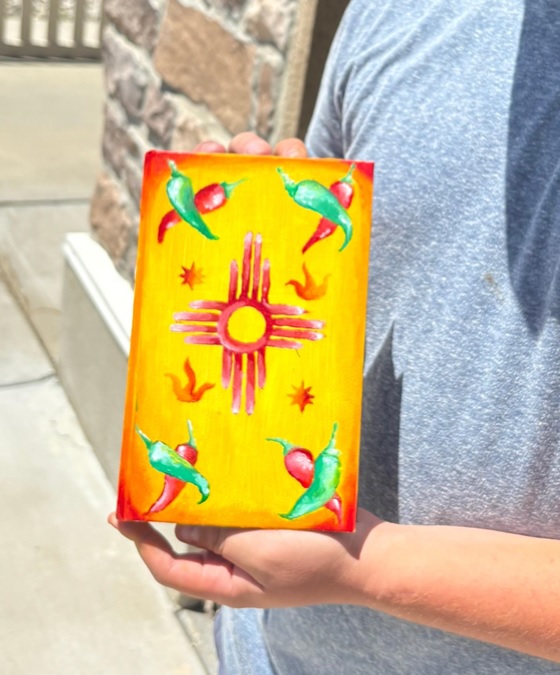
    At the beginning of summer, a friend asked me to paint his copy of the Book of Mormon. It felt like an epiphany. It was a way for me to step back into art, to use one of my talents to serve other people. I made an Instagram post offering to paint custom copies of the Book of Mormon for friends who’d received mission calls, and I got a lot of excited responses.

    When I paint those books, I make them as specific as possible to each person so my friends know they mean something to me. For one of my friends serving in New Mexico, I painted the state flag, with hot chili peppers and colors that capture that New Mexico vibe. For my friend who had won the state championship in a track-and-field relay with his teammate—who was also called to the same mission in Australia—I painted a hand exchanging a baton over two different books. When you put them together, you get the whole picture, all in Australia’s colors.

    The Spirit prompted me to write a letter to one of my friends in his book. He later texted me, saying, “That message really meant a lot to me. I was going through a really hard time.”

    I may never know how much receiving a painted book truly means in the moment. I’m sure my friends are grateful and think it’s cool. But I hope they realize later that it came from my desire to serve my Lord. As the scriptures say, “When ye are in the service of your fellow beings, ye are only in the service of your God.” I serve others because I love Him and because I love the people I’m serving.

    I learned that darkness is necessary in life and art, and that creating without purpose and intention makes the process feel incomplete. Because I knew what it felt like to be disconnected from my gifts, I now treasure the connection between creativity and service. The gray numbness I experienced helped me recognize color and feeling as sacred gifts. The contrast is what makes it meaningful—the purple makes the yellow more brilliant.

    Painting those books didn’t just reignite my love for art. It taught me, in the most tangible way, what it means to live a Christlike life—to embrace the full spectrum as He did. Christ is my ultimate inspiration for creating art and living fully. He is the first creator and encourages us to be creators as well. He is the light and the life of the world. His birth brought light, and his death brought darkness. He taught us that sadness is often the price we pay for lasting joy, and that the contrast itself is sacred.

    That’s how you live a beautiful, full-spectrum life. It’s actually pretty simple—but simple in a grand way, as all profound truths are when you take everything else away. Not by avoiding the hard colors or muting them, but by embracing them as essential parts of the complete picture. When you do, you discover that the contrast isn’t just bearable—it’s beautiful, and it’s what makes life worth living.

    A headshot of Aidan Pehrson.

    Aidan Pehrson

    Aidan Pehrson is a track-and-field athlete competing for Snow College. In addition to running, he enjoys painting, boating, surfing, and spending time with friends and family. He plans to leave on an LDS mission this summer.

      Filed Under: Articles, Craft Skills, Creativity, Faith & Mindset, Fine Art, Gospel Principles Tagged With: art, Inspiration, opposition

      The Desire to Paint the Savior

      December 27, 2024 By LDSPMA Leave a Comment

      Growing up, I was surrounded by creativity and love of the beauty in the world. My dad was a concert violinist, a writer, and an inventor. My mom sang hymns, gardened, and created beautiful quilts. Both were art appreciators. They spoke often of works of art that inspired them.

      My mom had traveled to Europe and talked about her experience seeing the works of Michelangelo and da Vinci. Stories of her travels led me to study works of art from these masters who demonstrated devotion to God in their work, which caused me to seek out other artists like Carl Bloch and more modern contemporary artists like Harry Anderson and Greg Olsen. Being in a home surrounded by beautiful paintings of Christ guided my journey to want to do the same.

      Preparing to Paint the Divine

      The desire to paint Christ came very early in my life; however, the application of this was and still is very intimidating. Of all the subjects I paint, this is the one that requires the most meditation, study, personal reflection, and help from Above. I find that when I am working on a painting of a spiritual nature, but especially one that includes an image of the Savior, it is very important how I prepare myself for the task.

      This starts with prayer, then leads to scripture study, which is often tied to the theme of the piece, and then I journal my ideas and impressions. I am also affected by what I listen to while I paint. I will listen to conference talks, hymns, classical music, or uplifting podcasts to help with the mood as I work. I pray for the Spirit to be present while I work so that the viewer feels the same spirit while appreciating the finished work.

      Searching for References

      The first time I attempted to paint a depiction of Christ, I prayed earnestly to find a model to photograph as a reference. I searched for someone with kindness in his eyes and the love of the Savior in his countenance. I was blessed to find a model who exhibited both attributes, and he was wonderful to work with. I would explain what I needed during our photo shoot, and his expression would become contemplative. The feeling of trying to bring the Spirit for both of us was there.

      I prepare myself personally as I plan to paint a representation of the Savior; models and actors do the same when they are trying to represent Him as well. It’s a daunting task for both of us, but I believe God sees our efforts and magnifies them. I’ve definitely felt His hand helping me with what He wants me to accomplish. The challenge for me then is to bring that same spirit into the physical work of art.

      Receiving Inspiration through Trials

      I have had some of my most emotional paintings come to me during my darkest times. There are paintings and ideas that have come to me specifically because of what I am going through at the time. It helps me to know that God sees me and speaks to me through the gifts He has given me.

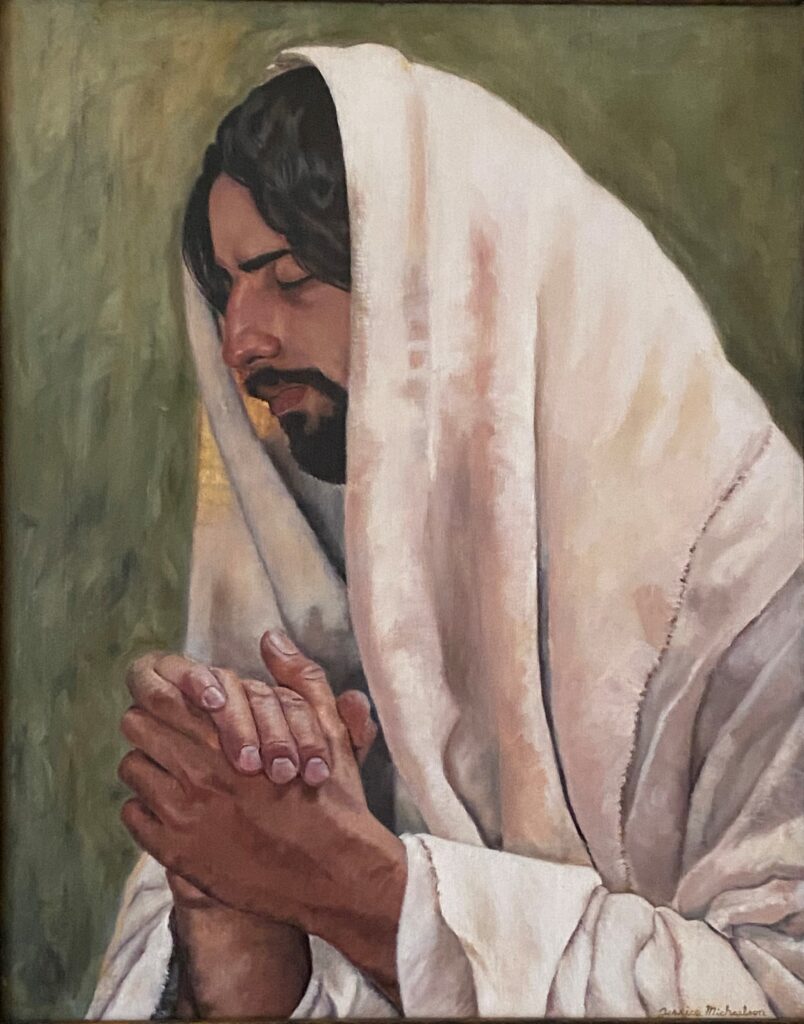
      I know also that if I am feeling these things, others are as well, and my prayer and hope is to allow God to use me to speak to others who are struggling. My painting Our Mediator came during a challenging time in my life, and I felt so strongly that because of Jesus, I would be able to get through my trials because He would mediate for me. It was such a comforting feeling.

      A painting of Christ.
      Our Mediator by Jessica Michaelson

      Coming Closer to Christ

      When I am painting works of Jesus, I find that I search and ponder about His teachings more in my daily life. I am searching for what He said in the scriptures and for the deeper meanings behind His words. I find that I grow closer to Him through this process, and it not only helps me paint, but also shapes me as a person.

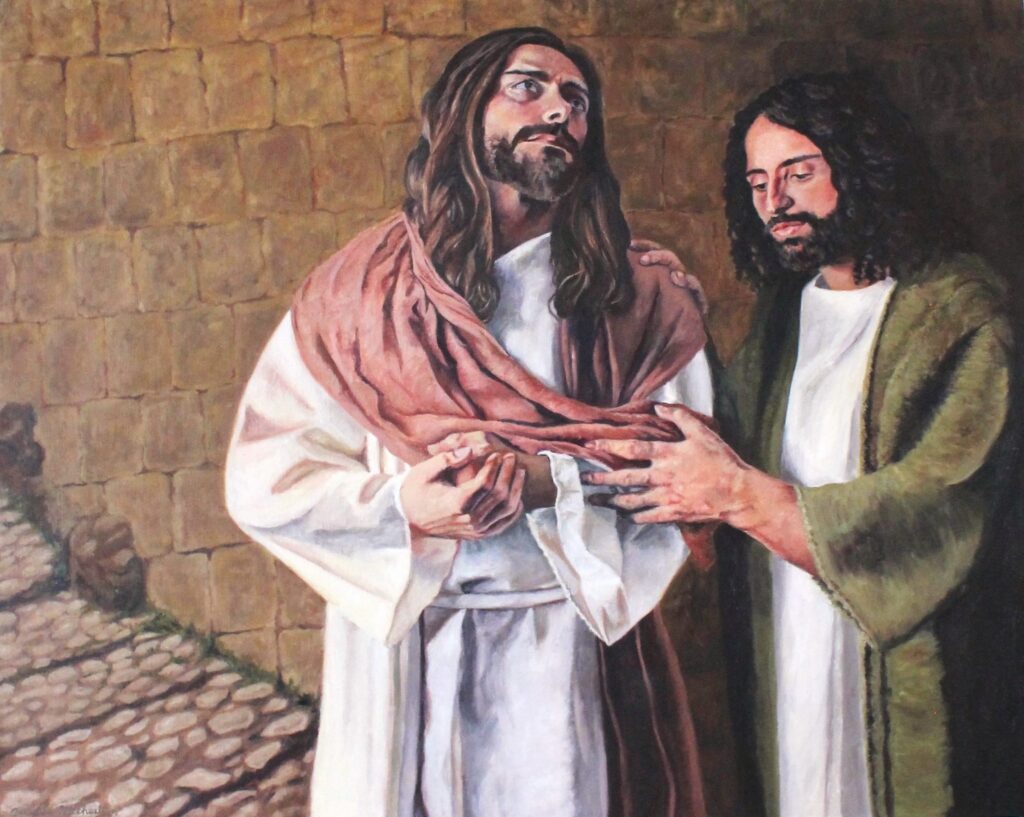
      After losing my father unexpectedly, I thought about how Jesus had experienced loss. He lost His adopted father, Joseph, His cousin John, and for a time, His friend Lazarus. Knowing this led me to paint Acquainted with Grief, which illustrated the grief Jesus felt in the moment of losing a loved one. I felt closer to Him knowing that He knows what my grief feels like.

      Acquainted with Grief by Jessica Michaelson

      Honoring the Great Creator

      God is the best example of being a perfect creator. What a wonderful example we have from Him of the joy of creation. He shows His love for us when He shares His creations with us. It is like admiring a sunset, knowing that it will disappear the next day, but that its beauty, while fleeting, is stunning.

      God’s creations show us the love God has for us. They show us that He created everything and continues to create not just the world around us, but also the beauty in our lives amidst our trials and weaknesses. That’s what I see every day as He takes my weaknesses and makes them stronger in my attempts to use the talents He has given me to glorify my Savior, Jesus Christ.

      Jessica Michaelson

      Jessica has been an artist as long as she can remember. Growing up, she would draw on walls and furniture and even went so far as to etch a picture in her bedroom door with a safety pin, much to the dismay of her parents. To save their home and their sanity, her parents enrolled her in private art lessons, and her love of art continued to blossom. Jessica found mentors and teachers in workshops from world-renowned artists.

      Jessica teaches art in her home studio part-time to both adults and children. She enjoys sharing what she knows and works with her students in nearly every medium. Not only has teaching been fulfilling, but it has solidified what Jessica has learned through countless hours of study and practice as only teaching can.

      In her continued art practice, she has found she enjoys working with an emphasis in portrait and figurative work, as well as works in nature. More recently, Jessica has been painting religious and spiritual work with a focus on painting Christ. Her religious work holds great meaning for her. Her works have been published in books and calendars and highlighted in gallery shows. You can learn more about her on her website.

        Filed Under: Articles, Craft Skills, Fine Art

        Val Bagley: Precious Things of Every Kind

        August 23, 2024 By LDSPMA Leave a Comment

        Shortly after moving from our Utah home and settling near the Idaho/Wyoming border, I entered the Star Valley Temple with my husband and was greeted by a humble-looking man in a white suit, who scanned my recommend and welcomed me to the House of the Lord. I glanced at his tag and recognized his name right away.

        “Val Bagley?” I said. “The artist?”

        He gave me a small smile, said yes, and indicated which way I should go to find the changing room. The message was loving and clear—we were there to serve the Lord, not to chat about our outside lives or careers. Later, when my son served as a missionary in the temple, Brother Bagley was his shift leader, and continued to set a positive example of service and dedication to the task at hand. I did, however, have the chance to talk to him about his career on another day.

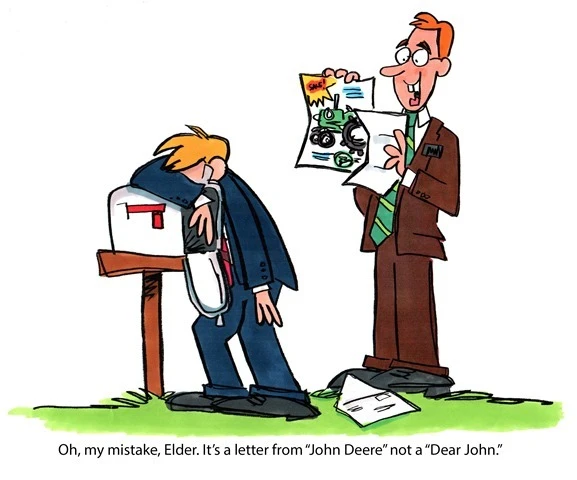
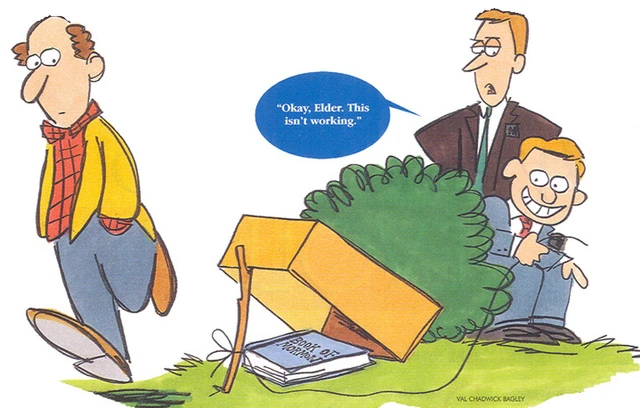
        In 1978, the New Era magazine featured a cartoon drawn by LDS artist Val Chadwick Bagley. It was the first of more than a thousand cartoons he would draw for both the New Era and the Friend over the next 46 years, beginning an unexpected career.

        “Pretty much most of my life, I’ve known what I wanted to do for a living,” he said on the occasion of his fortieth year in the industry. “I just didn’t know it would be drawing for the Church.”

        His very first piece of art to be recognized in a Church magazine was actually published in the Friend when he was seven years old, but he threw his copy of the magazine away because he felt he could do better.

        While serving as a missionary, he was assigned to be the mission public relations director, and he used his talents to fulfill this task. He drew pictures of visiting general authorities and illustrated the mission newsletter, and it was during this time that his first “official” drawing was accepted by the New Era, and he burst onto the scene.

        Whether or not you’re familiar with his name, his unique art style sets him apart and makes him immediately recognizable. His characters have a youthful look—wide eyes, rounded angles, and stylized hands and feet. Those characters point out some of the gentle humor to be found in our church—always appropriate to the moment, never mocking, but recognizing that we do have funny moments as a people and celebrating that humor through art.

        “My cartoons may be gospel-related, but they don’t have anything really to do with the gospel itself,” he shared. “For the most part, my cartoons are about people living the gospel, not the actual teachings themselves. I already know the New Era would never print a cartoon that made light of sacred things, which I wouldn’t draw anyway.”

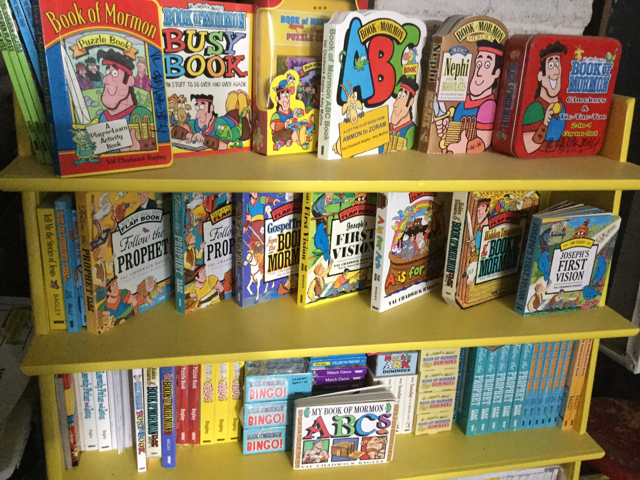
        Although starting as a magazine cartoonist, Val has since published several children’s picture books on a wide variety of topics, and also card games for LDS families. He does all this from a studio set in the peaked-roof attic of his house in Wyoming, where I was privileged to visit about a year ago with my family. The walls and the ceiling are covered with pieces of his original art, both published and some in various draft stages. His drawing table faces a window that looks to the east toward the mountains; not only a source of light for his work, but inspiration for his art. His home is just as bright and cheerful as his cartoons, decorated in a vintage fifties’-era style that’s both whimsical and inviting, exactly the sort of home you’d imagine an artist to have.  

        He has achieved success in his chosen field now, but after returning from his mission, he struggled to know if art—particularly cartooning—was the path he should pursue. He attempted college, but they weren’t teaching the things he wanted to learn, and his instructors encouraged him to give up and turn his attention to “serious art.” One day, while reading the Book of Mormon in the temple waiting room, he opened to Helaman 12:2:

        Yea, and we may see at the very time when he doth prosper his people, yea, in the increase of their fields, their flocks and their herds, and in gold, and in silver, and in all manner of precious things of every kind and art . . .

        The word “art” stood out to him, and he recognized that yes, there was a place for him and his unique talent. He had been drawing labels for cheese, but with this newfound conviction about his purpose, he approached Covenant Communications with the illustrations for a coloring book, which was published in 1992, and he continues to publish with them to this day.

        I asked Brother Bagley what advice he would offer to artists hoping to break into the field. He laughed and said that he’s still trying to make it big himself and could use a little advice as well, but he offered the following tips:

        • Practice, practice, practice. “Although I’ve always loved to draw cartoons, it took years and years of practice,” he said. “I would copy other cartoons that I liked and admired (Snoopy, mostly) until I developed my own drawing style.”
        • Draw consistently. “I kept four cartoon journals on my mission (one for every six months), and that is when I really refined my drawing style.”
        • Discover your intention. “I’ve never been a ‘doodler.’ I draw with purpose. My cartoons usually are telling a story or mean something. I don’t just draw to draw.”
        • Keep going despite rejection. “I’ve illustrated/written over 100 books which have sold over 1,000,000 copies, but I still get rejected 75% of the time.”

        My biggest takeaway from my time spent with Brother Bagley is the importance of seeking the Lord’s partnership whenever we undertake a piece of art meant to glorify Him or teach others about Him. Val Bagley is a humble man who speaks often of prayer as part of his creation process, and truly, when we do things in the way the Lord would have us do them, we can’t help but inspire those around us.

        A headshot of Tristi Pinkston.

        Tristi Pinkston

        Tristi Pinkston is the mother of four, the wife of one, the author of one hundred and seventy-five, and the editor of oodles. She serves as the chairman of the board for the Bear Lake Arts Council and participates enthusiastically (if not with utmost skill) in their theatrical productions. She is currently the editor-in-chief for the resource library here on the LDSPMA website. You can learn more about her on her website.

          Filed Under: Articles, Craft Skills, Fine Art Tagged With: art, cartooning, drawing

          Top “Quali-tee”: Launching a T-Shirt Design and Printing Business

          July 26, 2024 By LDSPMA Leave a Comment

          Alexa and Eric Allred are the dynamic duo behind the hip and successful Gem Rose Design Company. As a stay-at-home mother, Alexa found herself with spare time during her children’s preschool hours. She decided to use this opportunity to learn how to make personalized T-shirts for her young family. Meanwhile, her husband, Eric, began refining his art and design skills—a passion he’d developed in college but temporarily stowed away to focus on fatherhood and a demanding career in marketing. With Alexa’s eye for detail and Eric’s artistic skills, they now run a well-oiled machine. However, their journey has not been without challenges. Through years of trial and error, they learned valuable lessons they now share with creators looking to start a T-shirt design business of their own. 

          Alexa and Eric Allred

          Hone Your Digital Design Skills

          Eric transitioned from traditional markers and paper to digital graphics using the Procreate app on an iPad, teaching himself to use the program through online tutorials and YouTubevideos. Procreate uses natural media simulation, like painting with a standard paintbrush, to create pixel-based art. This step-by-step approach helped him make a smooth transition to digital design. 

          For higher-resolution designs, Eric made the switch to vector-based graphics. Vector images can be blown up without losing quality, making them ideal for signage, logos, and T-shirt design. Vector-based art involves manipulating points and curves instead of freehand sketching. He began using a limited vector software called Vectornator (now Linearity), then moved to Adobe Illustrator. To help make the switch from traditional brushstrokes to vector shapes and lines, Eric challenged himself to copy standard designs and logos to create graphics that remain sharp on any scale. 

          Understand which files to use when saving your designs. PNG files are raster files made up of pixels. They maintain high resolution while supporting transparent backgrounds, but enlarging them can stretch and blur the image. JPEG files are also pixel-based. They are often used for images on websites and digital platforms but lack the transparency feature crucial for T-shirt printing. The image will usually print on a white square background. Lastly, SVG files are preferable for T-shirt designs, as their vector-based nature means they can be enlarged without the blocky appearance of pixelated images.

          Choose a Method to Transfer Your Image

          Vinyl: Alexa began by using a Silhouette electronic vinyl cutter to create simple designs. However, cutting and weeding (removing extra material from negative spaces) was time-consuming and impractical when fulfilling large orders.

          Heat Press: heat press transfers use a thin, paint-like medium printed onto transfer paper. The flexible material melds onto the shirt upon application via heat and pressure. However, this method requires bulk orders with a minimum quantity of shirts featuring the same design to keep costs manageable.

          Sublimation: sublimation printing offers an option that doesn’t require a minimum print run. The technique involves transferring ink onto a film that remains wet until pressed onto the shirt, resulting in a vibrant and durable design. This process is limited to 100% polyester fabric, and the T-shirt must be white or light-colored.  

          DTF: Direct-to-film printing allows for more fabric and color options. Ink is printed onto a film material coated with powder and baked, creating a protected layer pressed onto the shirt. Many different designs can be printed on a single gang sheet, a long roll of film priced based on the square inch. Alexa has found this method to be ideal.

          Devise a Marketing Plan

          Alexa first began selling T-shirts at craft fairs, where she prepared thirty designs, including seasonal/holiday themes and year-round options. She brought her heat press, along with a selection of blank shirts of various sizes. Attendees could browse the designs, choose their favorite, and select a shirt color from the available options. She would then press the design onto the shirt. While a good portion of the shirts remained unsold, selling at craft fairs helped her gain visibility in the community. Handing out business cards and engaging with attendees allowed her to spread the word about the business. 

          Additionally, personal connections played a significant role in their marketing efforts. Through word of mouth, particularly from friends, family, and acquaintances, they attracted a steady stream of custom orders. Many of these orders came from people they knew through various aspects of life, such as sports teams, dance studios, or educators. Eventually, their customer base expanded beyond personal connections.

          They now advertise their designs on social media platforms like Instagram and Facebook. They use a “drop” marketing technique, offering specific designs for a limited time. For instance, during their “Easter drop,” they provided various Easter/spring-themed designs. To order, customers left a comment under the picture of their preferred shirt and design combination. Customers who purchase a T-shirt during a drop must place their order within the week. This method allows the company to place one big supply order and finish all the T-shirts by a specific date.

          Provide Exceptional Customer Service

          Eric and Alexa work closely with clients to customize designs. This process often involves adjusting colors, sizes, or other elements to match the customer’s vision. For instance, team events frequently require custom logos or artwork to represent their theme. They collaborate with the customer to gather details about their requirements, such as preferred colors, imagery, or quotes, and incorporate the elements into the design. Then they share the design with the customer for feedback, making revisions until they are satisfied. Customers can also choose a premade digital design from online sellers. They most often purchase from Etsy, but several other platforms offer artwork in PNG or SVG files. 

          Always communicate with the customer if there are delays or other issues with their order. Explain the situation without making excuses and present solutions to fix problems quickly. Your customers will appreciate your honesty and professionalism. Be approachable, flexible, and consistent in your services. Establishing trust with customers will encourage repeat orders and boost business prospects. 

          Look for Opportunities to Use Your Talents to Bless Others

          Following the tragic loss of a young boy in their town, Eric and Alexa offered their services to design a few shirts for a fundraiser to raise money for the boy’s family. They initially expected to produce around 200 shirts but ended up creating over 800 and raising over $13,000. The experience reminded them that designing T-shirts is more than a hobby or business venture—it has the power to make a meaningful impact on the community.

          Help others on their journeys. While it may seem counterintuitive to share hard-earned knowledge, they are happy to help when people seek advice and believe there’s room for everyone to be successful. 

          Eric and Alexa find joy in working together and bonding over their projects. They love knowing their designs have made a difference in people’s lives, take pride in seeing them in the wild, and aim to inspire others who want to cultivate their creative gifts.

          Headshot of Kami Pehrson.

          Kami Pehrson

          Kami Pehrson lives with her husband and five teenage children in Stansbury Park, Utah. She recently finished her master’s degree in English and creative writing and has written three novels—but is still trying to figure out what to do with them. She loves editing, reading, and playing word games on her phone. She also enjoys listening to audiobooks while half-heartedly doing Pilates in the living room.

                Filed Under: Articles, Fine Art, Marketing Tagged With: art, graphic design, t-shirt design

                Basic Whittling Techniques

                January 12, 2024 By LDSPMA Leave a Comment

                Whittling vs. Woodcarving

                Both whittling and woodcarving are distinct art forms in which the finished product is made of wood. Whittling requires a small, sharp blade and a piece of softwood. Woodcarving includes the whole universe of wood creations and incorporates various hand tools like gouges, skews, and chisels. Artists might also opt for rotating, handheld power tools with changeable burrs and a vacuum system to remove dust. Power carving tools work best with hardwoods like cherry, walnut, oak, and ebony.

                Tools and Supplies

                Many pocketknives come with a sheepsfoot blade that has a straight edge and a back that curves down to the tip. However, these knives can be difficult to hold while whittling and often are not strong enough to sustain a sharp edge. Whittling knives have longer, rounded handles for better control and fixed blades that retain their sharpness. I use a bench knife—those come in several shapes and sizes. You might wish to use a thumb guard to ensure you don’t cut yourself while carving. Carving gloves may also be helpful for beginners. Last, you will need a sharpening stone and leather strop to keep the blade honed.

                Types of Wood

                Whittling requires dry, soft, and even-grained wood like white pine, sugar pine, basswood, or aspen. Extremely soft woods such as balsa or tupelo can collapse under pressure from the blade. Also, they don’t take detail well and tend to fuzz when sanded. I prefer basswood, though I have whittled with random pieces of wood from crates, pallets, and tree branches. Avoid using green, uncured wood, which can warp or crack when drying. Basswood blanks are available from online suppliers, local cabinet shops, and stores specializing in woodworking supplies.

                Planning and Design

                Whittling Christmas ornaments and other decorations can be a fun and relaxing activity. Start with a small piece of wood about three to five inches long, and visualize your desired result. The design possibilities are endless. Woodworkers can carve anything from Santa Claus to bells, whistles, chains, sleighs, balls in cages, elves, animals, teddy bears, etc. You can find ideas in catalogs, on Pinterest, or in woodcarving magazines. Begin by using a pencil to mark the approximate size and dimensions of your design. Remove large portions of wood with a coping saw, then keep whittling until you achieve your desired result.

                Basic Cuts and Techniques

                When you give most people a piece of wood and a knife without instructions, they will often make a spear tip by pressing the blade against the wood and carving away from their body in an outward thrusting movement. Instead, you should hold the wood in your hand and make precise cuts using a squeezing motion with your fingers. Never pull or push the blade with your arm.

                There are three basic cuts used in whittling:

                • Stop Cut – This cut demarcates where you want the opposing cuts to end. You can create this cut by repeatedly dragging the blade’s tip to carve straight or curving lines that indicate a difference in wood thickness. After, reposition the wood and make pull cuts toward the line by squeezing your hand to remove wood chips up to that point. Repeat this movement as often as you wish until you have cut to the desired depth. An alternate method is to make multiple V-cuts in opposite directions to create a valley or depression in the wood, then cut toward it. Do not try to remove large portions of wood with a single cut, as this could cause the piece to crack.
                • Pull Cut – You can make this cut by wearing a leather thumb guard and pulling the knife blade toward your thumb. Use a squeezing motion to remove wood chips or slices in a controlled manner.
                • Push Cut – To make this cut, face the blade of the knife away from you and use your thumb to push against the back of the blade and remove small pieces of wood in a forward motion. Again, you are pushing with your thumb, not your arm.

                Finishing

                When you finish whittling, the piece will bear cut marks and small ridges from the knife blade. Though the result isn’t perfectly smooth, I prefer this rough look because it indicates that the piece has been hand-whittled. Of course, you may use sandpaper to smooth out these telltale signs.

                Once you finish creating an ornament or decoration, you’ll want to devise a way to hang it if required. Find the balance point and drill a 3/16 inch hole about 1/4 inch deep and fill it with wood glue. Then, cut a piece of twine or decorative cord to an inch long, double it, and place the ends in the hole with the glue. In a few hours, the loop will dry and can be attached to a hook for hanging.

                Add color, definition, and depth by painting your decoration. Depending on the design, you might need to paint in stages, allowing each layer to dry before applying more paint. After the paint is dry, you may apply a brown wash. Rub off the excess wash to mute the colors underneath, create depth, and add an antiqued look. Finally, spray with a fast-drying clear lacquer to protect the finish.

                As in most creative endeavors, some people are unable to visualize the end result or simply have no desire to create art in the first place. Some may feel that whittling is a hobby they just can’t do. Even if you fall into one of these categories, we all have gifts to share. Those gifts differ greatly across the range of interests and activities in which we all participate.

                A headshot of Bob Manning.

                Bob Manning

                Bob Manning was raised in northern Utah. As a teenager, he worked in his family’s orchards growing cherries, peaches, and apricots. He began whittling after seeing someone carve a “ball in a cage” from a piece of broom handle. Bob wore out a couple of pocketknives before purchasing a fixed blade whittling knife. He first decided to try whittling ornaments when his friend invited him to an annual Christmas ornament party, and later continued to create whimsical ornaments for family and friends.

                  Filed Under: Articles, Craft Skills, Fine Art Tagged With: carving, woodworking

                  Art Can Make You a Better Writer

                  December 15, 2023 By LDSPMA Leave a Comment

                  I am a visual learner. Images help me remember and understand things more thoroughly. Art has helped me become a better writer as well. Here are four ways to harness the creative power of art in your writing.

                  Turn to Art for Mental Respite

                  Art can inspire creativity by activating the part of your brain that is responsible for contemplation and daydreaming. Your brain isn’t designed to stay in work mode constantly. Giving your mind a break from structured assignments allows it to relax—it’s like a brain vacation. When my kids were small, they once sent me to my room for a time-out. It made for the best day ever! Sometimes your brain just needs a break.

                  Reflect on Art to Inspire Your Writing

                  Slow down and take time to analyze artwork or an interesting photo. Give yourself a moment to ponder about the details and reflect on your impressions. Doing this can lead to new ideas and give you insights that will spark your writing.

                  A painting called Pirates by Ned Young, an artist from Brigham City, Utah, hangs on our living room wall. It depicts two young boys standing atop a haystack next to a barn. One boy holds a sword and wears an eye patch, while the other boy looks through a telescope. Beside them, a skull-and-crossbones flag waves on a pole. When I look at that painting, it takes me to a place in my childhood. I can smell the hay. I can feel the summer heat. It makes me wonder if cats live in the barn. Are the boys looking for a place to hide treasure, or are they escaping from hungry cannibals? I get all these impressions from a watercolor painted in Utah.

                  Art isn’t just displayed in galleries—it’s all around us. You can find artistry in the way leaves overlap and create interesting compositions. Cloud formations are one of my favorite works of art. Look closely at a spider web or ripple patterns in the water. Find music in the sounds around you. Our Father in Heaven is the ultimate artist.

                  If you make art appreciation part of your life, your observation skills will grow. Your ability to write accurate descriptions will improve as you increase your awareness of the world around you.

                  Cultivate Empathy through Art

                  Elevating your awareness of the creativity around you can increase empathy toward others. As you pay more attention to the subjects in art and how they are portrayed, you may notice details that evoke an emotional response. For example, The Child’s Bath by Mary Cassat holds a special place in my heart because it depicts a woman bathing a toddler, and it elicits feelings of comfort, love, and contentment.

                  The Child’s Bath by Mary Cassat

                  On the flip side, The Scream by Edvard Munch also reminds me of motherhood, particularly when my kids haven’t picked up their Legos, and I step on one.  

                  The Scream by Edvard Munch

                  Find Story Ideas in Art

                  When you ask questions about what you’re seeing and why the artist portrayed the image in the way they did, it can kickstart your creativity. You can explore even further by inserting yourself into the picture and asking questions from a new perspective. What made the artist choose this subject? If you were the person in the painting, why are you in that setting? What is your story? Engage your senses as you ask these questions. What might you taste, smell, or hear in this situation? Use your enhanced focus to sharpen the way you write your descriptions.

                  Take the opportunity for an art break, whether it’s enjoying a painting, a sculpture, or the intrinsic beauty of nature. Art will stimulate your mind, boost your creativity, and help you become a better writer.

                  A headshot of Cathy Witbeck

                  Cathy Witbeck

                  Cathy Witbeck is a Canadian-born author-illustrator transplanted to the USA. She remembers writing and drawing ever since she could pick up a pencil. She did an especially lovely piece of artwork on the side of the septic tank with house paint at a very young age. Perhaps that’s when it was discovered that she was gifted, or maybe it’s why she was sent to the USA.
                  She has five grown kids and one grown husband. When she isn’t writing and illustrating, she is chasing after grandkids intent on making their own artwork.

                    Filed Under: Articles, Craft Skills, Fine Art, Writing Tagged With: art, Creativity, Inspiration

                    Combining Art and Writing

                    July 27, 2023 By LDSPMA 1 Comment

                    Art and writing are separate disciplines, each creative in its own way. While art can enhance the way we look at the world, writing helps us process words and ideas. Both subjects boost our creativity, help us learn to solve problems, and act as stress relievers. For me, adding art to writing is like putting a dill pickle on a burger.

                    It occurred to me that writing is like painting with words. Can the reverse be true? Can creating a piece of artwork be like writing a message? I think it can. Here are some ways you can combine art with writing.

                    The cover of Pysansky Promise by Cathy Witbeck.
                    1. Create a picture book—Ironically, my first picture book, Pysanky Promise, was about an art form, the art of pysanky, or Ukrainian Easter egg “writing.” The word “pysanky” derives from the Ukrainian word “pysaty,” which means “to write.” Messages are written using a process that involves drawing letters and designs on the eggs with beeswax and dipping them in dye. The art of pysanky is a very literal way of writing a message with art.
                    2. Make a graphic novel—This format is like a picture book that grew up or a comic book on steroids. Hats off to people with this talent.
                    3. Keep a doodle or art journal—I found an opportunity to combine art and writing when I started a Book of Mormon sketch journal. I realized that I learn and retain more information when I express my thoughts with visual images. This study journal is the kind of record I’d like to leave to my family as a legacy of my spiritual insights.
                    4. Write and draw in a nature sketchbook—You can jot down simple sketches that you label and date, or include complex observations and facts about the illustration. Sketching allows you to notice small details you may have missed at first or second glance.
                    5. Design a greeting card—When a card is displayed in a grocery store rack, usually only the top third is visible. Make that section of the card distinctive to catch the browser’s eye, and that the artwork matches the theme of the card. Avoid pictures of people, as a card should appeal to any ethnicity.
                    6. Create a website—Design your own logo and curate a portfolio page. If these suggestions add way too many dill pickles to your burger, find someone who is experienced in web and graphic design.
                    7. Offer free printables on your website—These resources provide a good way to draw in traffic while giving your reader documents to enjoy. You could also offer a bonus information link related to your printable topic, i.e., “Collecting Shells.”
                    8. Add your art to a PowerPoint—As a JustServe specialist, I made a PowerPoint using my art to emphasize important information in my presentation. I drew an illustration of a woman with a pile of responsibilities to contrast with an illustration of kids in a hot air balloon. My point was to demonstrate that JustServe is not a program to weigh you down, but an opportunity to lift you in service to others.
                    9. Use your art to enhance a newsletter, program cover, or bulletin.
                    10. Create your own hand lettering or make your own font.
                    11. Make a board game—Design the board and write the rules.
                    12. If you really want to go nuts, create your own world map. You could even write a study guide to share details about the images you choose to include.
                    13. Design a business card—A business card is a multi-purpose tool. When properly designed, it can advertise your services, showcase your brand, invite people to act, and provide contact information.

                     Items to consider when designing a business card include:

                    a) Shape—traditional rectangle vs. something creative that reflects your brand.

                    b) Size—you don’t want it to be so small that it gets lost, or so large that people use it as a fan on hot days.

                    c) Graphics—a popular trend is to include a wordless visual with a QR code on one side and text on the other.

                    I find that writing and making art build off each other. A story I’m working on will often give me an idea for an image I want to create and vice versa. Combining writing and art means I rarely run out of ideas. I keep track of them in a file and remind myself to be selective. A notepad sits beside my bed for brilliant concepts that wake me in the night. One morning I found the words “dill pickle” scrawled down on the paper. Maybe it was a reminder to combine art and writing? It’s a dill-ema!

                    A headshot of Cathy Witbeck

                    Cathy Witbeck

                    Cathy Witbeck is a Canadian-born author-illustrator transplanted to the USA. She remembers writing and drawing ever since she could pick up a pencil. She did an especially lovely piece of artwork on the side of the septic tank with house paint at a very young age. Perhaps that’s when it was discovered that she was gifted, or maybe it’s why she was sent to the USA.

                    She has five grown kids and one grown husband. When she isn’t writing and illustrating, she is chasing after grandkids intent on making their own artwork.

                      Filed Under: Articles, Craft Skills, Creativity, Faith & Mindset, Fine Art, Writing Tagged With: artist, drawing, Painting

                      • Page 1
                      • Page 2
                      • Go to Next Page »

                      Primary Sidebar

                      Write for Us

                      Would you like to see your article featured here on LDSPMA?

                      We are currently seeking article submissions. Learn what you need to know and submit your article here. 

                      Recent Articles

                      A green chalkboard, featuring the word COPYRIGHT in capital letters, surrounded by related keywords such as "licensing," "ownership," "media," "legal," etc.

                      When Is Fair Use Fair?

                      “Sometimes great wordsmiths say something in a way no one else can . . . Enjoy your quotes, but choose wisely as to what you share in your for-profit works.” -Michele Preisendorf

                      A man sits on the forest floor in a meditative pose.

                      When Your Brain Needs a Vacation

                      “As creators, everything we do requires brainpower; we need to care for our most essential creative tool.” -KaTrina Jackson

                      A woman reading a book while standing between two shelves full of books in a library or bookstore.

                      3 Ways to Research the Genre You’re Writing

                      “Successful writers know their readers … And successful writers write books that fulfill their readers’ wants while also adding unique and thrilling angles.” -Christina Crosland

                      Search the Articles Archive

                      Article Topics

                      Recent Podcast Episodes

                      Footer

                      • Email
                      • Facebook
                      • Instagram
                      • LinkedIn
                      • YouTube

                      Shop the LDSPMA Store

                      Support LDSPMA with branded merch, including shirts, hats, water bottles, notebooks, stickers and more! Every purchase helps fund LDSPMA programs.

                      Shop Now!

                      Copyright © 2026 LDSPMA. All Rights Reserved. LDSPMA is not endorsed by nor affiliated with The Church of Jesus Christ of Latter-day Saints.