Beautiful writing enhances the story. Purple prose distracts from it.
The term originates from the Roman poet Horace, who compared such grandiose writing to patches of ostentatious purple fabric sewn onto a simple and cheap garment. Even though purple denoted luxury and royalty, purple patches of it didn’t enhance plain clothing or convey wealth; instead, the patches stood out and drew awkward attention to themselves. Similarly, purple prose stands out when all parts of a story should work together cohesively.
What Purple Prose Is Not
Before we dive into purple prose, let’s be clear: beautiful metaphors, lengthy descriptions, and words written from the heart are NOT necessarily purple prose.
Beautiful writing and purple prose exist on the same spectrum, but they aren’t the same. Beautiful writing enhances the story by capturing and communicating strong emotions, meaningful moments, and notable details. It is also restrained and used with purpose. Conversely, purple prose distracts from the story by illustrating too many details—not those that really matter—and burying emotional beats beneath obtuse language.
The Venn diagram below illustrates these differences:
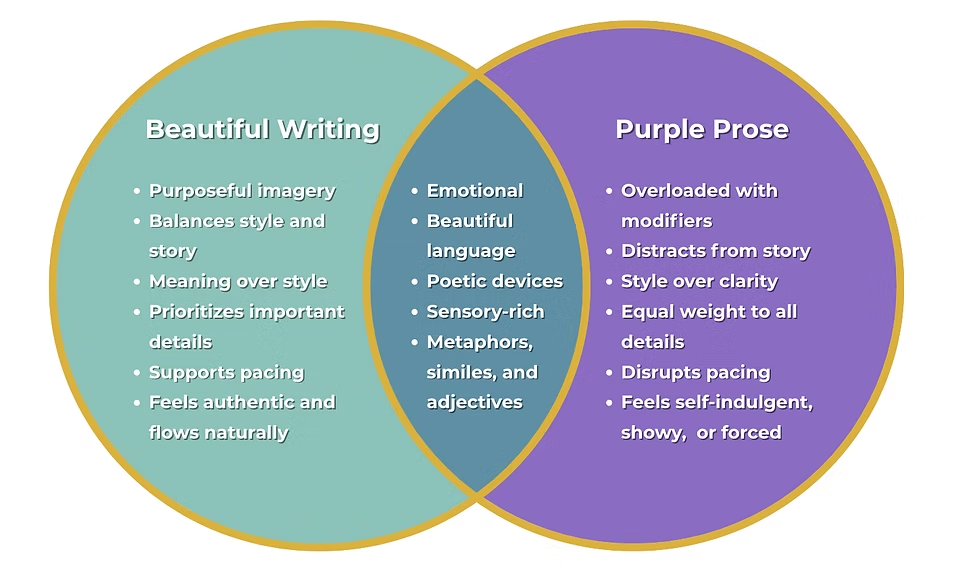
Remember, strong writing isn’t about the length of your descriptions or how many metaphors you can fit into a paragraph. It’s about choosing the right words for the right moment.
Recognizing Purple Prose
Since beautiful writing and purple prose are on the same spectrum, how do we recognize when we’ve gone into purple prose territory?
I am a person born from a patchwork of purple cloth. In my earliest writing years, I embroidered every sentence with glittering adjectives, laced every line with metaphors, and believed—deep in my melodramatic soul—that more was both timeless and in vogue. I scoured dictionaries for unusual words that sounded pretty when I whispered them aloud and kept a frequently updated list of favorite words—with their definitions, of course. So, I write this article as a fellow purple-souled writer who had to learn restraint the hard way.
If you’re wondering whether a section of your writing is purple, look for these three telltale signs from my own writing as a “very deep” 15-year-old.
1. Unnatural Word Choices
Stretching for rare or obscure words to sound “literary” can make prose feel pretentious or forced when it’s done too often. Readers may even stop reading if they don’t know what a lot of words mean. On the other hand, using only simple, basic vocabulary without much variation makes writing flat and forgettable. Striking the right balance with your vocabulary depends on your genre and audience.
Example:
Snowflakes dance to the cadence of the wind’s mournful song, the cynosure of their lilting sparkle drawing the light and frosting the world with lurid polish. A shroud of evanescent light covered the face of heaven, a gloved hand stretched out to smother the earth.
Why it doesn’t work:
Words like cynosure, lurid, and evanescent might look fancy (and sound really pretty coming off the tongue), but they trip up the reader and blur the meaning. For example, lurid can refer to ghastly pale, as my 15-year-old self was going for, but most people today would associate lurid with its more common meaning: gruesome and sensational.
Because my goal in this piece is to convey the beauty and melancholy of a lonely winter night illuminated by snow clouds, I need to prioritize meaning over fancy words.
Revision:
Snowflakes dance to the rhythm of the wind’s mournful song, their sparkle reflecting the light and frosting the world with ashen polish. A shroud covered the face of heaven, white clouds like gloved hands stretched out to smother the earth.
Why it works:
The revised version keeps the poetic tone but uses clear, understandable language that’s easy to visualize and is emotionally resonant. Lurid is changed to ashen to better depict the intended meaning, and the gloved-hand metaphor is now an unmistakable simile. This makes the scene more immersive and accessible without making readers grab a dictionary.
2. Tortured Metaphors and Similes
A well-crafted metaphor enhances meaning by making comparisons that feel insightful and true, or that paint a clear picture. Metaphors feel like a natural element of an author’s writing style. However, when comparisons become forced or too abstract, they distract from the intended meaning and leave readers scratching their heads.
Example:
The ashes of an ocean are desecrated by the wind
A silent dirge cresting over the sinuous bones
Pallid thorns piercing the luminescent veil in the sky.
A boundless cold freezes the spirit of the air
The advent of winter’s embrace descends.
Why it doesn’t work:
This poem was trying to paint a picture of a cold winter night, but did you know what “ashes of an ocean” were? How about “sinuous bones”? If you didn’t picture snowdrifts and dead plants, then the metaphors weren’t doing their job. This poem tries so hard to be deep, it accidentally buries the meaning. On top of that, a dirge is a song, so it can’t be silent. The overuse of metaphors and unique vocabulary forces the reader to trudge through a poetic blizzard.
Revision:
The wind scatters snowdrifts like ashes,
a quiet mourning rising over withered leaves.
Bare tree limbs reach through a pale, glowing sky
And a boundless cold settles in to grieve
as winter finally arrives.
Why it works:
By taking away the forced metaphors, the meaning can finally shine through. I think my younger self had some awesome metaphors that I may use again in later work, but the way I forced them together for this poem initially made them lose their impact and meaning.
The revision replaces the confusing metaphors with clear, grounded ideas and images. Now we’ve got a poem instead of a dramatic riddle.
3. Pacing Problems
When writers try to intensify images and scenes by stacking multiple noun or verb descriptors, detailing scenery in the middle of the action, or frequently utilizing run-on sentences, the intensity of the story actually diminishes. Imagine pausing a movie during a fight scene to stare at some flowers. Enough said.
Example:
I remember when the power went out. It was a chilly November evening, about 11:00 p.m. I was typing on my computer when I was suddenly plunged into darkness.
My eyes were still adjusting to the dark when a sudden loud knock sounded against my old, weathered green door. I slowly unfolded my too-long legs out of my desk chair, tucked my shoulder-length blonde hair behind my ear, and crept wordlessly to the peephole, managing to trip over seemingly every misplaced and I’ll-get-to-it-later object on the floor.
Why it doesn’t work:
In this scene, the narrator has just been startled by a knock on the door right after the power in their apartment mysteriously went out. This is a tense moment. Including so many details about the apartment door, the narrator’s appearance, and the messy room at this current moment cuts the intensity of the scene.
Revision:
I remember when the power went out. It was a chilly November evening, about 11:00 p.m. I was typing on my computer when I was suddenly plunged into darkness.
My eyes were still adjusting to the dark when a sudden loud knock sounded at the door. I slowly rose from my chair and crept to the peephole, managing to trip over seemingly every misplaced object on the floor.
Why it works:
The revision focuses on the action: knock, movement, obstacle. We stay in the moment, and the suspense builds instead of getting buried under a pile of descriptions. Details that the character would not be able to see in the dark, such as the door, are cut for now. The scene is now tighter and more immediate.
Beautiful writing doesn’t try to impress. It connects with readers and enhances your natural voice and vibe. So as you revise, ask yourself: Am I helping the reader see, feel, and follow—or am I showing off? If it’s the latter, no shame. Just edit.
But remember, don’t take away beauty from your writing either. Just be mindful to avoid going overboard with too much of a good thing. Most purple prose doesn’t need to be completely rewritten, just tweaked slightly. The goal is to make sure beautiful writing serves the story, rather than steals the spotlight.
This article was written by Amy Guan and was republished with permission from Ever Editing.
Amy Guan
Co-Owner and Managing Partner, Ever Editing