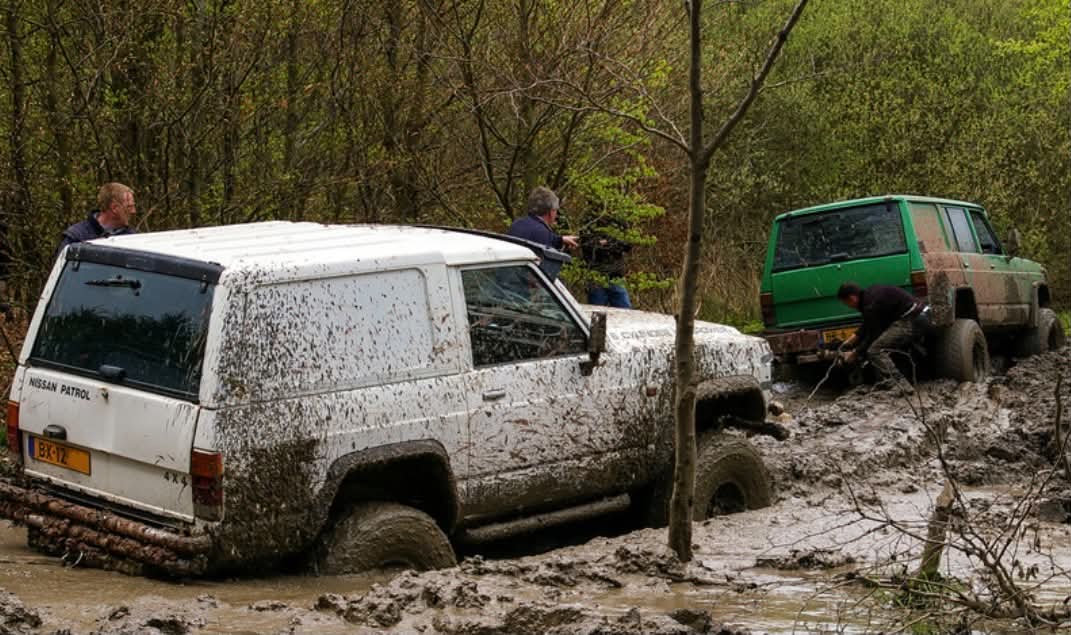
Do you ever feel like your wheels are spinning, but you’re not moving forward?
As a missionary in Flagstaff, AZ, my companion and I literally got our truck stuck in a rut on a very narrow dirt road. I remember the panicked feeling of being trapped and not knowing how we would get home. It took some time, a dozen or so prayers, and a lot of trial and error. Finally, using some very handy sticks for traction and a lot of oomph, we managed to get our truck unstuck.
This experience has never left me, and I think of it often when I’m mentally stuck in a rut, spinning my wheels with no progress, despite pressing the gas again and again. Personally, I don’t believe in writer’s block. I’m always able to put words on a page, even if they aren’t very good words. But, having struggled with motivation for certain projects, I do believe in creative ruts. Over the years, I’ve acquired a few useful tools that help me get unstuck. Here are five tips to help you get out of your own artistic ruts.
Co-Create with Body Doubling
I have a confession to make: I hate revisions. People who know me might raise their eyebrows. “But aren’t you an editor?” Well, yes. But I don’t hate revising other people’s stories—I hate revising my own. Without fail, I hit a wall. All the self-doubt I kept at bay while drafting comes sneaking in, mocking me and making me question all my writing choices. So to avoid that, I simply don’t start the revisions.
This avoidance, however, has proven to be a major problem because it prevents me from making progress on any of my stories.
I came up with an idea to help me with this particular rut. I invited several of my writing friends to hop on a Zoom call with me and just write for an hour. To my relief (and my story’s benefit), I discovered that having someone present while I wrote helped me overcome my motivation slump and actually start revising. I made my way through the murky fog of revision and emerged on the other side better for it.
I still meet with writer friends every week for scheduled writing time, which has had a huge impact on my writing and revising. If you haven’t tried this, I highly recommend it. Having someone on a Zoom call with you makes it a lot harder to get sucked into distractions because you have a witness to your efforts and an accountability partner to return and report your progress to.
Create in a Different Location
Another tool that can help you get out of your creative rut is to change your location. On my bad mental health days, I’ve found that simply getting out of my usual space helps me get out of my head. I’ll go to the library or a local park and just enjoy the world around me. Notebooks and sketchbooks are handy tools for alternate locations. Being somewhere new can spark ideas you wouldn’t have otherwise thought of. If you’ve been tapping the same artistic vein nonstop for weeks, months, or even years in the same location, try changing it up. You might find some new ideas to help you work through whatever is keeping you in that rut.
Explore a Different Medium
I don’t consider myself an artist, at least not in the traditional sense. I have some talent in painting, but my people always look like stick figures. However, when my creativity is running low and I’m struggling to make sense of my story, switching things up by painting or sketching can be therapeutic. It allows me to experiment without the pressure of forcing myself to write. Painting especially helps me want to write more.
Try this out for yourself: if you’re a painter, maybe try writing a poem. (See this article about poetry.) If you’re a writer, try painting or knitting. If you’re a musician, try cooking or cross-stitching. Put yourself in a different medium to get the creative juices flowing. You never know when the perfect idea will strike—it might be while you’re learning to make the perfect crème brûlée.
Change Up the Format
Another tool that’s helped me break out of my rut is changing up the format. Most of my writing is done on my desktop computer. However, there are days when I sit at my keyboard and can’t bring myself to write. I’ll check my email for the thousandth time or watch yet another short on YouTube, but completely neglect the project I want to be working on.
This is where changing up the format comes into play. When I was a kid, I did most of my writing by hand—I have dozens of notebooks and journals to prove it. I still handwrite in my journal, but I rarely do so for stories anymore. Recently, my work-in-progress was being difficult, and my motivation was extremely lacking. On a whim, I put pen to paper in a blank notebook. To my surprise, I wrote seven-and-a-half pages in one session. I’d gotten myself out of the rut simply by changing how I wrote.
Try experimenting with different formats. If you’re a composer who uses MuseScore, try composing by hand. If you’re a painter who mostly uses oil, try watercolors. If you’re a digital artist, sketch something on paper. Writers, try writing by hand or typewriter. The novel format will help you find new pathways forward.
Follow Prompts
What if you’ve tried it all and you are still struggling to get unstuck? Not to worry, my friends, I’ve got one more trick up my sleeve. Despite trying some of the tools mentioned above, I may still find myself completely and utterly unmotivated, uninspired, and unexcited about working on any of my projects.
This is where prompts come in handy. Sometimes the scariest thing about starting a new project is just knowing where to start. Having constraints, such as “paint a picture with only primary colors,” “write a short story featuring a hamster, a poncho, and a hammer,” or “write a poem using only words that start with the letter ‘A’” can prime the pump. Constraints actually allow for more creativity because they force your brain to work within a set of defined parameters, and they give you a firm launch point.
There are countless free prompts available online for all sorts of art. These can include prompts to write short stories with a specific setting, character, or genre; create a song in a certain key, time signature, or rhythm; paint something that starts with the letter “R” or only with black and yellow pigments; and plenty more. Let your muse take over and turn that blank page into an answer to the prompt.
Creating is hard and can take a lot of energy. You’re bound to find yourself in a rut now and then when you work the same way over and over again. My hope is that these five tools will help you find the traction you need to get unstuck and get back to doing what you do best—inspiring others through your art.

KaTrina Jackson
Author, Editor




Leave a Reply