• Skip to main content
  • Skip to primary sidebar
  • Skip to footer

LDSPMA

Empowering Latter-day Saints to spread light and truth by connecting them at the intersection of faith, creativity, and professional skill

  • Conference
    • Propose a Session or Workshop for the 2026 LDSPMA Conference
    • 2025 Conference Recordings
      • Purchase Recordings Access
      • Grid Schedule
    • Exhibitors & Sponsors
    • FAQs
    • Volunteer
    • Past Conferences
      • 2025 Conference
        • Sessions
        • Workshops
        • Awards Gala
        • Internship Fair
        • LDSPMA’s Got (Secret) Talent!
      • 2024 Conference
        • Sessions
        • Workshops
        • ZIFF Networking Dinner
        • Schedule
  • Membership
    • Email Sign Up (Free)
    • LDSPMA NextGen
    • University Chapters
    • Facebook Group
  • Programs
    • Master Classes (2026)
    • Monthly Zoom Discussions (Free)
    • Mentoring Program
  • Podcast
    • Watch
    • Listen
      • Listen on Apple Podcasts
      • Listen on Spotify
      • Listen on Buzzsprout
    • Called to Create Conversations
  • Articles
    • All Articles
    • Faith & Mindset
      • Gospel Principles
      • Creativity
      • Productivity
    • Craft Skills
      • Writing
      • Media, Film & Theater
      • Podcasting & Speaking
      • Music
      • Fine Art
    • Professional Skills
      • Editing
      • Publishing
      • Business
      • Cultural Diversity
      • Marketing
  • Awards
    • 2026 Award Nominations
    • Praiseworthy Awards
    • Spark Awards
    • Lifetime Achievement Awards
    • Apply to Be an Awards Judge
  • About
    • Mission
      • LDSPMA in the Media
      • Success Stories
      • Viewpoint on LDSPMA
    • LDSPMA Leadership
    • Volunteers
      • Volunteer Year-Round
      • Volunteer at the Conference
      • Apply to Be a Presenter
      • Apply to Be an Awards Judge
      • Resources for Current Volunteers
    • Policies
    • Contact US
  • Support LDSPMA
    • Donate
    • Volunteer

Articles

Book of Mormon Picture Books for Young Families

January 31, 2026 By Kami Pehrson Leave a Comment

Kennedy Kofford ran into a familiar problem for many Latter-day Saint parents: she wanted to teach her children gospel stories, but the books available were either too simple to be meaningful, too complex for young minds, or too long to finish before children lost interest—or fell asleep.

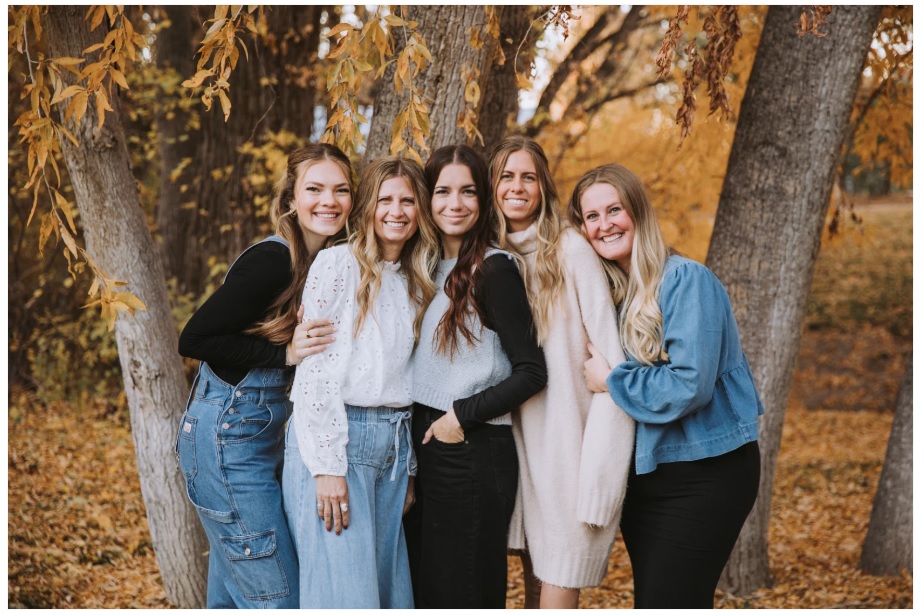
Kennedy saw this challenge as an opportunity. She shared her idea with the women in her family, and what began as a simple conversation quickly grew into a collaborative family business called Faithful Chapters. Together, five women—Kennedy, her sisters-in-law Kenzie, Kaylie, and Laylah, and the family matriarch, Camille—create illustrated Book of Mormon board books that are doctrinally sound and visually engaging for young families.

From Concept to Creation

With no entrepreneurial experience, the women taught themselves the necessary skills through Google, ChatGPT, and community resources to navigate everything from obtaining business licenses and ISBNs to finding printing companies and designing packaging.

“We didn’t know much about starting a business,” Kenzie admits. “It felt pretty intimidating, and we didn’t know if we could do it.” For aspiring entrepreneurs, Kenzie offers encouragement: “There’s so much help out there now. Anybody can do it—and there’s room for everyone to succeed.”

Then Camille became involved. “We’re making this happen,” she said. “It’s going to be awesome—and I’ll finance it.” So, they pressed forward.

Kennedy credits Camille’s financial backing as crucial to their enterprise. “We all have young families and don’t have extra money to throw into a business.” The women agree that it has taken every one of them to bring their vision to life.

Camille adds, “We really, truly need each other’s support and contributions to make this happen.”

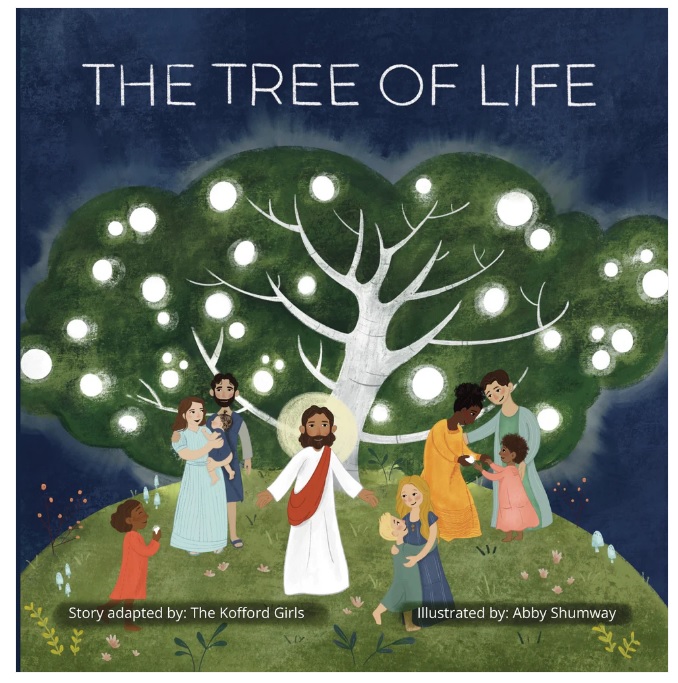
The women gathered to select Book of Mormon stories, focusing on principles rather than retelling narratives. Camille explains their approach: “For us, it’s about the message. The tree of life teaches about returning to Christ and feeling God’s love. The brass plates teach obedience and persistence—even when answers don’t come immediately.”

Kennedy and Camille draft each book, keeping them to twelve pages or less, then pass manuscripts back and forth for revisions. When the story feels strong, they bring it to the whole group for final edits and fresh perspectives. This collaborative effort ensures each book reflects the combined voice, testimony, and insight of all five women.

A careful balance of doctrine, clarity, and creativity shapes how the team adapts scripture for a broad audience. Toddlers are drawn to the illustrations, while children around five or six years old engage more deeply with the text. Even parents can discover details they hadn’t noticed before.

Camille laughs as she recalls reading one story aloud: “Two of my grown children stopped me and said, ‘Wait—that happened?’”

Finding the Right Illustrator

Finding the right illustrator was their next challenge. They posted on Instagram and reached out through personal networks, asking several artists to submit sample sketches. After praying for guidance, Kaylie felt prompted to search through BYU’s illustration program portfolios, where she discovered Abby Shumway’s work. Kaylie had envisioned images with “a sort of Alice in Wonderland vibe,” and Abby’s art fit that specification perfectly.

But it wasn’t enough for the art to be beautiful. The Koffords knew they needed an illustrator with a testimony of the stories themselves—and Abby’s faith is evident in her art. “It’s just so happy and draws your attention,” Kenzie says. “We really connected with her work; it was whimsical, bright, and full of life.”

The women all worked together to adapt the visuals for a G-rated audience. To soften intense moments in Nephi’s story, Abby illustrated Laban asleep in polka-dotted underwear with a pot carefully placed in front of his head—or lack thereof! The depiction adds humor while leaving room for parents to teach the story in age-appropriate ways.

Design and Production

Each book’s QR code links to family home evening resources formatted and overseen by Laylah, who spearheaded the lesson structure. Families can access her quick five-minute lessons or more detailed discussions, along with printable coloring pages—making the books flexible for varied schedules and ages.

The books also feature an interactive element inspired by Kenzie’s childhood love of finding hidden CTR rings in The Friend magazine. Faith the Mouse serves as the series’ mascot, hiding on every page for children to discover.

The women wanted books that could survive diaper bags, toddlers, and years of use while still teaching sacred stories. They initially designed the board books at 5×5 inches but then realized Abby’s detailed illustrations lost their impact at that size. “You couldn’t see Faith the Mouse or the bite mark in the fruit,” Kenzie said. They resized to 6×6 inches and continued refining. “It’s a process,” she adds. “You just keep trying until you get it right.”

Looking Forward

Faithful Chapters plans to ship directly to customers who order through Instagram. Despite her faith in their endeavor, Laylah admits she was a little nervous about their launch. “I just worried that we wouldn’t get any orders,” she says. But those concerns quickly vanished. “We get the notifications on our phones, and we get excited every time! It’s very heartwarming to feel the support.”

Internet sales are just the beginning. “Our goal is to get into brick-and-mortar stores,” Kenzie says. “We’re still fresh—we’re focusing on getting our books out to friends and family first.”

The Kofford girls plan to move chronologically through Book of Mormon stories, eventually offering themed bundles and expanding into Bible stories and Church history.

Divine Guidance and Greater Purpose

Beyond business goals, the Kofford women feel a deeper spiritual calling. Laylah explains, “Obviously, we’ve had hurdles, but God always guides us to a solution.”

She adds, “As I’ve been rereading the Book of Mormon, I’ve noticed so many things I missed before. I feel strongly that this is what God wants us to do: introduce His children to the Book of Mormon earlier.”

For Kaylie, the books meet a deeply personal need. “My husband left the Church about four years ago, and I have four kids ages one to eight,” she shares. “Even with a supportive husband, it’s sometimes hard to pull out the scriptures and teach the stories by myself. These board books are such a tool in my belt—something simple, engaging, and beautiful.”

Faithful Chapters is intentionally designed to meet families where they are, supporting households of different beliefs with equal care.

This shared sense of purpose fuels the sisters’ commitment. “We hope that when kids go to Sunday School,” Kenzie says, “they already know the stories because of our books.”

Beyond creating products, Faithful Chapters has strengthened family bonds. “We’re all busy,” Kenzie adds, “but starting a business together has been so meaningful, and we’re all in it together.”

As Faithful Chapters moves forward, the women are building more than a business. They’re creating a foundation of faith for the next generation—one colorful page at a time.

Headshot of Kami Pehrson.

Kami Pehrson

Kami Pehrson lives with her husband and five teenage children in Stansbury Park, Utah. She recently finished her master’s degree in English and creative writing and has written three novels—but is still trying to figure out what to do with them. She loves editing, reading, and playing word games on her phone. She also enjoys listening to audiobooks while half-heartedly doing Pilates in the living room.

    Filed Under: Articles, Creativity, Faith & Mindset, Professional Skills, Publishing Tagged With: board books, children's books, illustrations, LDS businesses, LDS creators

    Working Through Creative Block

    January 8, 2026 By LDSPMA Leave a Comment

    Over the last few years, I’ve experienced a creative block in an unexpected place: my life.

    Can you get a creative block in life?

    Writer’s block is something I’m all too familiar with. Either I’d spend hours staring at a blank page, or I’d type and delete paragraphs in an attempt to figure out where the story was supposed to go, despite having a detailed outline. Other times, I’d already finished entire drafts of the same story and nothing had changed up to that point, so I really knew where it was supposed to go. Despite believing my story should be working, I couldn’t get it to budge.

    Fun fact about me: I’m extremely stubborn. When I think a problem has a reason and a solution, I will figure them out. I don’t just want to trudge through the situation and get past it. I want to understand why it’s happening, and I want the experience to be smoother the next time around, thanks to what I’ve learned.

    That said, I didn’t conquer my writer’s block until I figured out how to break through the creative block as it applies to life.

    There are times in life when I feel stuck. Maybe I have goals and a plan, but everything suddenly feels wrong anyway. I feel paralyzed and unable to move forward with anything. I struggle to decide what steps to take next, whether it’s about a job, school, parenting, or my writing career. Nothing makes sense, and I can’t understand why.

    Over the last couple of years, I have taken this uncertainty to God. With His help, I’ve worked through why I was experiencing this form of creative block, and since then, I’ve found that the process that got me through it helps me with other creative blocks as well. I’ll walk you through my process here.

    1. I examine what I believe to be true.

    The first thing I do is identify misconceptions about where I am. In list form, I write statements that highlight my beliefs about reality. Seeing the list in front of me helps me think through the process and feel out what’s not quite right.

    Here’s an example of a list I might make when trying to figure out what’s holding me back from moving forward in life:

    • I’m going to try to traditionally publish my novel.
    • I’m going to attend a family ward instead of a young single adult ward.
    • I’m going to wake up early to write and work out before work every day.
    • I’m going to drive my sister to work and pick her up every day, even though it may interfere with my work schedule.
    • I need to look for a new job.

    As I go over the list, I pay close attention to how I feel emotionally and spiritually. When I land on a statement that needs reconsideration, it feels as if I have struck a nerve. Whether it’s anxiety or a spiritual sense that something is wrong, it’s clear to me which “truth” is not fully true.

    2. I write why I believe this statement is true.

    Usually, the problem is not that the statement is fully false. Say the troublesome statement is, “I need to look for a new job.” Maybe I don’t actually “need” to do that. The problem might lie in my approach to that belief. To discover what the deeper issue is, I start listing out other mindsets and beliefs related to that statement, such as:

    • I need a new job in the next month.
    • I want a job in retail or event management.
    • I have to make at least $18/hour and get benefits.
    • I don’t want to work on Sundays.
    • I’m looking on Indeed.

    There’s often more than one perspective I need to reevaluate, so I don’t stop listing them until I feel I’ve spiritually considered everything that’s relevant.

    3. I consider alternatives to those statements.

    Each statement that feels significant gets its own bulleted list. As I brainstorm changes I could make to those mindsets or goals, eventually one or more options will feel right. Maybe it’s that I don’t need to rush to find a job. Or maybe I need to consider a career change. Maybe I’m undervaluing my time. Maybe I need to explore other platforms or reach out to my network. I consider multiple possibilities for each statement, and they often require more than one change.

    By the end of this process, I usually start to feel excited again. Things are beginning to make sense, even if the necessary changes aren’t what I’d hoped for. Since learning to apply this process to my creative block in life, I’ve also successfully used it to overcome writer’s block and other challenges. Once I begin implementing these changes, everything starts to flow in new ways.

    Creativity is one of the most divine traits we can access, and so I recognize obstacles as evidence of dissonance between my human limitations and an omniscient, all-powerful Father in Heaven. Being stuck doesn’t mean I’m failing. It only means I have more to learn and new ways to collaborate with the Divine. This process has provided me with so much clarity in moments of frustration. I would love to hear from you if you try it and find that it helps you achieve your own breakthroughs, no matter what types of blocks you encounter!

    A headshot of Mariah K. Porter.

    Mariah K. Porter

    Mariah K. Porter is a member of the LDSPMA and the author of Tomorrow I Will Make a List: Managing the Depressive Habit of Procrastination. In addition to her nonfiction, she has also written That Prince Guy, This Glass Heart, and These Extraordinary Thorns, which are fairy tale retellings. You can learn more about her here.

      Filed Under: Articles, Craft Skills, Creativity, Faith & Mindset, Productivity, Writing Tagged With: creative block, writers block

      Five Ways to Get Your Scrooge on This Christmas

      December 23, 2025 By LDSPMA 1 Comment

      The word “scrooge”entered the English language around the year 1899, more than fifty years after the publication of A Christmas Carol. The word, to no one’s surprise, means “a miserly person” and feels very apt when we think of portrayals of the character Mr. Ebeneezer Scrooge by actors like Jim Carrey and Michael Caine.

      But in our modern culture, we seem to have forgotten that while Scrooge may have started off as a miser—a “squeezing, wrenching, grasping, scraping, clutching, covetous old sinner” as Dickens says—he did not stay that way (2). In fact, the reason why A Christmas Carol still resonates with audiences around the globe is because Scrooge changes.

      At the end of the short novella, Scrooge is a different man, one who was generous with everything he had, who reconnected with his family and those around him, and who “knew how to keep Christmas well” (68).

      As Elder Gong has said, “Why don’t we remember that [new] Mr. Scrooge? Are there those around us, perhaps we ourselves, who could be a different person if only we would stop typecasting or stereotyping them as their old self? . . . Let’s give the new Scrooge in each of us a chance to change” (Christ, Our Savior, Is Born, 2023).

      In the spirit of a miserly man who changes into a truly generous soul, here are five ways we can be more like Ebeneezer Scrooge this Christmas:

      1) Reconnect with Family and Friends

      In any version of A Christmas Carol, the audience sees Scrooge’s extremely affable nephew, Fred, visit his uncle at his place of business, inviting him to Christmas dinner. But Scrooge, of course, refuses.

      However, the Ghost of Christmas Present shows Scrooge his nephew celebrating Christmas with his family. And while Fred does make Scrooge the object of a joke, Fred is also trying to defend him. “His offences carry their own punishment, and I have nothing to say against him,” says Fred (45).

      At the end of his journey, Scrooge reconnects with Fred, who was so excited to see him that “it was a mercy he didn’t shake his arm off” (67). Scrooge did his best to love and support his nephew and, of course, Tiny Tim.

      What can you do to reconnect with your friends and family? Perhaps you can text someone you haven’t for a while, or call an aunt or uncle who lives far away. Be like Scrooge and reach out to your loved ones this Christmas.

      2) Give Generously

      My favorite part of A Christmas Carol is when Scrooge becomes a generous man. He buys a prize turkey for the Cratchit family, raises Bob’s salary, and gives to all around him. This is perhaps the most obvious sign of Scrooge’s change—that he goes from keeping a tight grip on all his wealth to being generous with everything he has because he learned from the Ghost of Christmas Future that he could not take any of his possessions with him. So, he gives.

      Perhaps you could visit one of the Giving Machines throughout the world or donate time through JustServe. Perhaps you can donate to a charitable cause or spend time making blankets for local children in need. Be like Scrooge and give generously this Christmas.

      3) Let Go of the Past

      Perhaps the saddest part of Scrooge’s story is when he sees his fiancée, who tells him, “. . . another idol has displaced me; and if it can cheer and comfort you in time to come, as I would have tried to do, I have no just cause to grieve” (27).

      Scrooge never mentions this long-lost love again, but I think it is telling that he says to the Ghost of Christmas Past, “Why do you delight to torture me?” (28). By the end of his journey, Scrooge has made peace with his past and is trying to move on despite what happened to him. He tries to be a friend to others, he gives of himself, he keeps his family close instead of pushing them away . . . these are all evidence that Scrooge has let go of the past to find peace in his future.

      What can you do to let go of the past? Perhaps there is someone you need to forgive. Perhaps it is yourself. Perhaps it is time to let go of possessions or other memories that have become a burden to you and move forward with faith. Be like Scrooge and let go of your past this Christmas.

      4) Mentor Others

      One of the most crucial moments of Scrooge’s journey was when he saw the too-pure-for-this-world Tiny Tim. “‘Spirit,’ said Scrooge, with an interest he had never felt before, ‘tell me if Tiny Tim will live.’” (40). The line “with an interest he had never felt before” is telling—Tiny Tim awoke a protective urge in Scrooge he had not felt previously with any of his tenants and their problems, nor with his employees.

      Tiny Tim helps motivate Scrooge’s change, resulting in Scrooge becoming “a second father” to Tiny Tim (68). He mentored and admired Tiny Tim because he thought of others more than himself. 

      What can you do to mentor others? Perhaps you can help your children perform Secret Santa for someone else. Perhaps you can talk with a sibling, a friend, or a coworker about what they’re going through in their life. Be like Scrooge and mentor others this Christmas.

      5) Honor Christmas in Your Heart

      Scrooge’s change was cemented when he promised the Ghost of Christmas Future, “I will honour Christmas in my heart, and try to keep it all the year. I will live in the Past, the Present, and the Future. The Spirits of all Three shall strive within me. I will not shut out the lessons that they teach!” (62).

      This is the culmination of his entire arc—he learned how Christmas could change people as they celebrated the holiday as families, drawing closer to each other. The Ghosts are the Ghosts of Christmases Past, Present, and Future, after all. Scrooge learned to honor Christmas and did so not only on the day of Christmas, but every day throughout the year thereafter.

      What can you do this year to honor Christmas in your heart now and throughout the year? Perhaps you read the Christmas story every few months to remember why this season matters. Perhaps you keep a reminder on your desk of the Savior to keep Him in your thoughts. Be like Scrooge and honor Christmas in your heart—and try to keep it all the year.

       At the end of Scrooge’s journey, he had a tough road ahead of him. To the gentleman who had asked for donations the day before who was now completely incredulous at Mr. Scrooge’s greeting to him, Scrooge says, “That is my name, and I fear it may not be pleasant to you” (66). Scrooge had to work to help others realize he had changed.

      We can help continue Scrooge’s good work by showing others the best of this remarkable character, helping others see that he had truly become a good man—“as good a friend, as good a master, and as good a man as the good old city [ever] knew” (68).

      All book quotes from A Christmas Carol by Charles Dickens, Dover Thrift Edition 1991 reprint of the 1843 edition.

      KaTrina Jackson

      KaTrina Jackson loves penguins, cross-stitching, chocolate, and piano music, and spends much of each day trying to fit those loves in around her jobs as a freelance editor and as a project manager for Eschler Editing. She graduated with a degree in editing and publishing from Brigham Young University because she couldn’t get enough stories in her life. She’s also a member of three different writing groups, attends and teaches at multiple writing conferences yearly, volunteers with LDSPMA and has since 2021, and is currently working on publishing her first novel. When she’s not writing, editing, or reading, she can be found practicing yoga, teaching piano lessons or performing with her husband, or watching Disney movies while working on a cross-stitch project. She and her husband live in Olathe, Kansas.

        Filed Under: Articles, Faith & Mindset, Gospel Principles Tagged With: giving, repentance

        A Complete Life of Color

        December 12, 2025 By LDSPMA Leave a Comment

        I can’t remember a time when art hasn’t been part of my life. It’s always been more than just a hobby—it’s been a way for me to make sense of things that words can’t really explain. It taught me how to slow down, give details the attention they deserve, and prioritize quality over just a completed product.

        Learning these qualities helped with my perfectionism. I have a desire for excellence that honestly isn’t always healthy and threatens to turn my hobbies into chores. But art taught me to enjoy the process rather than fixating on getting everything perfect. The more patient I was with myself and the process, the more I could enjoy creating and developing my skills.

        The lessons I learned through my paint, canvas, colored pencils, and sketchbooks served as metaphors for life. Through the application of color, I learned to appreciate the whole spectrum of human experiences. I can apply that artistic mindset to every challenge and triumph. That perspective helped me realize that just as I use complementary colors like yellow and purple to create depth, life is built on that same principle of contrast and opposition.

        But it’s a lot easier to understand this principle than to live it. Opposition isn’t just something that we must endure—it’s a fundamental truth that has existed since the beginning of time. The world needs night to have day. Animals graze, and predators prey on them. Summer gives way to winter. Life guarantees we’ll face opposition, and the wise understand that struggles are actually a gift, that enduring hardships helps us live a richer life.

        Good artists know that complementary colors create depth because they’re opposite each other on the color wheel, making them more vivid when placed side by side. Life works the same way—if we never experience the deep purples of sorrow, we can never fully appreciate the brilliant yellows of joy. Without one, the other loses its meaning. A life carefully sheltered from hardship might feel safe and comfortable. Some might argue that it is not worth the risk of another failed relationship, trying out for the team again, or taking a chance that might result in pain, but I invite you to appreciate your heartbreak. A person who avoids all adversity can’t fully experience the depth that struggle makes possible.

        The next time sadness comes—and it will—try to resist shaking your fist at it or rushing past it. Instead, take time to feel it. Notice what emotions are moving through your heart and soul. With time, something good will eventually happen. One day, someone good will come around, you’ll make the team, or you’ll triumph in some way. Your spectrum will be complete, and you will live a life full of all the best colors.

        In contrast to your previous sadness, this good thing will illuminate your soul in a way that shallow pleasure never could. There’s no replacement for that happiness—the joy that comes from emerging through genuine sorrow.

        I’ve walked through my share of dark valleys. I felt the grief of my friend’s drowning, and the loss of my grandfather when I was thousands of miles from home. Each brought intense pain—the deep purples and blues of my emotional spectrum. Yet the worst moments of my life were when I shut down completely, and my spectrum converted to grayscale.

        By the end of my senior year, the numbness from school pressures and responsibilities had turned into creative burnout. I was making art for portfolios and grades—not because I was inspired or excited to do it. Each piece was assigned to me, so every brushstroke seemed forced. I wasn’t connected to my work anymore. My art, which had taught me about patience and joy, had become just another source of stress. During that time, I felt nothing at all. Not sadness, not joy, not even anger—just a dull gray that stretched across my landscape. I would have given anything to feel sadness again, to feel anything. I needed to know I could still feel. I pleaded with God, “Please just let me cry again.”

        I learned that even the darkest colors are necessary. My struggles were specific to me and my journey, and they became essential preparation for what came next.

        At the beginning of summer, a friend asked me to paint his copy of the Book of Mormon. It felt like an epiphany. It was a way for me to step back into art, to use one of my talents to serve other people. I made an Instagram post offering to paint custom copies of the Book of Mormon for friends who’d received mission calls, and I got a lot of excited responses.

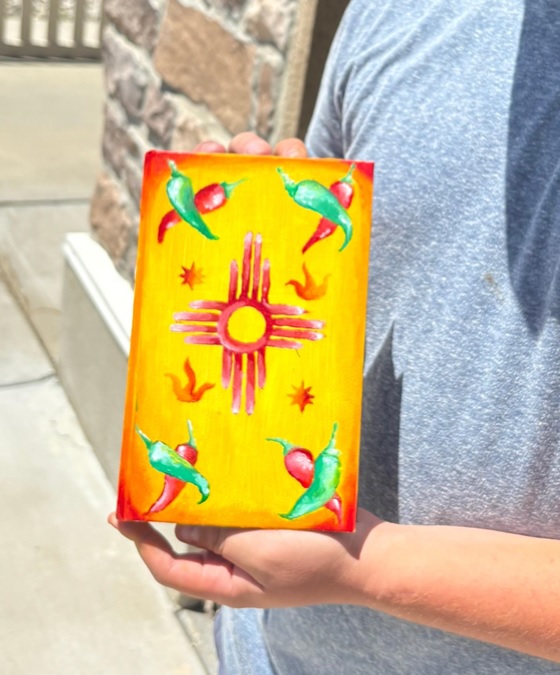
        When I paint those books, I make them as specific as possible to each person so my friends know they mean something to me. For one of my friends serving in New Mexico, I painted the state flag, with hot chili peppers and colors that capture that New Mexico vibe. For my friend who had won the state championship in a track-and-field relay with his teammate—who was also called to the same mission in Australia—I painted a hand exchanging a baton over two different books. When you put them together, you get the whole picture, all in Australia’s colors.

        The Spirit prompted me to write a letter to one of my friends in his book. He later texted me, saying, “That message really meant a lot to me. I was going through a really hard time.”

        I may never know how much receiving a painted book truly means in the moment. I’m sure my friends are grateful and think it’s cool. But I hope they realize later that it came from my desire to serve my Lord. As the scriptures say, “When ye are in the service of your fellow beings, ye are only in the service of your God.” I serve others because I love Him and because I love the people I’m serving.

        I learned that darkness is necessary in life and art, and that creating without purpose and intention makes the process feel incomplete. Because I knew what it felt like to be disconnected from my gifts, I now treasure the connection between creativity and service. The gray numbness I experienced helped me recognize color and feeling as sacred gifts. The contrast is what makes it meaningful—the purple makes the yellow more brilliant.

        Painting those books didn’t just reignite my love for art. It taught me, in the most tangible way, what it means to live a Christlike life—to embrace the full spectrum as He did. Christ is my ultimate inspiration for creating art and living fully. He is the first creator and encourages us to be creators as well. He is the light and the life of the world. His birth brought light, and his death brought darkness. He taught us that sadness is often the price we pay for lasting joy, and that the contrast itself is sacred.

        That’s how you live a beautiful, full-spectrum life. It’s actually pretty simple—but simple in a grand way, as all profound truths are when you take everything else away. Not by avoiding the hard colors or muting them, but by embracing them as essential parts of the complete picture. When you do, you discover that the contrast isn’t just bearable—it’s beautiful, and it’s what makes life worth living.

        A headshot of Aidan Pehrson.

        Aidan Pehrson

        Aidan Pehrson is a track-and-field athlete competing for Snow College. In addition to running, he enjoys painting, boating, surfing, and spending time with friends and family. He plans to leave on an LDS mission this summer.

          Filed Under: Articles, Craft Skills, Creativity, Faith & Mindset, Fine Art, Gospel Principles Tagged With: art, Inspiration, opposition

          Writing with Faith: An Interview with LDS Author Gale Sears

          November 27, 2025 By Kami Pehrson Leave a Comment

          Gale Sears’ path to becoming an acclaimed LDS historical fiction author began with writing screenplays. She earned a bachelor’s degree in playwriting from BYU and a master’s degree in theater from the University of Minnesota. For decades, Gale’s creative life revolved around the stage—acting, directing, and crafting stories for live audiences.

          “I didn’t start writing novels until I was almost 50,” she shares, yet storytelling had always been part of her nature. “When I was about seven or eight years old, just after I’d learned about words, we had a little shed out in our backyard in Lake Tahoe, where I grew up. It was a magical place. I’d go out there with paper and pencil and write stories.”

          Exploring Different Genres

          The transition from playwriting to novel writing came naturally. “I had a story in my head that I thought would be a very cool play, but it was kind of epic, and it didn’t fit the genre,” Gale explains. “So, I started jotting down thoughts and a skeletal outline of chapters for a book, which I’d never thought of before because my mind always thought in terms of plays. I had to learn a different writing process because plays are composed of dialogue, but novels must include descriptions of place and setting.”

          That story became Autumn Sky, the first book in a trilogy published by Covenant Communications.

          Writing as a Divine Calling

          For Gale, writing is a sacred practice, centered on divine guidance. “I pray constantly. I have no ego when I’m writing my books. I believe that EGO stands for Edging God Out, and I’m not ever going to do that. When I dedicate my work and consecrate it to His purposes, I must include Him in the process.”

          The Spirit guides Gale throughout her process. “It’s as if I’m walking along and all of a sudden, I stumble, and something makes me pause. I stop and say, ‘Okay, something’s wrong here. Either I’m pushing it too much, or I’m not telling the right story, or I’m not going in the right direction.’ That’s how I know.”

          The Power of Research

          This spiritual foundation shapes every aspect of Gale’s work, especially her research approach. She is tenacious about accuracy. “If you’re going to write historical fiction, it needs to be true to the history,” she emphasizes.

          For The Silence of God, which explores communism and Christianity in revolutionary Russia, she immersed herself in Russian history and communist theory. “I wanted to tell the story of what a society looks like when they rip God out of their lives,” she explains. She thought she’d have to create a fictional Orthodox Christian family—until she experienced what she calls a “God wink.”

          “I thought to myself, I’m never going to find an LDS Russian family back in that time,” she recalls. “Well, I was at the Church History Library and found this article about the Lindelof family—the one and only LDS family in Russia during the Bolshevik Revolution.” This moment of divine serendipity became central to the novel.

          For Letters in the Jade Dragon Box, set in China under Mao Tse-Tung, she studied Chinese culture and government systems. The book juxtaposes Mao’s communist regime with the gospel as experienced by early Latter-day Saints in Hong Kong.

          Belonging to Heaven draws from George Q. Cannon’s actual journal entries about his mission to Hawaii, exploring his relationship with Jonathan Napela, one of the first Hawaiian converts to the Church.

          Her novella, Brilliant, required research into autism, Indian culture, mathematics, and Eastern philosophy to authentically portray its protagonist—a young autistic college professor from India. Gale met with Indian families and individuals who understand autism and reviewed autobiographies to ensure accuracy.

          But Gale doesn’t just rely on books. She travels to the locations she writes about—Italy, Russia, Hawaii—with her husband, George, acting as photographer and videographer. She interviews people from the cultures she depicts and visits ethnic markets.

          “I’ll go up to people and say, ‘Do you have a minute? Can we talk about Indian food?’ or whatever I need to learn,” Gale explains. “Most of the time, people are gracious and thrilled to help.”

          “It’s so important in historical fiction that readers feel as though they’re there,” she says. Whether it’s the food her characters eat, the clothes they wear, or the streets they walk, Gale ensures every sensory detail rings true. Each book ends with an extensive bibliography and notes explaining the historical context. “I stick to the facts as much as possible, but if I need to deviate because of the story, I let readers know.”

          Blending Faith and Story

          When depicting conversations about faith, Gale uses a subtle touch. “I want to tell the story of God’s Saints in a way that all my readers can appreciate, and weave in Christ’s teachings without beating people over the head with the gospel.”

          For example, in The Silence of God, the LDS character Agnes discusses the law of consecration with her Bolshevik friend, Natasha, while chopping cabbage for borscht. The exchange feels natural rather than preachy. “You can push doctrinal discussions too far to where readers feel like they’re in a Sunday school room, or you can just put a little flavor of it,” Gale explains. “You have to honor your readers and trust that they’re smart enough to interpret the story through their own lens.”

          This approach has connected with readers beyond the LDS community. “I have a lot of readers who are not LDS who appreciate the structure of the story and how I involve Christ in it,” she says. Universal themes of faith, courage, sacrifice, and family resonate across religious boundaries.

          Writing Process and Craft

          Despite her theatrical background’s emphasis on structure, Gale describes herself as “pretty much a pantser.” However, she acknowledges the value of structure, particularly in historical fiction, where “the journey has to go through certain historical processes.”

          “Normally, I start with a character,” she explains. “Then I ask, ‘What is this character’s journey?’ With historical fiction, that journey is kind of mapped out for me.”

          Character development comes through revelatory moments. In Letters in the Jade Dragon Box, the protagonist, Chen Wen-Shan, receives a box from her grandfather containing paintings and letters. This catalyst unfolds her family’s story under Mao’s regime.

          Advice for Aspiring Writers

          For young LDS creators and writers, Gale offers perspective gained from her unique journey:

          • Don’t worry about starting late or about success, fame, or money. Just stay true to the story you’re called to tell.
          • Focus on impact, not numbers. If your book only touches 10 people, that’s wonderful. If it only touches your family and they love it, that’s wonderful too. Remember, it’s a success just to get your story down on paper…Well done, you!
          • Remember the importance of the individual reader’s testimony. You’re planting a gospel seed, and you may not see it grow, but someday the Lord will use it. Eternity is long.
          • Write stories that inspire. For example, if you’re writing fantasy, you can still include the quest for good against evil. Your character’s struggles and triumph can encourage and lift a young person who’s questioning their abilities and whether life is worth the effort.
          • Consecrate your work. “When I dedicate my books to the Lord, I say, ‘Lord, take this little offering that I’m making and do with it what you want.’ I might not have a huge readership, but that’s not my path, and I don’t really mind.”    

          A Legacy of Faith

          Gale’s work now extends beyond novels. Her children’s book, Christmas for a Dollar, based on her father’s experiences during the Great Depression after losing his mother and contracting polio, has been adapted into a Christmas movie.

          No matter what form her writing takes, Gale ensures it is an act of discipleship. She reminds fellow writers that life is a tapestry, and we’re only seeing the back side. In seasons of trial, the threads look tangled. But eventually, God will turn that tapestry around, and we will see His divine design. Until then, authors can help readers through difficult times by writing good stories that show them there is light ahead.

          “These stories, these people’s lives—what a blessing it is for me to be able to share them,” Gale reflects. “And hopefully, prayerfully, the stories will resonate with someone and help them and strengthen them. That’s what I want.” 

          Headshot of Kami Pehrson.

          Kami Pehrson

          Kami Pehrson lives with her husband and five teenage children in Stansbury Park, Utah. She recently finished her master’s degree in English and creative writing and has written three novels—but is still trying to figure out what to do with them. She loves editing, reading, and playing word games on her phone. She also enjoys listening to audiobooks while half-heartedly doing Pilates in the living room.


            Filed Under: Articles, Creativity, Faith & Mindset Tagged With: authors, interview, research, Writing

            The Art of the Interview

            November 14, 2025 By LDSPMA Leave a Comment

            As creators, one of the greatest tools we have is the ability to listen carefully and ask meaningful questions. The art of interviewing can help us open doors to understanding, build trust, and draw out authentic stories that uplift and inspire others.

            When I was going through BYU’s journalism program in the late 1990s, I was surprised to discover there wasn’t a class specifically on interviewing. Which seemed strange, because interviewing is half the job!

            So, I learned it on the job. Over the years, writing for a variety of publications, I’ve interviewed people from all walks of life: farmers, CEOs, investors, first responders, city officials, cancer patients, etc. I’ve interviewed people over the phone, through email, video calls, or in person; sometimes in a tractor or in a hallway after a city council meeting. Each format comes with its quirks, but the heart of interviewing is always the same: helping people share their authentic stories.

            For those of us who create—whether it’s articles, books, podcasts, or films—interviewing is a sacred opportunity to really see someone, listen with care, and draw out their inner truths. Here are a few lessons I’ve learned along the way.

            Making It Happen

            Tracking down an interviewee and getting them to commit can be the biggest hurdle because people are busy or hesitant. The key? Be flexible. Offer multiple times, be willing to adjust, and show that you respect their schedule. That first impression will help build trust.

            I’ve used a go-between person to contact my interviewee many times. For example, when I worked for an agriculture magazine, I found it hard to get in touch with farmers. As a farm girl myself, I knew that most farmers just wanted to be left alone. So, I’d usually have the dairy association or another trusted contact reach out first to vouch for me. They were much easier to get ahold of after that.

            Also consider mode of contact. Some people prefer email, others text, others a phone call. Be open to trying different methods depending on the person—it shows respect for their preferences and increases your chances of connecting.

            Set the Stage with Clarity and Trust

            People get nervous in interviews. They don’t want to be misrepresented or say something wrong about a topic that matters deeply to them. That’s why I start by sharing my goals: “I’m writing about X, and I hope readers will come away with Y.” My hope is to reassure them that the experience will be positive and that I want the same outcome they do.

            Once, I had to contact someone for a tragic story. As I spoke to the interviewee, I told them, “Readers want to know what happened. Take your time. Our goal is to help readers understand.” That moment reminded me that interviews offer a safe space for someone to share something deeply personal, even painful.

            A little transparency and compassion reassures people that you’re not trying to “catch” them      and that you’re on their side. Trust begins before the first question.

            Send Your Questions in Advance

            I don’t always do this, but in cases where I sense the person is apprehensive, it works wonders. When someone has time to think beforehand, they’re able to dig deeper. Instead of surface-level responses, they’ll share insights that come from reflection. That’s often where the most meaningful and memorable stories come out.

            Try not to send too many questions, however, as that can feel overwhelming. I usually tell people, “I’ll send a few questions to get your mind going, but I’ll also have some follow-ups as we go.” That balance gives them confidence without making the process feel daunting.

            Create a Safe Space for Conversation

            My interview style is very conversational. I always begin with small talk.
            I’ll ask about where they grew up or comment on something interesting in their background, whether it relates to the story or not. It helps them relax and feel like they’re talking to a friend rather than facing an interrogation.

            From there, I generally don’t talk a lot. I ask questions in a natural way (rather than sounding like they come from a list), and then I listen and react. “Really? That must have been amazing!” That connection sparks something between myself and the person I’m interviewing. In those moments, we are on the same team and have the same goal. And that feels good.

            When people sense that you genuinely care about them—not just their quotes—they open up. Their answers become longer, warmer, and more personal.

            Ask Open-Ended Questions—and Really Listen

            There’s a time and place for yes-or-no questions, like the courtroom. Many people equate that line of questioning as negative and aggressive. Plus, their answers don’t tell you much. Open-ended questions invite people to tell stories, and follow-up questions show that you’re paying attention.

            If someone apologizes for “sharing too much,” I always tell them, “The more, the better.” Giving them permission to share more allows them room to add details and even emotion. Sometimes the added information helps give the story more heart, or leads to stories in the future. That simple reassurance often unlocks beautiful details they might have held back otherwise.

            Note-Taking vs. Recording

            I started my career when note-taking was the norm, and it took practice to master. Through countless interviews, I learned to pick out important information. Over time, you develop a knack for what should be quoted (such as key points expressed in interesting ways) and what can be summarized (such as basic background details).

            These days, recording conversations and using AI to transcribe them is a game changer! Always make sure to ask permission before recording. Even when recording, I still take notes during the interview. It keeps me engaged, helps me stay focused, and provides direction when it comes time to write the story.

            Always Offer Your Appreciation

            Many people want to share their stories, but it’s not required. Your interviewee offered their valuable time and a piece of themselves. Follow up and let them know how much you valued their time, and when appropriate, share the finished piece. Gratitude also helps build relationships for future interviews and collaborations.

            The Takeaway

            I feel strongly as a journalist that the Lord wants me to learn from each person I talk to. And I have. Every conversation is an opportunity to learn and understand perspectives we might never have considered. For us creators, interviewing is a chance to practice empathy, patience, and kindness. When we combine diligence with heart in our interviews, we open doors to truth, understanding, and the power of shared human experiences.

            Carrie K. Snider

            Carrie K. Snider is a Phoenix-based writer. She grew up on a dairy farm and graduated with a degree in journalism from BYU. She has reported for the Deseret News, EastIdahoNews.com, Good News Utah, and others. Several of her articles have received Praiseworthy Awards from LDSPMA. Carrie enjoys hiking, swimming, and watching musicals with her husband and four kids.

              Filed Under: Articles, Craft Skills, Media, Film & Theater, Professional Skills Tagged With: asking questions, finding stories, interviewing

              A Conversation with Al Carraway

              October 31, 2025 By LDSPMA Leave a Comment

              Al Carraway is a convert to The Church of Jesus Christ of Latter-day Saints, as well as a multi-award-winning international speaker and author of the books Wildly Optimistic, More Than the Tattooed Mormon, and Cheers to Eternity. She currently lives in Arizona with her husband, Ben, and their three children. For the past eleven years, she’s traveled the world telling her story of conversion and faith through difficult times.

              According to Al, “Joining the Church is the most personal thing you could ever ask of someone,” as you have to change the way you think while leaving behind traditions, culture, and more that were once all you knew. Al began navigating these changes as a newly baptized tattooed twenty-one-year-old, and found that many established members of the Church did not treat her well. Being productive rather than destructive in the face of obstacles has become her process, and paying attention to her recurring thoughts has helped her incorporate God in that process.

              Al has continually built her relationship with God since her conversion sixteen years ago. Whether mad, hurt, or confused, she’s honest with Him about how she feels and speaks to Him as though He’s right in front of her. During times when she’s felt He’s not there or not listening, she’s discovered that she simply hadn’t been willing to see how He showed up for her in ways she didn’t desire or expect. The adversary can get in our heads and alter our perspectives. Al fights his influence by being productive, by casting him out, and by removing the limitations she has placed on God while rooting herself deeper in her knowledge that He is real.

              As her relationship with God has developed, Al has learned that, for her, the unexpected and unwanted things in her life are always God intervening on her behalf. All good things come from God, and she finds reminders of Him in even the smallest of good feelings. “That is God participating in your personal life. That is you experiencing God.”

              Self-love has bridged the gap between insecurity and Al’s God-given purpose. As a writer and speaker, she doesn’t put stock in what others think of her, good or bad, because those opinions do not fill her. Allowing them to affect her can be disheartening and unmotivating. When she moved to Utah, strangers told her, “God could never love someone like you. Why would I ever want to date you? Who is going to marry someone that looks like that?” In recent years, Al continues to receive hate that sometimes escalates over extended periods. She trusts her relationship with God and does what He asks her to do, even if she knows she will face unpleasant backlash. She invests in loving herself and witnesses the ways God participates in her life. “Love God and serve Him and everything else is just noise. And when you do that . . . life just blossoms.”

              A few years ago, Al’s family lived in a single hotel room in New York for two months while looking for housing. COVID, insurance, and other circumstances beyond their control left her feeling helpless. When talking to God about how she had been left out to dry, God responded, “Why won’t you let me bless you? Why won’t you let me take you somewhere better? That’s why I exist.” Al has learned to let God show her how great He is through all her trials and seasons of life. While there may be plenty to be said about what Peter could have done “better” when walking on the water, the truth remains that Peter is the only one who got out of the boat and tried to get closer to Christ. When Christ said, “O thou of little faith,” it wasn’t to rebuke Peter for his shortcomings—it was in response to Peter doubting that Christ would save him. Christ was always going to rescue him.

              Not only will Christ rescue us, but He will also take us somewhere better, whatever that path might look like. Al shared, “Our God is one who only exists to bring us to greater magnifications.” She continues to work on trusting Him better, stating, “My favorite things have come from my sinkings.”

              Al also voiced, “Our God is not a god of avoidance and prevention.” How many miracles and conversions would be lost if God had prevented the suffering that preceded them? In every detail of our lives, God is working to keep His promises and prepare for us something better than what we want for ourselves, even in the middle of the suffering. Many times, Al has acted on a prompting that didn’t seem to pan out only to find significance in it with the passing of time. The point isn’t that God can calm the wind and water—it’s that we continue reaching for Him, even in the storm.

              Al is passionate about embracing a lifestyle that reflects God’s importance. She’s teaching her family to try new things, to invest in themselves, to be intentional with their time, and to talk to God. Even when they didn’t have much money, they would spend time together by getting in the car and driving, with or without a specific destination in mind. When someone says or does something hurtful, Al lets it hurt for a little bit, but she doesn’t let a bad day turn into a bad life. Her goal is to continually seek more ways to magnify her life.

              As for her old nickname, “the tattooed Mormon,” Al confesses that she has always hated it. Years ago, she received a blessing and was told that God does not see her tattoos. To Him, they do not exist. If He doesn’t see them, why should she care what others think about them? Ninety-nine percent of the time, she doesn’t think about them, and once people start to know her, they don’t seem to see them either.

              Loving herself and accepting the love of others, including God, continues to change her life. Al testifies that all of God’s future blessings for us are already prepared by Him. We are His, and that is all that matters in making us worthy. “That is everything.”

              This article is based on a Called to Create podcast aired season 2, episode 2. To hear the full podcast, click here.

              Filed Under: Articles, Called to Create Conversations Tagged With: faith, trials

              A Conversation with Lisa Valentine Clark

              October 17, 2025 By LDSPMA Leave a Comment

              Lisa Valentine Clark, a self-described “plucky, spirited gal from Lincoln, Nebraska,” graduated from Brigham Young University with a degree in English and began her career in the improv group The Garrens. Later, she starred in the movie Once I Was a Beehive, hosted the TV show Random Acts, published a book called Real Moms: Making It Up as We Go, and currently hosts BYUradio’s The Lisa Show.

              Lisa didn’t plan on being an actress, author, comedian, or podcast host. “I just sort of stumbled into my life,” she says. “[I had] lots of hopes and dreams, and I always knew that I would have a fun [and interesting] life, but the details were all very muddy.”

              Lisa met her husband, Christopher, in college. He had just returned from his mission in Finland, and she was the president of the English Society. Together they performed what she describes as a “really horrible, really cheesy” play called The Mysteries, which they took very seriously. It was a collection of Bible stories wherein he was cast as Satan and she was cast as a chicken on Noah’s Ark. Lisa recalls, “[I was] the best chicken, the most committed chicken. My mother-in-law, to this day, remembers my performance and asks me to do it regularly.”

              Lisa credits her parents with nurturing her creativity and willingness to be vulnerable. “My dad just made us laugh all the time. My mom didn’t take herself seriously. She was really super committed to whatever she did.”

               Still, growing up was sometimes difficult for Lisa, being “a little bit awkward” and feeling different because of her faith. “I always felt off, I think, like most people do.” Instead of feeling bad about her otherness, she decided to commit to it one hundred percent, embracing her self-deprecating humor. “I’ve collected people in my life that also love ‘their thing,’ but don’t take themselves too seriously.”

              While she and her friends are all artists, in the end, they all just want to make each other laugh. She says, “I don’t try to pretend that I don’t care…But I can’t control the outcome, or if people like it or don’t.” This confidence allows her to have fun with the people she cares about, taking her to exciting new places in life.

              Lisa’s open and honest approach to life enables her to connect with others and communicate with them in a relatable way. She doesn’t try to divide her life into categories or pretend that she or her family is perfectly put together. The image she portrays in public matches who she is at home. “Come into the fold. [. . . ] And let’s have a dinner party after.”

              This mindset has been a springboard to lift Lisa from dark times in her life, most significantly the loss of her husband in 2020 from Lou Gehrig’s disease (ALS). Lisa says, “You’ve got to really feel your feelings…the deepest, darkest lows crack you wide open to feel higher highs. And I do feel like there’s a purpose in it, and I don’t want to be, like, ‘Oh, there’s purpose in suffering,’ because I sort of hate myself when I say that. But I do think it is true.”

              Christopher’s terminal diagnosis meant that Lisa witnessed her talented husband slowly decline over four and half years. A trained classical pianist, he had always found joy and expression in music. Lisa remembers, “He closed the piano, and I said, ‘What are you doing?’ And he said, ‘My piano playing days are over. It was a good run…So now I just want to focus on [directing and doing] other things that I love.’” For Lisa, accepting that Christopher could no longer play the piano meant coming to terms with his impending death. She told herself, “This is happening. You’d better get with the program and learn how to carry this, or you’re going to fall apart every day. And you’re going to miss the joy that is surrounding you.”

              Even while Lisa was caring for him by brushing his teeth, dressing him, and getting him ready for the day, Christopher assured her that he didn’t blame God for his trials and helped her see that life isn’t fair for anyone. “[His outlook] really softened it and changed my whole perspective of God’s purpose for each one of us, how He loves us, how He trusts us, and what faith really means,” Lisa says. “Something that Chris taught me in going through this is that, no matter what we go through, God is with us. And I saw evidence of that every day. And then I was telling the kids, ‘Oh, do you see that? That means God loves us.’”

              Lisa expands her innate capacity for joy through humor, sharing that she and Christopher laughed together every day. “But when he needed to feel the gravity of his situation and the deep sense of loss, he felt it.” Sharing this balance with Christopher sustained her during the hard times.

              After his passing, Lisa carried these lessons into her own healing process. She admits that it’s not always easy to maintain a joyful attitude and that sometimes she would rather stay in her comfortable bed than face her grief. “I try not to let it ruin my entire day as it used to. I try to honor it and feel it for as long as I need to, and recognize that I’m not going to feel that way all the time.”

              Talking with supportive friends and family helps Lisa sort through her thoughts and emotions. She also stresses the importance of having a goal or purpose to give herself a break from the heaviness of life. Lisa recalls, “I haven’t played the piano for years, probably over a decade. And then about six, seven months after Chris died, I just was so in my head and not ready to see people or be in the world. And I started playing the piano again.” Learning a musical piece helped her focus on something good. “Those kinds of coping skills have saved my life.”

              Despite the challenges Lisa has faced, she maintains that life is not meant to be a punishment, but to bring joy. “We have the opportunity to show and share love,” she says. In the final weeks of Chris’s life, this was manifested in how people wanted to express their love to him, and how all he wanted to do was tell everyone how much and why he loved them. This experience deepened her conviction that relationships and expressions of love outweigh creative achievements and résumés.

              While she acknowledges that it would be easy to say “This is it” after such a profound loss, Lisa promised Christopher that she wouldn’t give up. “I feel called to create more relationships, better relationships with my children and friends…None of us knows how much time we have, and our time on earth is so precious and important.”

              Lisa’s journey has taught her to appreciate and create meaningful experiences for herself and others. “I feel that so passionately,” she says. “That includes art, right? It’s all-encompassing. But the real focus, I feel, is those relationships and how we show up for the world, because it does have a rippling effect.” She finds that humor isn’t just about punchlines—it’s about using the unique talents and gifts we are given. Making people laugh is inseparable from her faith, and in the end, she says, “It all boils down to love.”

              This article is based on a Called to Create podcast aired season 4, episode 17. To hear the full podcast, click here.

              Filed Under: Articles, Called to Create Conversations Tagged With: comedy, grief, overcoming

              • Page 1
              • Page 2
              • Page 3
              • Interim pages omitted …
              • Page 21
              • Go to Next Page »

              Primary Sidebar

              Recent Articles

              A father and child read a book.

              Book of Mormon Picture Books for Young Families

              By Kami Pehrson – “We’re all busy, but starting a business together has been so meaningful, and we’re all in it together.” – Kenzie Kofford

              Young woman writes with a quill.

              Working Through Creative Block

              By Mariah K. Porter – “Being stuck doesn’t mean I’m failing. It only means I have more to learn and new ways to collaborate with the Divine.”

              Five Ways to Get Your Scrooge on This Christmas

              By KaTrina Jackson – “Be like Scrooge and let go of your past this Christmas.”

              Recent Podcast Episodes

              Popular Articles

              A senior couple walking down a quiet lane

              Sometimes Things Do Work Out

              By Steve Dunn Hanson – We can choose how any situation or circumstance we find ourselves in will ultimately affect us. We can literally shape the results of all our experiences.

              Cussing & Creating: 3 Reasons Why You Shouldn’t (& Should!) Use Profanities in Your Writing

              By Lizzy Pingry – Writers must evaluate the way they express themselves: how does our use of language and its profanities build or destroy our stories? 

              Portrait of a Painter: The Journey of Latter-day Saint Artist Dan Wilson

              By Howard Collett – “God is in the very details of our work. That doesn’t just apply to Christian artists working on temple paintings, but it applies to anyone in any career. God can answer specific questions to help us be better providers, better employees, better employers, better husbands or wives, or wherever we need help.” – Artist, Dan Wilson

              More Articles

              A person walking along a rocky trail at sunset.

              Passion and Persistence: Nurturing Creativity through Contemplation, Focus, and Endurance

              By Joseph A. Browning – While the best artists appreciate steady hands, God works best with quiet minds.

              Clarity found in glasses

              The 3 Cs of Editing: Clarity, Consistency, and Correctness.

              By Devan Jensen – As editors, we focus on three Cs: clarity, consistency, and correctness.

              A singer and producer work on a song.

              Getting Started in Music Production

              By Becky Willard – “Reverse engineering trains your ear to hear the detail in every sound that makes up the song.”

              Footer

              • Email
              • Facebook
              • Instagram
              • LinkedIn
              • YouTube

              Copyright © 2026 LDSPMA. All Rights Reserved. LDSPMA is not endorsed by nor affiliated with The Church of Jesus Christ of Latter-day Saints.