• Skip to main content
  • Skip to footer

LDSPMA

Empowering Latter-day Saints to spread light and truth by connecting them at the intersection of faith, creativity, and professional skill

  • Conference
    • 2026 LDSPMA Anthology Submissions
    • Theme Contests
    • FAQs
    • Exhibitors & Sponsors
    • Volunteer at the LDSPMA Conference
    • Past Conferences
      • 2025 Conference
        • Sessions
        • Workshops
        • Awards Gala
        • Internship Fair
        • LDSPMA’s Got (Secret) Talent!
      • 2024 Conference
        • Sessions
        • Workshops
        • ZIFF Networking Dinner
        • Schedule
  • Membership
    • Email Sign Up (Free)
    • LDSPMA NextGen
    • University Chapters
    • Facebook Group
  • Programs
    • Mentoring Program
    • Monthly Zoom Discussions (Free)
    • Master Classes (2026)
  • Podcast
    • Watch
    • Listen
      • Listen on Apple Podcasts
      • Listen on Spotify
      • Listen on Buzzsprout
    • Called to Create Conversations
  • Articles
    • All Articles
    • Faith & Mindset
      • Gospel Principles
      • Creativity
      • Productivity
    • Craft Skills
      • Writing
      • Media, Film & Theater
      • Podcasting & Speaking
      • Music
      • Fine Art
    • Professional Skills
      • Editing
      • Publishing
      • Business
      • Cultural Diversity
      • Marketing
  • Awards
    • 2026 Award Nominations
    • Praiseworthy Awards
    • Spark Awards
    • Lifetime Achievement Awards
    • Past Award Winners
    • Apply to Be an Awards Judge
  • About
    • Mission
      • LDSPMA in the Media
      • Success Stories
      • Viewpoint on LDSPMA
    • LDSPMA Leadership
    • Volunteers
      • Volunteer Year-Round
      • Volunteer at the LDSPMA Conference
      • Apply to Be a Presenter
      • Apply to Be an Awards Judge
      • Resources for Current Volunteers
    • Policies
    • Contact US
  • Support LDSPMA
    • Donate
    • Volunteer

Posts Archive

A Complete Life of Color

December 12, 2025 By LDSPMA Leave a Comment

I can’t remember a time when art hasn’t been part of my life. It’s always been more than just a hobby—it’s been a way for me to make sense of things that words can’t really explain. It taught me how to slow down, give details the attention they deserve, and prioritize quality over just a completed product.

Learning these qualities helped with my perfectionism. I have a desire for excellence that honestly isn’t always healthy and threatens to turn my hobbies into chores. But art taught me to enjoy the process rather than fixating on getting everything perfect. The more patient I was with myself and the process, the more I could enjoy creating and developing my skills.

The lessons I learned through my paint, canvas, colored pencils, and sketchbooks served as metaphors for life. Through the application of color, I learned to appreciate the whole spectrum of human experiences. I can apply that artistic mindset to every challenge and triumph. That perspective helped me realize that just as I use complementary colors like yellow and purple to create depth, life is built on that same principle of contrast and opposition.

But it’s a lot easier to understand this principle than to live it. Opposition isn’t just something that we must endure—it’s a fundamental truth that has existed since the beginning of time. The world needs night to have day. Animals graze, and predators prey on them. Summer gives way to winter. Life guarantees we’ll face opposition, and the wise understand that struggles are actually a gift, that enduring hardships helps us live a richer life.

Good artists know that complementary colors create depth because they’re opposite each other on the color wheel, making them more vivid when placed side by side. Life works the same way—if we never experience the deep purples of sorrow, we can never fully appreciate the brilliant yellows of joy. Without one, the other loses its meaning. A life carefully sheltered from hardship might feel safe and comfortable. Some might argue that it is not worth the risk of another failed relationship, trying out for the team again, or taking a chance that might result in pain, but I invite you to appreciate your heartbreak. A person who avoids all adversity can’t fully experience the depth that struggle makes possible.

The next time sadness comes—and it will—try to resist shaking your fist at it or rushing past it. Instead, take time to feel it. Notice what emotions are moving through your heart and soul. With time, something good will eventually happen. One day, someone good will come around, you’ll make the team, or you’ll triumph in some way. Your spectrum will be complete, and you will live a life full of all the best colors.

In contrast to your previous sadness, this good thing will illuminate your soul in a way that shallow pleasure never could. There’s no replacement for that happiness—the joy that comes from emerging through genuine sorrow.

I’ve walked through my share of dark valleys. I felt the grief of my friend’s drowning, and the loss of my grandfather when I was thousands of miles from home. Each brought intense pain—the deep purples and blues of my emotional spectrum. Yet the worst moments of my life were when I shut down completely, and my spectrum converted to grayscale.

By the end of my senior year, the numbness from school pressures and responsibilities had turned into creative burnout. I was making art for portfolios and grades—not because I was inspired or excited to do it. Each piece was assigned to me, so every brushstroke seemed forced. I wasn’t connected to my work anymore. My art, which had taught me about patience and joy, had become just another source of stress. During that time, I felt nothing at all. Not sadness, not joy, not even anger—just a dull gray that stretched across my landscape. I would have given anything to feel sadness again, to feel anything. I needed to know I could still feel. I pleaded with God, “Please just let me cry again.”

I learned that even the darkest colors are necessary. My struggles were specific to me and my journey, and they became essential preparation for what came next.

At the beginning of summer, a friend asked me to paint his copy of the Book of Mormon. It felt like an epiphany. It was a way for me to step back into art, to use one of my talents to serve other people. I made an Instagram post offering to paint custom copies of the Book of Mormon for friends who’d received mission calls, and I got a lot of excited responses.

When I paint those books, I make them as specific as possible to each person so my friends know they mean something to me. For one of my friends serving in New Mexico, I painted the state flag, with hot chili peppers and colors that capture that New Mexico vibe. For my friend who had won the state championship in a track-and-field relay with his teammate—who was also called to the same mission in Australia—I painted a hand exchanging a baton over two different books. When you put them together, you get the whole picture, all in Australia’s colors.
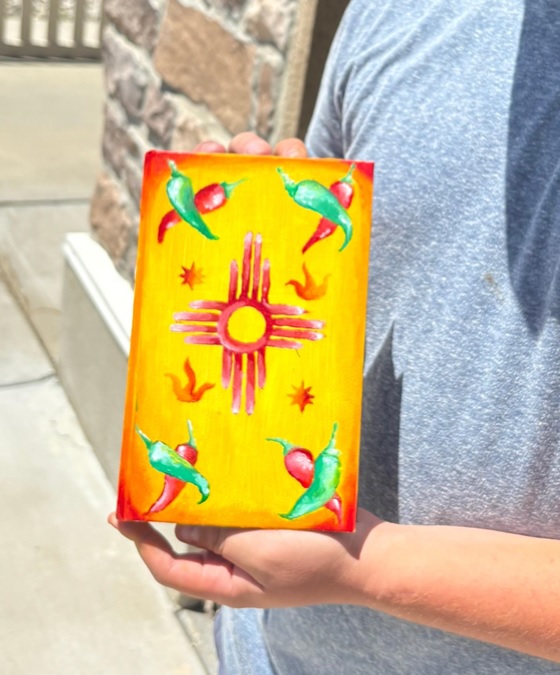
The Spirit prompted me to write a letter to one of my friends in his book. He later texted me, saying, “That message really meant a lot to me. I was going through a really hard time.”

I may never know how much receiving a painted book truly means in the moment. I’m sure my friends are grateful and think it’s cool. But I hope they realize later that it came from my desire to serve my Lord. As the scriptures say, “When ye are in the service of your fellow beings, ye are only in the service of your God.” I serve others because I love Him and because I love the people I’m serving.

I learned that darkness is necessary in life and art, and that creating without purpose and intention makes the process feel incomplete. Because I knew what it felt like to be disconnected from my gifts, I now treasure the connection between creativity and service. The gray numbness I experienced helped me recognize color and feeling as sacred gifts. The contrast is what makes it meaningful—the purple makes the yellow more brilliant.

Painting those books didn’t just reignite my love for art. It taught me, in the most tangible way, what it means to live a Christlike life—to embrace the full spectrum as He did. Christ is my ultimate inspiration for creating art and living fully. He is the first creator and encourages us to be creators as well. He is the light and the life of the world. His birth brought light, and his death brought darkness. He taught us that sadness is often the price we pay for lasting joy, and that the contrast itself is sacred.

That’s how you live a beautiful, full-spectrum life. It’s actually pretty simple—but simple in a grand way, as all profound truths are when you take everything else away. Not by avoiding the hard colors or muting them, but by embracing them as essential parts of the complete picture. When you do, you discover that the contrast isn’t just bearable—it’s beautiful, and it’s what makes life worth living.


A headshot of Aidan Pehrson.

Aidan Pehrson

Aidan Pehrson is a track-and-field athlete competing for Snow College. In addition to running, he enjoys painting, boating, surfing, and spending time with friends and family. He plans to leave on an LDS mission this summer.

    Filed Under: Articles, Craft Skills, Creativity, Faith & Mindset, Fine Art, Gospel Principles Tagged With: art, Inspiration, opposition

    Writing with Faith: An Interview with LDS Author Gale Sears

    November 27, 2025 By Kami Pehrson Leave a Comment

    Gale Sears’ path to becoming an acclaimed LDS historical fiction author began with writing screenplays. She earned a bachelor’s degree in playwriting from BYU and a master’s degree in theater from the University of Minnesota. For decades, Gale’s creative life revolved around the stage—acting, directing, and crafting stories for live audiences.

    “I didn’t start writing novels until I was almost 50,” she shares, yet storytelling had always been part of her nature. “When I was about seven or eight years old, just after I’d learned about words, we had a little shed out in our backyard in Lake Tahoe, where I grew up. It was a magical place. I’d go out there with paper and pencil and write stories.”

    Exploring Different Genres

    The transition from playwriting to novel writing came naturally. “I had a story in my head that I thought would be a very cool play, but it was kind of epic, and it didn’t fit the genre,” Gale explains. “So, I started jotting down thoughts and a skeletal outline of chapters for a book, which I’d never thought of before because my mind always thought in terms of plays. I had to learn a different writing process because plays are composed of dialogue, but novels must include descriptions of place and setting.”

    That story became Autumn Sky, the first book in a trilogy published by Covenant Communications.

    Writing as a Divine Calling

    For Gale, writing is a sacred practice, centered on divine guidance. “I pray constantly. I have no ego when I’m writing my books. I believe that EGO stands for Edging God Out, and I’m not ever going to do that. When I dedicate my work and consecrate it to His purposes, I must include Him in the process.”

    The Spirit guides Gale throughout her process. “It’s as if I’m walking along and all of a sudden, I stumble, and something makes me pause. I stop and say, ‘Okay, something’s wrong here. Either I’m pushing it too much, or I’m not telling the right story, or I’m not going in the right direction.’ That’s how I know.”

    The Power of Research

    This spiritual foundation shapes every aspect of Gale’s work, especially her research approach. She is tenacious about accuracy. “If you’re going to write historical fiction, it needs to be true to the history,” she emphasizes.

    For The Silence of God, which explores communism and Christianity in revolutionary Russia, she immersed herself in Russian history and communist theory. “I wanted to tell the story of what a society looks like when they rip God out of their lives,” she explains. She thought she’d have to create a fictional Orthodox Christian family—until she experienced what she calls a “God wink.”

    “I thought to myself, I’m never going to find an LDS Russian family back in that time,” she recalls. “Well, I was at the Church History Library and found this article about the Lindelof family—the one and only LDS family in Russia during the Bolshevik Revolution.” This moment of divine serendipity became central to the novel.

    For Letters in the Jade Dragon Box, set in China under Mao Tse-Tung, she studied Chinese culture and government systems. The book juxtaposes Mao’s communist regime with the gospel as experienced by early Latter-day Saints in Hong Kong.

    Belonging to Heaven draws from George Q. Cannon’s actual journal entries about his mission to Hawaii, exploring his relationship with Jonathan Napela, one of the first Hawaiian converts to the Church.

    Her novella, Brilliant, required research into autism, Indian culture, mathematics, and Eastern philosophy to authentically portray its protagonist—a young autistic college professor from India. Gale met with Indian families and individuals who understand autism and reviewed autobiographies to ensure accuracy.

    But Gale doesn’t just rely on books. She travels to the locations she writes about—Italy, Russia, Hawaii—with her husband, George, acting as photographer and videographer. She interviews people from the cultures she depicts and visits ethnic markets.

    “I’ll go up to people and say, ‘Do you have a minute? Can we talk about Indian food?’ or whatever I need to learn,” Gale explains. “Most of the time, people are gracious and thrilled to help.”

    “It’s so important in historical fiction that readers feel as though they’re there,” she says. Whether it’s the food her characters eat, the clothes they wear, or the streets they walk, Gale ensures every sensory detail rings true. Each book ends with an extensive bibliography and notes explaining the historical context. “I stick to the facts as much as possible, but if I need to deviate because of the story, I let readers know.”

    Blending Faith and Story

    When depicting conversations about faith, Gale uses a subtle touch. “I want to tell the story of God’s Saints in a way that all my readers can appreciate, and weave in Christ’s teachings without beating people over the head with the gospel.”

    For example, in The Silence of God, the LDS character Agnes discusses the law of consecration with her Bolshevik friend, Natasha, while chopping cabbage for borscht. The exchange feels natural rather than preachy. “You can push doctrinal discussions too far to where readers feel like they’re in a Sunday school room, or you can just put a little flavor of it,” Gale explains. “You have to honor your readers and trust that they’re smart enough to interpret the story through their own lens.”

    This approach has connected with readers beyond the LDS community. “I have a lot of readers who are not LDS who appreciate the structure of the story and how I involve Christ in it,” she says. Universal themes of faith, courage, sacrifice, and family resonate across religious boundaries.

    Writing Process and Craft

    Despite her theatrical background’s emphasis on structure, Gale describes herself as “pretty much a pantser.” However, she acknowledges the value of structure, particularly in historical fiction, where “the journey has to go through certain historical processes.”

    “Normally, I start with a character,” she explains. “Then I ask, ‘What is this character’s journey?’ With historical fiction, that journey is kind of mapped out for me.”

    Character development comes through revelatory moments. In Letters in the Jade Dragon Box, the protagonist, Chen Wen-Shan, receives a box from her grandfather containing paintings and letters. This catalyst unfolds her family’s story under Mao’s regime.

    Advice for Aspiring Writers

    For young LDS creators and writers, Gale offers perspective gained from her unique journey:

    • Don’t worry about starting late or about success, fame, or money. Just stay true to the story you’re called to tell.
    • Focus on impact, not numbers. If your book only touches 10 people, that’s wonderful. If it only touches your family and they love it, that’s wonderful too. Remember, it’s a success just to get your story down on paper…Well done, you!
    • Remember the importance of the individual reader’s testimony. You’re planting a gospel seed, and you may not see it grow, but someday the Lord will use it. Eternity is long.
    • Write stories that inspire. For example, if you’re writing fantasy, you can still include the quest for good against evil. Your character’s struggles and triumph can encourage and lift a young person who’s questioning their abilities and whether life is worth the effort.
    • Consecrate your work. “When I dedicate my books to the Lord, I say, ‘Lord, take this little offering that I’m making and do with it what you want.’ I might not have a huge readership, but that’s not my path, and I don’t really mind.”    

    A Legacy of Faith

    Gale’s work now extends beyond novels. Her children’s book, Christmas for a Dollar, based on her father’s experiences during the Great Depression after losing his mother and contracting polio, has been adapted into a Christmas movie.

    No matter what form her writing takes, Gale ensures it is an act of discipleship. She reminds fellow writers that life is a tapestry, and we’re only seeing the back side. In seasons of trial, the threads look tangled. But eventually, God will turn that tapestry around, and we will see His divine design. Until then, authors can help readers through difficult times by writing good stories that show them there is light ahead.

    “These stories, these people’s lives—what a blessing it is for me to be able to share them,” Gale reflects. “And hopefully, prayerfully, the stories will resonate with someone and help them and strengthen them. That’s what I want.” 

    Headshot of Kami Pehrson.

    Kami Pehrson

    Kami Pehrson lives with her husband and five teenage children in Stansbury Park, Utah. She recently finished her master’s degree in English and creative writing and has written three novels—but is still trying to figure out what to do with them. She loves editing, reading, and playing word games on her phone. She also enjoys listening to audiobooks while half-heartedly doing Pilates in the living room.


      Filed Under: Articles, Creativity, Faith & Mindset Tagged With: authors, interview, research, Writing

      The Art of the Interview

      November 14, 2025 By LDSPMA Leave a Comment

      As creators, one of the greatest tools we have is the ability to listen carefully and ask meaningful questions. The art of interviewing can help us open doors to understanding, build trust, and draw out authentic stories that uplift and inspire others.

      When I was going through BYU’s journalism program in the late 1990s, I was surprised to discover there wasn’t a class specifically on interviewing. Which seemed strange, because interviewing is half the job!

      So, I learned it on the job. Over the years, writing for a variety of publications, I’ve interviewed people from all walks of life: farmers, CEOs, investors, first responders, city officials, cancer patients, etc. I’ve interviewed people over the phone, through email, video calls, or in person; sometimes in a tractor or in a hallway after a city council meeting. Each format comes with its quirks, but the heart of interviewing is always the same: helping people share their authentic stories.

      For those of us who create—whether it’s articles, books, podcasts, or films—interviewing is a sacred opportunity to really see someone, listen with care, and draw out their inner truths. Here are a few lessons I’ve learned along the way.

      Making It Happen

      Tracking down an interviewee and getting them to commit can be the biggest hurdle because people are busy or hesitant. The key? Be flexible. Offer multiple times, be willing to adjust, and show that you respect their schedule. That first impression will help build trust.

      I’ve used a go-between person to contact my interviewee many times. For example, when I worked for an agriculture magazine, I found it hard to get in touch with farmers. As a farm girl myself, I knew that most farmers just wanted to be left alone. So, I’d usually have the dairy association or another trusted contact reach out first to vouch for me. They were much easier to get ahold of after that.

      Also consider mode of contact. Some people prefer email, others text, others a phone call. Be open to trying different methods depending on the person—it shows respect for their preferences and increases your chances of connecting.

      Set the Stage with Clarity and Trust

      People get nervous in interviews. They don’t want to be misrepresented or say something wrong about a topic that matters deeply to them. That’s why I start by sharing my goals: “I’m writing about X, and I hope readers will come away with Y.” My hope is to reassure them that the experience will be positive and that I want the same outcome they do.

      Once, I had to contact someone for a tragic story. As I spoke to the interviewee, I told them, “Readers want to know what happened. Take your time. Our goal is to help readers understand.” That moment reminded me that interviews offer a safe space for someone to share something deeply personal, even painful.

      A little transparency and compassion reassures people that you’re not trying to “catch” them      and that you’re on their side. Trust begins before the first question.

      Send Your Questions in Advance

      I don’t always do this, but in cases where I sense the person is apprehensive, it works wonders. When someone has time to think beforehand, they’re able to dig deeper. Instead of surface-level responses, they’ll share insights that come from reflection. That’s often where the most meaningful and memorable stories come out.

      Try not to send too many questions, however, as that can feel overwhelming. I usually tell people, “I’ll send a few questions to get your mind going, but I’ll also have some follow-ups as we go.” That balance gives them confidence without making the process feel daunting.

      Create a Safe Space for Conversation

      My interview style is very conversational. I always begin with small talk.
      I’ll ask about where they grew up or comment on something interesting in their background, whether it relates to the story or not. It helps them relax and feel like they’re talking to a friend rather than facing an interrogation.

      From there, I generally don’t talk a lot. I ask questions in a natural way (rather than sounding like they come from a list), and then I listen and react. “Really? That must have been amazing!” That connection sparks something between myself and the person I’m interviewing. In those moments, we are on the same team and have the same goal. And that feels good.

      When people sense that you genuinely care about them—not just their quotes—they open up. Their answers become longer, warmer, and more personal.

      Ask Open-Ended Questions—and Really Listen

      There’s a time and place for yes-or-no questions, like the courtroom. Many people equate that line of questioning as negative and aggressive. Plus, their answers don’t tell you much. Open-ended questions invite people to tell stories, and follow-up questions show that you’re paying attention.

      If someone apologizes for “sharing too much,” I always tell them, “The more, the better.” Giving them permission to share more allows them room to add details and even emotion. Sometimes the added information helps give the story more heart, or leads to stories in the future. That simple reassurance often unlocks beautiful details they might have held back otherwise.

      Note-Taking vs. Recording

      I started my career when note-taking was the norm, and it took practice to master. Through countless interviews, I learned to pick out important information. Over time, you develop a knack for what should be quoted (such as key points expressed in interesting ways) and what can be summarized (such as basic background details).

      These days, recording conversations and using AI to transcribe them is a game changer! Always make sure to ask permission before recording. Even when recording, I still take notes during the interview. It keeps me engaged, helps me stay focused, and provides direction when it comes time to write the story.

      Always Offer Your Appreciation

      Many people want to share their stories, but it’s not required. Your interviewee offered their valuable time and a piece of themselves. Follow up and let them know how much you valued their time, and when appropriate, share the finished piece. Gratitude also helps build relationships for future interviews and collaborations.

      The Takeaway

      I feel strongly as a journalist that the Lord wants me to learn from each person I talk to. And I have. Every conversation is an opportunity to learn and understand perspectives we might never have considered. For us creators, interviewing is a chance to practice empathy, patience, and kindness. When we combine diligence with heart in our interviews, we open doors to truth, understanding, and the power of shared human experiences.

      Carrie K. Snider

      Carrie K. Snider is a Phoenix-based writer. She grew up on a dairy farm and graduated with a degree in journalism from BYU. She has reported for the Deseret News, EastIdahoNews.com, Good News Utah, and others. Several of her articles have received Praiseworthy Awards from LDSPMA. Carrie enjoys hiking, swimming, and watching musicals with her husband and four kids.

        Filed Under: Articles, Craft Skills, Media, Film & Theater, Professional Skills Tagged With: asking questions, finding stories, interviewing

        A Conversation with Al Carraway

        October 31, 2025 By LDSPMA 1 Comment

        Al Carraway is a convert to The Church of Jesus Christ of Latter-day Saints, as well as a multi-award-winning international speaker and author of the books Wildly Optimistic, More Than the Tattooed Mormon, and Cheers to Eternity. She currently lives in Arizona with her husband, Ben, and their three children. For the past eleven years, she’s traveled the world telling her story of conversion and faith through difficult times.

        According to Al, “Joining the Church is the most personal thing you could ever ask of someone,” as you have to change the way you think while leaving behind traditions, culture, and more that were once all you knew. Al began navigating these changes as a newly baptized tattooed twenty-one-year-old, and found that many established members of the Church did not treat her well. Being productive rather than destructive in the face of obstacles has become her process, and paying attention to her recurring thoughts has helped her incorporate God in that process.

        Al has continually built her relationship with God since her conversion sixteen years ago. Whether mad, hurt, or confused, she’s honest with Him about how she feels and speaks to Him as though He’s right in front of her. During times when she’s felt He’s not there or not listening, she’s discovered that she simply hadn’t been willing to see how He showed up for her in ways she didn’t desire or expect. The adversary can get in our heads and alter our perspectives. Al fights his influence by being productive, by casting him out, and by removing the limitations she has placed on God while rooting herself deeper in her knowledge that He is real.

        As her relationship with God has developed, Al has learned that, for her, the unexpected and unwanted things in her life are always God intervening on her behalf. All good things come from God, and she finds reminders of Him in even the smallest of good feelings. “That is God participating in your personal life. That is you experiencing God.”

        Self-love has bridged the gap between insecurity and Al’s God-given purpose. As a writer and speaker, she doesn’t put stock in what others think of her, good or bad, because those opinions do not fill her. Allowing them to affect her can be disheartening and unmotivating. When she moved to Utah, strangers told her, “God could never love someone like you. Why would I ever want to date you? Who is going to marry someone that looks like that?” In recent years, Al continues to receive hate that sometimes escalates over extended periods. She trusts her relationship with God and does what He asks her to do, even if she knows she will face unpleasant backlash. She invests in loving herself and witnesses the ways God participates in her life. “Love God and serve Him and everything else is just noise. And when you do that . . . life just blossoms.”

        A few years ago, Al’s family lived in a single hotel room in New York for two months while looking for housing. COVID, insurance, and other circumstances beyond their control left her feeling helpless. When talking to God about how she had been left out to dry, God responded, “Why won’t you let me bless you? Why won’t you let me take you somewhere better? That’s why I exist.” Al has learned to let God show her how great He is through all her trials and seasons of life. While there may be plenty to be said about what Peter could have done “better” when walking on the water, the truth remains that Peter is the only one who got out of the boat and tried to get closer to Christ. When Christ said, “O thou of little faith,” it wasn’t to rebuke Peter for his shortcomings—it was in response to Peter doubting that Christ would save him. Christ was always going to rescue him.

        Not only will Christ rescue us, but He will also take us somewhere better, whatever that path might look like. Al shared, “Our God is one who only exists to bring us to greater magnifications.” She continues to work on trusting Him better, stating, “My favorite things have come from my sinkings.”

        Al also voiced, “Our God is not a god of avoidance and prevention.” How many miracles and conversions would be lost if God had prevented the suffering that preceded them? In every detail of our lives, God is working to keep His promises and prepare for us something better than what we want for ourselves, even in the middle of the suffering. Many times, Al has acted on a prompting that didn’t seem to pan out only to find significance in it with the passing of time. The point isn’t that God can calm the wind and water—it’s that we continue reaching for Him, even in the storm.

        Al is passionate about embracing a lifestyle that reflects God’s importance. She’s teaching her family to try new things, to invest in themselves, to be intentional with their time, and to talk to God. Even when they didn’t have much money, they would spend time together by getting in the car and driving, with or without a specific destination in mind. When someone says or does something hurtful, Al lets it hurt for a little bit, but she doesn’t let a bad day turn into a bad life. Her goal is to continually seek more ways to magnify her life.

        As for her old nickname, “the tattooed Mormon,” Al confesses that she has always hated it. Years ago, she received a blessing and was told that God does not see her tattoos. To Him, they do not exist. If He doesn’t see them, why should she care what others think about them? Ninety-nine percent of the time, she doesn’t think about them, and once people start to know her, they don’t seem to see them either.

        Loving herself and accepting the love of others, including God, continues to change her life. Al testifies that all of God’s future blessings for us are already prepared by Him. We are His, and that is all that matters in making us worthy. “That is everything.”

        This article is based on a Called to Create podcast aired season 2, episode 2. To hear the full podcast, click here.

        Filed Under: Articles, Called to Create Conversations Tagged With: faith, trials

        A Conversation with Lisa Valentine Clark

        October 17, 2025 By LDSPMA Leave a Comment

        Lisa Valentine Clark, a self-described “plucky, spirited gal from Lincoln, Nebraska,” graduated from Brigham Young University with a degree in English and began her career in the improv group The Garrens. Later, she starred in the movie Once I Was a Beehive, hosted the TV show Random Acts, published a book called Real Moms: Making It Up as We Go, and currently hosts BYUradio’s The Lisa Show.

        Lisa didn’t plan on being an actress, author, comedian, or podcast host. “I just sort of stumbled into my life,” she says. “[I had] lots of hopes and dreams, and I always knew that I would have a fun [and interesting] life, but the details were all very muddy.”

        Lisa met her husband, Christopher, in college. He had just returned from his mission in Finland, and she was the president of the English Society. Together they performed what she describes as a “really horrible, really cheesy” play called The Mysteries, which they took very seriously. It was a collection of Bible stories wherein he was cast as Satan and she was cast as a chicken on Noah’s Ark. Lisa recalls, “[I was] the best chicken, the most committed chicken. My mother-in-law, to this day, remembers my performance and asks me to do it regularly.”

        Lisa credits her parents with nurturing her creativity and willingness to be vulnerable. “My dad just made us laugh all the time. My mom didn’t take herself seriously. She was really super committed to whatever she did.”

         Still, growing up was sometimes difficult for Lisa, being “a little bit awkward” and feeling different because of her faith. “I always felt off, I think, like most people do.” Instead of feeling bad about her otherness, she decided to commit to it one hundred percent, embracing her self-deprecating humor. “I’ve collected people in my life that also love ‘their thing,’ but don’t take themselves too seriously.”

        While she and her friends are all artists, in the end, they all just want to make each other laugh. She says, “I don’t try to pretend that I don’t care…But I can’t control the outcome, or if people like it or don’t.” This confidence allows her to have fun with the people she cares about, taking her to exciting new places in life.

        Lisa’s open and honest approach to life enables her to connect with others and communicate with them in a relatable way. She doesn’t try to divide her life into categories or pretend that she or her family is perfectly put together. The image she portrays in public matches who she is at home. “Come into the fold. [. . . ] And let’s have a dinner party after.”

        This mindset has been a springboard to lift Lisa from dark times in her life, most significantly the loss of her husband in 2020 from Lou Gehrig’s disease (ALS). Lisa says, “You’ve got to really feel your feelings…the deepest, darkest lows crack you wide open to feel higher highs. And I do feel like there’s a purpose in it, and I don’t want to be, like, ‘Oh, there’s purpose in suffering,’ because I sort of hate myself when I say that. But I do think it is true.”

        Christopher’s terminal diagnosis meant that Lisa witnessed her talented husband slowly decline over four and half years. A trained classical pianist, he had always found joy and expression in music. Lisa remembers, “He closed the piano, and I said, ‘What are you doing?’ And he said, ‘My piano playing days are over. It was a good run…So now I just want to focus on [directing and doing] other things that I love.’” For Lisa, accepting that Christopher could no longer play the piano meant coming to terms with his impending death. She told herself, “This is happening. You’d better get with the program and learn how to carry this, or you’re going to fall apart every day. And you’re going to miss the joy that is surrounding you.”

        Even while Lisa was caring for him by brushing his teeth, dressing him, and getting him ready for the day, Christopher assured her that he didn’t blame God for his trials and helped her see that life isn’t fair for anyone. “[His outlook] really softened it and changed my whole perspective of God’s purpose for each one of us, how He loves us, how He trusts us, and what faith really means,” Lisa says. “Something that Chris taught me in going through this is that, no matter what we go through, God is with us. And I saw evidence of that every day. And then I was telling the kids, ‘Oh, do you see that? That means God loves us.’”

        Lisa expands her innate capacity for joy through humor, sharing that she and Christopher laughed together every day. “But when he needed to feel the gravity of his situation and the deep sense of loss, he felt it.” Sharing this balance with Christopher sustained her during the hard times.

        After his passing, Lisa carried these lessons into her own healing process. She admits that it’s not always easy to maintain a joyful attitude and that sometimes she would rather stay in her comfortable bed than face her grief. “I try not to let it ruin my entire day as it used to. I try to honor it and feel it for as long as I need to, and recognize that I’m not going to feel that way all the time.”

        Talking with supportive friends and family helps Lisa sort through her thoughts and emotions. She also stresses the importance of having a goal or purpose to give herself a break from the heaviness of life. Lisa recalls, “I haven’t played the piano for years, probably over a decade. And then about six, seven months after Chris died, I just was so in my head and not ready to see people or be in the world. And I started playing the piano again.” Learning a musical piece helped her focus on something good. “Those kinds of coping skills have saved my life.”

        Despite the challenges Lisa has faced, she maintains that life is not meant to be a punishment, but to bring joy. “We have the opportunity to show and share love,” she says. In the final weeks of Chris’s life, this was manifested in how people wanted to express their love to him, and how all he wanted to do was tell everyone how much and why he loved them. This experience deepened her conviction that relationships and expressions of love outweigh creative achievements and résumés.

        While she acknowledges that it would be easy to say “This is it” after such a profound loss, Lisa promised Christopher that she wouldn’t give up. “I feel called to create more relationships, better relationships with my children and friends…None of us knows how much time we have, and our time on earth is so precious and important.”

        Lisa’s journey has taught her to appreciate and create meaningful experiences for herself and others. “I feel that so passionately,” she says. “That includes art, right? It’s all-encompassing. But the real focus, I feel, is those relationships and how we show up for the world, because it does have a rippling effect.” She finds that humor isn’t just about punchlines—it’s about using the unique talents and gifts we are given. Making people laugh is inseparable from her faith, and in the end, she says, “It all boils down to love.”

        This article is based on a Called to Create podcast aired season 4, episode 17. To hear the full podcast, click here.

        Filed Under: Articles, Called to Create Conversations Tagged With: comedy, grief, overcoming

        Creating 3D Characters

        October 3, 2025 By LDSPMA Leave a Comment

        Characters can make or break your fiction. It’s imperative that you populate your story world with three-dimensional characters who feel real. Cardboard characters used merely to push your plot along will leave readers feeling empty. Satisfying fiction is filled with characters that readers believe could exist. The more realistic, the better.

        Readers don’t want flat characters. They want characters with dimension and depth. If you’ve ever seen Shrek, you might remember the scene when he tells Donkey that ogres are like onions. You want your characters to be like onions with lots of layers that readers are anxious to peel away as they get to know them.

        Discovery, depth, and dimension can help you create 3D characters that are memorable, compelling, and realistic.

        Discovery

        The discovery phase can be compared to an awkward but necessary first date. What would you notice on a first date? At the top of the list would be their physical appearance. Hair color, eye color, physical stature, accent, voice quality, clothing style, laugh, and even skin tone might be part of your character’s description. Do they smile much? Are their teeth crooked? Do they stutter? Is there a stain on his shirt? Is her hair unkempt? Filling out a character sheet will help you keep track of your character’s physical features and other details. You can download a free character sheet from my website.

        Another way to discover your character is to surf websites or use AI to find a model who most closely resembles the character in your mind. You can then refer to this image to make sure your physical descriptions are consistent throughout your story.

        I like to create a document with images of my characters, along with other physical descriptions like height, weight, body type, speech patterns, and clothing style. Sometimes I even use a celebrity’s appearance as the basis for a character. I print out this document and keep it close as I write the story.

        Remember, like a first date, this is all superficial. The physical descriptions only scratch the surface of your characters—don’t stop there. To effectively create compelling characters, you have to dig deeper.

        Depth

        You want to move beyond what is apparent to the eye and go deeper into the personality of your characters. One of the best ways to learn more about them is to interview them. Ask questions and listen to their answers. You might be surprised at what you learn. Ask them where they grew up, if they were happy as a child, which parent they were closest to and why, and if anything traumatic happened during their childhood. Interview them about school and ask which classes they liked best/least and why. Who was their hero? What music did they listen to? What was their favorite movie? What event most shaped their lives and why?

        Ask about activities in high school, friends, and those they didn’t like and why. Did they go to college? Marry young? Have children? Join the Army? Fight for a cause? Go into business? Spend too much money? Do they have a pet? Do they like to eat dessert before dinner? What happened in their lives that shaped them into who they are now? The more questions you ask, the deeper you’ll dive into their psyche. In order to fully understand a character’s motivations, you have to know why they are at this point when your story begins.

        You likely won’t use any of this information within your story, but you’ll be able to create a more developed character by doing this background work. To help you get started, you can download a free character interview on my website.

        My son was cast as the lead character, Edward Bloom, in the play Big Fish. Edward is a complex character, and my son spent a significant amount of time thinking about him and how he would react in certain situations. He thought about what emotions Edward might experience in different scenes. He put a lot of effort into developing this character, and the result was pure magic on stage. My son brought Edward to life and created an emotional experience for the audience.

        That’s exactly what you want for your readers. You want them to read the last sentence of your book, then sit back and continue thinking about your characters and your story for days to come. You want readers to experience your story themselves, and that’s what happens when your characters are fully developed.

        Dimension

        Now that you’ve dug deeper, it’s time to add even more dimension. This is where the characters become so real to you that you have a difficult time distinguishing them from people you actually know.

        When creating multi-dimensional characters, it’s important to think about how that character reacts or responds in situations. For example, if Jane learns that her best friend has just been kidnapped, how does she react or respond? Does she fall apart? Scream? Pass out? Yell at people? Call someone? Cry? Get mad? Go out and look for her friend? Is her response reasonable or over the top?

        How your characters react shows who they are and serves to characterize them more deeply. However, you also need to make sure the reaction fits the character (unless that is a specific device in your story—as in, he or she is having a mental breakdown).

        A character who is generally calm would not throw a chair through a window when he discovers his shirt wasn’t ironed. This aggressive reaction doesn’t fit the situation or his persona and will feel contrived unless there has been enough revealed about this character that the reader understands his reaction. Reactions are an effective way to deepen the characters in your stories and to help readers understand them.

        Look for ways to add dimension to your characters. One way to do this is to freewrite as if you are your character. When I’m stuck on a scene or don’t know how my character feels about something, I find it helpful to take out a notebook and pen and start writing. I’ll write the thoughts and feelings of my character and keep going until I get a better feel for my character in this scene.

        Freewriting means that you tie up and gag your inner editor. Set a timer for five minutes, then write, write, write. Don’t give yourself any rules or limitations—simply write. This technique can help you get to know your characters in unexpected ways.

        Characters Must Feel Real

        Your characters will feel more realistic and compelling when you discover their physical attributes, dig deeper into their personality, and add dimension through their reactions. The more time you spend on developing your character, the more that character will be believable. Character motivations, or reasons for doing what they do, will feel justified and understandable.

        Having three-dimensional characters will make your story come alive, so take the time to fully create them. Your readers will thank you.

        Headshot of Rebecca Talley.

        Rebecca Talley

        Rebecca Talley is the mom of ten children and nana of thirteen of the world’s most adorable grandkids. She lives with her family and her husband, Del, in Houston, TX, where she tries to avoid the heat and humidity by living in the pool.

        She has published thirteen novels/novellas, a children’s picture book, a chapter book, a writing resource guide, and numerous children’s stories and articles for both online and print magazines. When she isn’t writing, Rebecca likes to date her husband, play with her kids and grandkids, swim in the ocean, crochet, and dance to disco music while she cleans the house.

        You can find Rebecca’s websites here and here.


          .

          Filed Under: Articles, Craft Skills, Writing Tagged With: characters, description

          Using Music, Dance, and Drama to Combat Gangs and Criminality

          September 19, 2025 By LDSPMA Leave a Comment

          In a world that is increasingly filled with chaos, participation in the arts can be a valuable resource to maintain positive relationships, combat mental health issues, and give a sense of belonging. Our friend Rebecca Burnham from Summit Stages shares an interview she conducted with Jerry (J.J.) First Charger Jr. about his work with at-risk youth. We redacted some paragraphs for space, but you can read the full article here.

          Jerry (J.J) First Charger Jr. is a Blackfoot man from Kainai who is a hero to many young people, including some of my own children. I first met Jerry when I was helping in a community-building collaboration between Blackfoot and settler high schoolers in our area. Jerry was great with the kids, and enthusiastically helped them develop confidence in themselves and each other. I was also wowed by the breadth of his talents and his willingness to share them with us. He competently taught break-dancing, stage-combat, Indigenous singing, improv, acting and more.

          More recently, Jerry’s dance crew, the Westwind Thunders, made Global News (a Canadian network) on a dance tour where they mixed breakdancing and Indigenous styles of dance, (including hoop, fancy, grass, chicken and jingle dress and fancy shawl). I was able to attend one of their performances and was almost brought to tears. I was taken aback by the skill and stamina of the dancers, the joy I saw on the faces of the kids, and the beauty of the dances, especially those performed by Indigenous students in full regalia. My son, who had carried water for the Thunders working as an EA, said it was just as impressive to see how Jerry worked with the kids, that he “leads through pure rapport. The kids would do anything for him, and because of him they know they can do anything.”

          I was surprised and moved by the spiritual roots of Jerry’s approach to teaching and the degree to which personal experience has helped him relate and help so many young people and communities who have endured generations of persecution and personal trauma. Here is his story.

          Jerry was twenty-two years old when he woke up in a drunk tank in Cardston, Alberta. This was not a first-time experience. He didn’t remember what brought him there–but that wasn’t new either. Only a few months earlier, he’d gotten drunk to the point of black out at a family wedding and wound up severely beating up his little brother, only to wake up the next day with no memory of the conflict. It terrified and deeply shamed him that his brother could have died at his hands. Not knowing how to cope, he’d retreated even further into drugs and alcohol.

          Jerry asked the guard what had happened and learned that he’d been at the home of some friends who had wound up calling the police and did not want him coming back. He didn’t know what he’d done, but it was once again threatening his relationships. Why did he keep messing up like this?

          He had tried to get help and only gotten more alienated. He felt abandoned and angry at his family, friends and society. All of this had brought him here, sitting on the cold, hard floor of a drunk tank, scared and hopeless. In his distress, he prayed, and he heard an answer, an invitation to change his life. That wasn’t happening. He’d seen friends and family go to treatment, only to relapse as soon as they came out, a month, or even a year later.

          He thought about how his life seemed like a waste to this point. He wanted to be remembered as a good person, who helped others out, not as a menace to society, leaving wreckage in his wake. But he knew he couldn’t do it. He was too weak and he would fail.

          The Creator said, “You can change. Trust me.”

          “But how?” he asked.

          Again, he heard, “It can be done. Just trust me.”

          He had no arguments left. He agreed he would change, but only if the Creator agreed to never leave him. “Because if you do, I will fail.”

          “J.J., I will never leave you. I will always be there for you.”

          A few hours later, Jerry walked out of the drunk tank, never to return, “because of the love of the Creator and because I called my spirit back,” he says. He returned to church and the Creator, true to His promise, has been with him ever since.

          Seven years of sobriety later, Jerry got a call from a friend who said the Young Offenders Centre in Lethbridge was looking for a youth mentor to run a drumming and dance program for young inmates. He taught the youth inmates to sing, drum and dance. He found this to be a gateway to connection. He noticed that the youth came to trust him first as their music and movement mentor with whom they had fun, and that opened the door to honest discussions about personal responsibility and the power to change. Drumming, he has since learned, is correlated with resilience among war-torn people in Africa. He didn’t know that then, but he started seeing that same burgeoning resilience in the youth with whom he was working.

          Music, dance and drama gave him a natural way to teach the inmates that making mistakes is not a good reason to be beaten down. “Everybody makes mistakes. That’s how you learn and grow.” This allowed him to teach about choice and consequence as a learning rather than a punitive experience. Instead of using language like “good and evil” that tended to activate inmates’ shame and their fear of rejection, he taught about choosing between positive energy and negative energy. Jerry told the inmates that, “before you can help your children, you better fix yourself, take on some personal responsibility for your actions, be mindful and accountable.”

          Inmates loved it. They told him that his program was a sharp contrast to the rest of their prison experience. Among the things they said were, “We love coming to your programs because you make us think,” “You made me feel like I was not in jail. You took the walls away from me,” and “You helped me enjoy myself and learn that life can be fun again.” It was a novel approach to correction, but Jerry believed the system should be focused on rehabilitation, not punitive measures.

          Jerry began to work with kids who were struggling to cope with chaotic home lives, and with parents who feared having their battles with addiction, anger, and so forth revealed to a counselor in a system that they didn’t trust. Once again, music and dance were the gateway he needed to get into a position of trust from which he could help.

          One of the key tools he uses now is BBoying and BGirling (breakdancing). He has learned that it helps kids self-regulate. Breakdancing and hip hop were popularized as an antidote to violence in the Bronx, New York, when gang violence was so pervasive that you could get killed for crossing the street wearing the wrong colors. Former gang leader African Bambaataa persuaded other leaders to embrace the creative expression offered by hip hop as a way of pulling back from the brink of annihilation. Gang members started settling turf wars with dance battles instead of weapons. It allowed them to flex their muscles and show off how tough they were, but in a way that left them alive to better themselves and compete again another day. “The old school BBoys said that they were [so] busy practicing for the next battle that they did not have time to do criminal activities.”

          He speaks about one struggling student whose family would not let their boy anywhere near counseling. But they were happy to let Jerry teach him breakdancing and that helped the boy develop the supports he needed and the self-regulation skills to cope better at school.

          Jerry cites new understanding of the therapeutic power of play. “The experts in the field of therapy are pointing out that dance, art and play are effective tools for dealing with trauma. That is where the healing happens.”

          Filed Under: Articles, Cultural Diversity, Dance, Music Tagged With: dance, mental health, youth

          Twenty of the Most Confused Grammatical Terms

          September 5, 2025 By LDSPMA Leave a Comment

          We love English. Twenty percent of the world’s population speaks it, with about 400 million native speakers and 1.5 billion learning it as a second language. English blends and borrows words from many cultures and languages. It’s a linguistic melting pot. 

          English is fascinating! But let’s face it—it’s also really complicated. English is one of the languages with the most complex grammatical structures. And when you throw in spelling . . . well, English can be rough to nail down.

          But no worries! We’ve collected a list of some of the most confused grammatical terms in the English language. If you learn these, you’ll be speaking and writing English better in no time.

          A lot, Alot, Allot

          A lot is an adverb that means “much” or “frequent.”

          I go to the gym a lot.

          That is a lot of ice cream. 

          Alot is not a word. Don’t write it.

          Allot is a verb that means “to distribute” or “to assign a portion.”

          I will allot half of the posters to my business partner to hang up.

          After her speech, Dimitria will allot ten minutes for questions.

          Affect, Effect

          This one is tricky, but the main rule is affect is used as a verb and effect is used as a noun.

          The new machinery will affect the productivity of the plant.

          The effect of the lights is stunning.

          Among, Between

          Among is used for relationships of three or more items. Between is used for relationships of only two items.

          I can’t choose which among all my shoes to wear.

          I often stand between the stop sign and the fire hydrant when waiting for the bus.

          Assure, Ensure, Insure

          All three of these words are verbs that mean “to make sure.”  Though some of their definitions cross over, there are a few rules of thumb you can remember that will help you place the correct word in the right context.

          Assure removes doubt and suspense from someone’s mind. Ensure can be replaced with guarantee. And insure is mainly used for financial risk. Refer to Merriam-Webster’s dictionary for more examples and definitions.

          I assure my pets I will be home no later than 3:00.

          David ensures he has next week off work.

          Gemma will need to insure her new car. 

          Complement, Compliment

          Complement means “to complete.” Compliment means “to say something nice to or about someone.”

          Her red heels complement her shade of lipstick.

          Jane complimented Michael on his choice of tie for the evening.

          Every day, Everyday

          Every day is a noun or adverb. Everyday is an adjective and is used only before a noun.

          Erika teaches yoga classes every day.

          Erika’s everyday yoga classes will keep you invigorated.

          Farther, Further

          Farther refers to literal distances. Further means “more.”

          Jenna runs farther than Jared every time they jog.

          The team decided they needed to discuss the concept further.

          Fewer, Less

          If you can count it, use fewer. If you can’t count it, use less.

          The fewer pets  you own, the less hair you’ll find on the floor.

          The less flour Halley uses in the mix, the fewer pancakes she’ll be able to make.

          In to, Into

          Into refers to movement and is attached to a noun. When separated with a space, the in and to in in to are normally attached to other parts of the sentence than to each other. For example, in the phrase “call in to order food,” call in and to order go together more than in and to.

          Chloe stepped into the car.

          Please sign in to your computer.

          Its, It’s

          Its is a possessive pronoun showing ownership. It’s is a contraction meaning “it is.”

          The dog lazily gnawed at its bone.

          Kiana assures Luz that it’s happening sooner than she would think. 

          I.E., E.G.

          I.E. means “in other words.” E.G. means “for example.”

          When decorating my home, I prefer to use earth tones (e.g., greens, browns, and tans).

          When decorating my home, I prefer to use earth tones (i.e., warm and muted

          shades found in nature).

          Lay, Lie

          Lay can be replaced with “place.” Lie can be replaced with “recline.”

          After a long day, Noah wants only to lie in his bed.

          I lay six eggs in the carton.

          Like, Such as

          Like is used to give a comparison. Such as is used for specific examples.

          I have read many novels like Dracula, Twilight, and Carmilla. (This sentence implies that the reader has read novels similar to these but not necessarily these novels.)

          I have read many novels, such as Dracula, Twilight, and Carmilla. (This sentence implies that the reader has read these specific novels.)

          Lose, Loose

          These words are mainly mixed up because they are spelled so similarly. Loose is something that is not tight. Lose means “to be deprived of.”

          I lose my keys constantly.

          Stella has a loose tooth.

          Peak, Peek, Pique

          These words can be confusing because they are all pronounced the same. But they each have different meanings. Peak is the “top or apex of something.” Peek is “to take a quick glance.” And pique is “to excite or irritate.”

          Did you see the snow at the peak of the mountain?

          Jill peeked around the corner.

          That topic always piques my interest.

          That, Which

          These words are used pretty interchangeably in speech and writing, but here is the correct grammatical rule: Use that if information that follows is important and should not be taken out of the sentence. Use which if the information that follows can be taken out without changing the meaning of the sentence.

          The peach that is sitting on the end of the table is Gabe’s.

          My favorite fruit, which is a peach, is sitting at the end of the table.

          Their, There, They’re

          These are common words in English and are often confused because they are all pronounced the same. Here’s the difference in their meaning: Their is a possessive pronoun showing that more than one person or thing owns something. There is the opposite of here. (You can remember that because they are almost spelled the same.) They’re is a contraction for “they are.”

          The new car is their blue Subaru.

          You won’t find the blue ball over there.

          They’re as tall as my sister.

          Than, Then

          Here’s another set of words that gets confused because they are often pronounced the same way. Then is linked to a sequence, normally “if . . . then” or “first . . . then.” Than is used for comparisons. 

          If you think you can beat me, then give it your best shot.

          Peter is faster than Sam.

          To, Too

          These words are pronounced the same way and almost spelled the same way too! The difference is that too means “also” or “an excessive amount,” while to is used in every other instance. We won’t list those because there are a lot of them. 

          Vanilla Coke is my go-to drink.

          Do you want to come to my house a quarter to one?

          Annelise is wearing red too.

          That is too much ice cream to eat in one sitting.

          Your, You’re

          These words are pronounced the same but have different usages. Your is a possessive pronoun showing that you own something. You’re is a contraction meaning “you are.”

          You’re going to your grandmother’s tomorrow after lunch.

          Your sweater you’re wearing obviously shrunk in the dryer.

          The examples above are just some of the many grammatical terms that are commonly confused in the English language. But now you have a succinct list to look back on if you get confused. Keep practicing your grammar, and with the help of this tip, you’ll be a grammar master in no time!

          We would like to thank Breanna Call and our friends at Ever Editing for allowing us to share this article with you. To read the other great articles they’ve written, click here.

          Filed Under: Articles, Craft Skills, Writing Tagged With: grammar, Writing

          • « Go to Previous Page
          • Page 1
          • Page 2
          • Page 3
          • Page 4
          • Interim pages omitted …
          • Page 32
          • Go to Next Page »

          Footer

          • Email
          • Facebook
          • Instagram
          • LinkedIn
          • YouTube

          Copyright © 2026 LDSPMA. All Rights Reserved. LDSPMA is not endorsed by nor affiliated with The Church of Jesus Christ of Latter-day Saints.