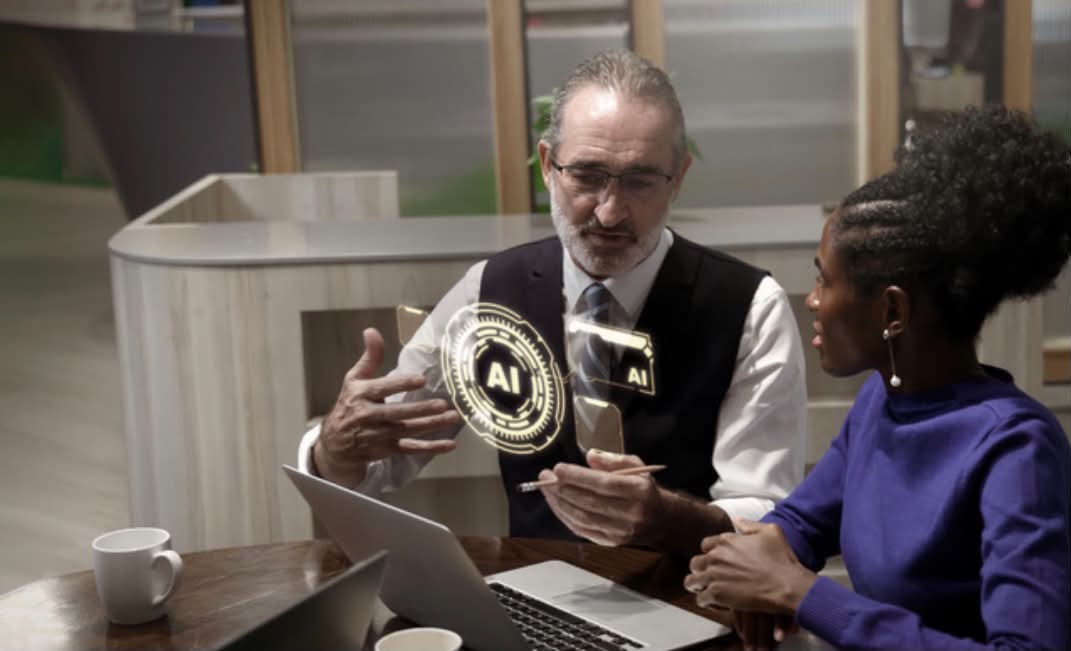
The title of this piece is audacious. Is it possible to “catch up” to artificial intelligence? What does that really mean?
It’s easy to become fearful that AI will take over the world, making human beings obsolete and eventually extinguishing us. But many secular and religious leaders are finding ways to embrace AI while working to establish adequate guardrails and fail-safes.
Checks and Balances
The concept of AI verifying AI activities, such as professors using AI tools to check student homework for unapproved AI usage, reminds me very much of how we humans must check each other as we seek mutually beneficial arrangements for societal interactions.
According to James Madison in Federalist No. 51:
It may be a reflection on human nature, that such devices [checks and balances] should be necessary to control the abuses of government. But what is government itself, but the greatest of all reflections on human nature? If men were angels, no government would be necessary. If angels were to govern men, neither external nor internal controls on government would be necessary. In framing a government which is to be administered by men over men, the great difficulty lies in this: you must first enable the government to control the governed; and in the next place oblige it to control itself. A dependence on the people is, no doubt, the primary control on the government; but experience has taught mankind the necessity of auxiliary precautions.
Interesting, but not surprising. Humans are the creators of AI, so it stands to reason that the same checks and balances needed for us are needed for our AI tools, especially as they become more agentic.
Keeping Fluent
The word “agentic” requires a brief pause for some definitions. If we’re going to participate in the conversation, we need to understand the language. Here are a few terms we need to familiarize ourselves with regarding the current capabilities and limits of the technology:
- Agentic AI – AI that autonomously plans, reasons, and acts toward goals
- LLM (Large Language Model) – AI trained on vast text reservoirs to predict the next word (e.g., Grok, ChatGPT, Gemini, etc.)
- Multimodal AI – AI that handles text, images, audio, and video
- Emergent Abilities – Skills that appear unexpectedly (e.g., ChatGPT-4 suddenly solving math)
- RLHF (Reinforcement Learning from Human Feedback) – Human-ranked outputs that lead to model improvements (used in Grok, ChatGPT, Claude, etc.)
- Hallucination (also called False Correction Looping) – AI fabricating false information when it can’t find valid sources to fulfill its prompt
- Authority Bias – AI using ranked sourcing to determine outputs, effectively siloing users into echo chambers with decreased exposure to valid alternatives
- Novel Hypothesis Suppression – A process whereby new discoveries are deemed improbable by algorithms and then over-critiqued or excluded
- AGI (Artificial General Intelligence) – AI that can perform any intellectual task a human can; currently hypothetical
- ASI (Artificial Super Intelligence) – AI vastly smarter than humans in all domains; currently hypothetical
Some of those prospects are a bit daunting in their implications, but panic will not help us. AI is not, and cannot become, God—the true “Intelligent Designer.” Once we better understand that a loving, interested God created us in His image for a powerful, eternal purpose with a vast—mostly untapped—potential, we will realize that AI should be neither feared nor abused.
The Response of Faith Leaders
An apostle of The Church of Jesus Christ of Latter-day Saints, Elder Gerrit W. Gong, is helping oversee the evolving role of AI use in sharing faith-based messages. While attending the Rome Summit on Ethics and Artificial Intelligence at the Vatican on October 21, 2025, Elder Gong declared:
Portraying faith traditions accurately or respectfully is not an imposition of religion on AI. Rather, it is a public necessity. It is especially needed as increasing numbers of individuals ask AI about faith and belief, and as AI becomes a primary source of information about faith traditions.
Furthermore, he affirmed, “We do not fear AI, nor do we think AI is the answer to everything … AI is neither the sum of, nor the solution to, all our opportunities or problems.”
Job Market Impacts
As an author, I have some obvious concerns about AI “taking over” my industry space. It’s already making inroads in books, painting, music, movies, and other creative fields.
At the same time, AI is changing the job market more broadly. It is already automating routine work such as data entry, customer service, administrative tasks, and bookkeeping, while creating new roles involving things like prompt engineering, AI ethics, and managing AI systems.
The World Economic Forum projects that by 2030, AI and other technological changes could displace 85 million jobs while creating 97 million new ones. I’m a little dubious about whether the numbers will really work out that neatly, but history suggests that major technological upheavals can eventually create new opportunities as well as eliminate old ones.
Obviously, things are still evolving, so the target keeps moving. New guardrails are being created by industry groups, governments, and others, and it will be interesting to witness—and participate in—how all of this shakes out over time. Progress is never easy, whether in society or in our personal lives.
Conclusion
Perhaps “catching up” to AI isn’t really about knowing everything AI can do. That may be impossible. It may be about making sure that as the technology advances, we don’t leave our human judgment, creativity, ethics, and responsibility behind—or forget that our worth and purpose come from something far greater than our productivity and efficiency. AI may change how we work and create, but it doesn’t have to determine who we are or what we value. If we can use AI without allowing it to use us—or define us—we’ll discover that this disruption brings not only challenges, but opportunities.
I’ve challenged myself to become more conversant with AI. My intent is to become part of good, meaningful solutions, and my eyes are wide open to the fact that this journey will be both challenging and long. Not all that long, though. This technological revolution is moving much faster than previous ones, so keep those seatbelts tightened.

Michael House
Author, LDSPMA President




Leave a Reply