Can you really spot AI writing? Here are the subtle clues to look for.
One of the biggest topics being debated in the writing world is how to approach or handle AI in writing. On one hand, AI can be an incredibly helpful tool for authors. It can help brainstorm, organize research, spark ideas, explore alternative verbiage, help you remember how to use a certain phrase—all things that most people agree can boost the writing process in a great way.
On the other hand, there are many fears about AI writing becoming a replacement for real writing—whether that means writers relying on AI or AI replacing humans altogether.
The key is to use AI responsibly and not let it replace your own voice. Readers can tell when AI has been used too freely, even if they don’t immediately recognize what’s off. When people copy and paste whole paragraphs of AI-generated content, that’s when inaccuracies, fabricated sources, awkward phrasing, or overly formal styles are noticeable.
Why Should Writers Learn to Recognize AI Writing?
Why is it important for writers and readers to recognize AI writing? Here are a few reasons:
To Stop Misinformation
AI can and has spread inaccurate facts and information in the publishing industry.
Imagine following a top summer reading list published by multiple newspapers only to realize that 10 of the 15 books were just made up by AI and, worst of all, were attributed to real authors. That actually happened in May 2025 in newspapers like the Chicago Sun-Times and The Philadelphia Inquirer. Notably, the fake reading list was published just two months after the Chicago Sun-Times had announced that 20% of its staff had accepted buyouts as the paper dealt “with fiscal hardship.” Naturally, subscribers were outraged, and the situation sparked debates online about publishing standards and credibility in a time when AI is being used more and more.
Now imagine browsing books on Amazon, finding an intriguing one with numerous positive reviews, only to realize the reviews seem to be written by AI. And maybe the book itself is AI-generated. That is all too common now.
AI-written “companion” books (summaries, workbooks, and guides of legitimate books) are also becoming a widespread problem on Amazon. These low-quality books are designed to piggyback on the success of new, human-written books by using nearly identical titles and the original author’s own name. By the time these books are caught and taken down, damage has already been done in the form of stolen sales, ruined reputations, and confused readers.
Recognizing AI writing helps writers judge the trustworthiness of certain sources and ensure the accuracy of references. This is especially important for authors of nonfiction books.
Generative AI chatbots are designed to be very agreeable, and their responses to prompts sound very authoritative and convincing, even when they are completely wrong. Many writers—or, unfortunately, their readers—are finding that AI boldly cites sources that don’t exist, attributes fake quotes to characters, or proclaims wrong details as truth. Authors, reporters, and lawyers who have relied on AI to assist them in writing have taken public hits to their reputations for publishing incorrect information. Learning to spot AI writing can help authors choose credible and real sources.
To Protect the Revision Process
Some authors have paid for beta reading services only to discover later that the “feedback” was produced entirely by AI. The so-called beta readers confidently referenced sentences and ideas that didn’t exist anywhere in the manuscript, leaving the authors with wasted time and money, not to mention reduced confidence in the revision process.
Being aware of AI writing could help authors—especially those self-publishing—put safeguards in place to find beta readers who won’t use AI and to spot AI-generated feedback.
Some ways authors can carefully vet beta readers include reading detailed client reviews instead of relying on five-star ratings, utilizing reputable author circles for recommendations, and exchanging a small sample at first. Authors can also request examples of the reviewer’s work, use AI content detectors (imperfect as they currently are) as a preliminary screening tool, and request to pay for services after the feedback is received. For more on this topic, see 7 Ways Writers Can Prevent Beta Readers From Submitting AI-Generated Feedback.
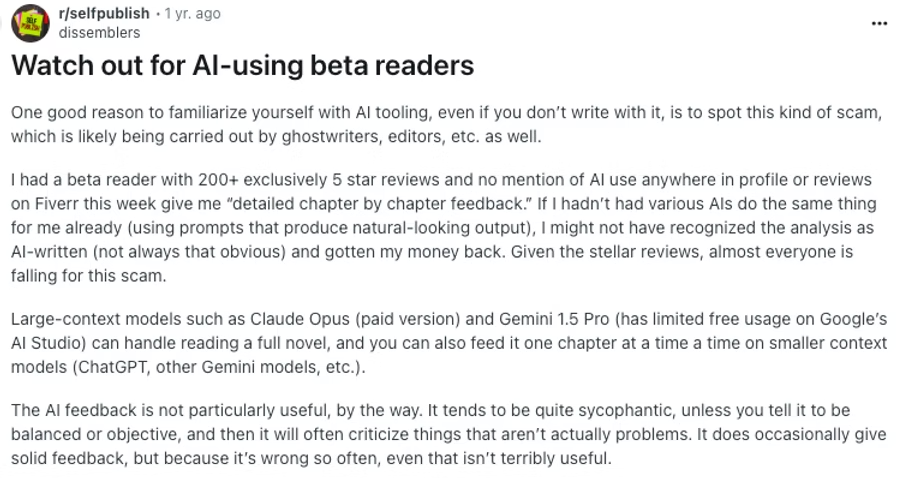
Occasionally checking out publishing forums, such as r/selfpublish, is a great way to stay informed on recent trends and pitfalls in the publishing industry.
To Preserve Creative Writing
From deciding to engage with a lengthy post on Reddit to picking a book, readers want to read content that is original, nuanced, relatable, and real. Aka, the kind of content that comes from lived experience.
Almost every piece of published creative writing comes with an unspoken agreement between writer and reader: that it is written by another person. We care that care has been put into the media we consume and become invested in.
AI can suggest ideas, but it struggles to form cohesive storylines or maintain consistent character and plot threads. Writers who can see these shortcomings can better appreciate the skill they bring to their own work.
How Can Writers Recognize AI Writing?
When it comes to AI writing, there are no hard and fast methods to determine if a piece of text is, in fact, AI. AI-detection software is getting better, but so is AI. The only indisputable way to tell if someone is using AI models, like ChatGPT, Copilot, and Gemini, in their writing is if they forget to cut out their prompt.
But the more AI-generated content is used in online discourse, social media, emails, and even creative works, the better we are getting at identifying it. This is because people are wired to recognize faulty patterns, inconsistent tones, and unnatural expressions. That’s why the concept of the uncanny valley—when something looks or sounds almost human, but feels slightly off—is a thing we pick up on fast.
You can also identify multiple clues found in AI writing patterns that indicate the writing likely wasn’t written by a human. If you see a few of these clues in what you’re reading, be wary of the source.
First Clue: A Dramatic Change
The best clue might ultimately be familiarity. If a person’s writing style shifts dramatically within the same piece of content, or if they use more complex vocabulary or grammatical phrases than usual, it stands out. A sudden shift in tone, style, verbiage, etc., is something to take note of.
Second Clue: Frequent Em Dashes
A common attribute of AI-generated writing is its frequent use of em dashes. It is no surprise that AI favors em dashes, since AI models are trained on real human writing. And writers love em dashes!
Em dashes are some of the most versatile punctuation—they can function like a colon, semicolon, parentheses, or even comma. Those of us who love to write probably use em dashes on an hourly basis; however, the general public does not—especially on social media.
Because em dashes are easily identifiable, a piece of informal content like social media posts or articles that are filled with them may be an early indicator that AI was used, because humans likely wouldn’t use em dashes in these contexts as much.
Third Clue: Overly Formal and Structured
Remember the structured paragraph essay format you were taught in school? Introduction (broad overview and thesis statement), body paragraphs (supporting details and transition phrases), and conclusion (restatement of introduction). That structure was designed to teach students how to organize their thoughts clearly and is still used in professional reports, proposals, and academic-adjacent writing. But in everyday situations, few people write this way. AI, on the other hand, often does.
AI tends to default to professional or academic language. It favors grammatically perfect sentences with predictable connectors like “furthermore,” “in addition,” or “it’s not x but y.” While these phrases aren’t wrong, their overuse can make the writing feel stiff, robotic, and overly polished. The issue is when this formula shows up in places where writing is usually more flexible, like emails, social media, casual articles, or creative writing. The rigid structure of the formula throws the casual tone off.
In short, if the writing feels like it came out of a textbook or a standardized test—especially in places where a looser or more conversational tone would make sense—it might be AI.
Fourth Clue: Surface-Level Substance
AI-generated writing tends to lack substance. This is partly because AI is trained to predict what sounds plausible or typical, not what’s nuanced or new. As a result, its writing often resembles marketing copy: agreeable and inoffensive. But unlike marketing copy, which is typically concise and snappy, AI-generated writing tends to be verbose and overly relies on metaphors to explain simple concepts. You’ll notice familiar buzzwords, vague clichés, and an overall upbeat tone that avoids conflict or complexity.
In sum, it’s writing that wants to please everyone.
Fifth Clue: No Mistakes/Too Perfect
We’ve all encountered the red or blue lines that show up under our misspelled words or incorrectly formatted phrases. And what are the programs that mark our mistakes powered by? AI. So it makes sense that AI-generated writing rarely contains typos, misspellings, or incorrect grammar.
But flawless grammar and punctuation just isn’t part of the writing process, especially in early drafts. And flawless content is often not the goal in the first place. People bend grammar to sound more natural or to make a point or to simply be creative. We start messy and then revise. We leave a sentence fragment for emphasis. AI can’t make those intentional deviations effectively.
So, when you encounter flawless and overly professional or stiff text on places like social media, that may be an indication of AI.
Authors can use AI to support their work, but they must do so responsibly—for their readers and themselves.
These are all helpful clues—but that’s all they are. Even when several signs point toward AI, there’s still plenty of room for doubt. Writers who use em dashes and ensure their writing is error-free shouldn’t feel afraid that their work will be confused with AI. Unless you have hard evidence, it’s best to assume the writing came from a human.
Make AI a tool, not a replacement. At the end of the day, readers love, value, cherish, connect with, and pay for books written by humans.
This article was written by Amy Guan and was republished with permission from Ever Editing.

Amy Guan
Co-Owner and Managing Partner, Ever Editing


