• Skip to main content
  • Skip to footer

LDSPMA

Empowering Latter-day Saints to spread light and truth by connecting them at the intersection of faith, creativity, and professional skill

  • Conference
    • 2026 LDSPMA Anthology Submissions
    • Theme Contests
    • FAQs
    • Exhibitors & Sponsors
    • Volunteer at the LDSPMA Conference
    • Past Conferences
      • 2025 Conference
        • Sessions
        • Workshops
        • Awards Gala
        • Internship Fair
        • LDSPMA’s Got (Secret) Talent!
      • 2024 Conference
        • Sessions
        • Workshops
        • ZIFF Networking Dinner
        • Schedule
  • Membership
    • Email Sign Up (Free)
    • LDSPMA NextGen
    • University Chapters
    • Facebook Group
  • Programs
    • Mentoring Program
    • Monthly Zoom Discussions (Free)
    • Master Classes (2026)
  • Podcast
    • Watch
    • Listen
      • Listen on Apple Podcasts
      • Listen on Spotify
      • Listen on Buzzsprout
    • Called to Create Conversations
  • Articles
    • All Articles
    • Faith & Mindset
      • Gospel Principles
      • Creativity
      • Productivity
    • Craft Skills
      • Writing
      • Media, Film & Theater
      • Podcasting & Speaking
      • Music
      • Fine Art
    • Professional Skills
      • Editing
      • Publishing
      • Business
      • Cultural Diversity
      • Marketing
  • Awards
    • 2026 Award Nominations
    • Praiseworthy Awards
    • Spark Awards
    • Lifetime Achievement Awards
    • Past Award Winners
    • Apply to Be an Awards Judge
  • About
    • Mission
      • LDSPMA in the Media
      • Success Stories
      • Viewpoint on LDSPMA
    • LDSPMA Leadership
    • Volunteers
      • Volunteer Year-Round
      • Volunteer at the LDSPMA Conference
      • Apply to Be a Presenter
      • Apply to Be an Awards Judge
      • Resources for Current Volunteers
    • Policies
    • Contact US
  • Support LDSPMA
    • Donate
    • Volunteer

Posts Archive

Val Bagley: Precious Things of Every Kind

August 23, 2024 By LDSPMA Leave a Comment

Shortly after moving from our Utah home and settling near the Idaho/Wyoming border, I entered the Star Valley Temple with my husband and was greeted by a humble-looking man in a white suit, who scanned my recommend and welcomed me to the House of the Lord. I glanced at his tag and recognized his name right away.

“Val Bagley?” I said. “The artist?”

He gave me a small smile, said yes, and indicated which way I should go to find the changing room. The message was loving and clear—we were there to serve the Lord, not to chat about our outside lives or careers. Later, when my son served as a missionary in the temple, Brother Bagley was his shift leader, and continued to set a positive example of service and dedication to the task at hand. I did, however, have the chance to talk to him about his career on another day.
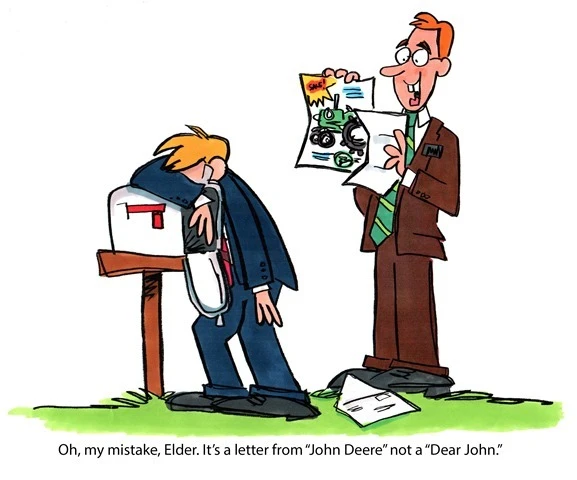
In 1978, the New Era magazine featured a cartoon drawn by LDS artist Val Chadwick Bagley. It was the first of more than a thousand cartoons he would draw for both the New Era and the Friend over the next 46 years, beginning an unexpected career.

“Pretty much most of my life, I’ve known what I wanted to do for a living,” he said on the occasion of his fortieth year in the industry. “I just didn’t know it would be drawing for the Church.”

His very first piece of art to be recognized in a Church magazine was actually published in the Friend when he was seven years old, but he threw his copy of the magazine away because he felt he could do better.

While serving as a missionary, he was assigned to be the mission public relations director, and he used his talents to fulfill this task. He drew pictures of visiting general authorities and illustrated the mission newsletter, and it was during this time that his first “official” drawing was accepted by the New Era, and he burst onto the scene.

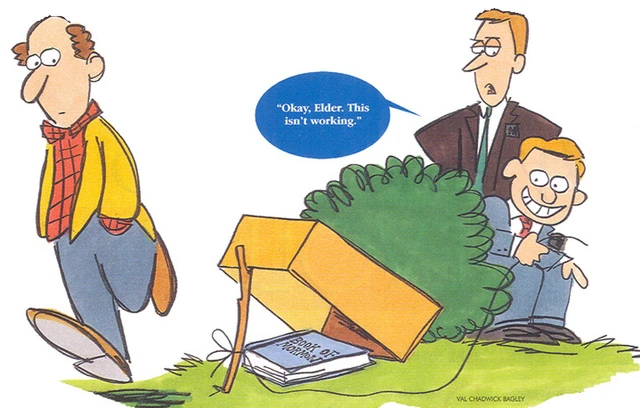
Whether or not you’re familiar with his name, his unique art style sets him apart and makes him immediately recognizable. His characters have a youthful look—wide eyes, rounded angles, and stylized hands and feet. Those characters point out some of the gentle humor to be found in our church—always appropriate to the moment, never mocking, but recognizing that we do have funny moments as a people and celebrating that humor through art.

“My cartoons may be gospel-related, but they don’t have anything really to do with the gospel itself,” he shared. “For the most part, my cartoons are about people living the gospel, not the actual teachings themselves. I already know the New Era would never print a cartoon that made light of sacred things, which I wouldn’t draw anyway.”
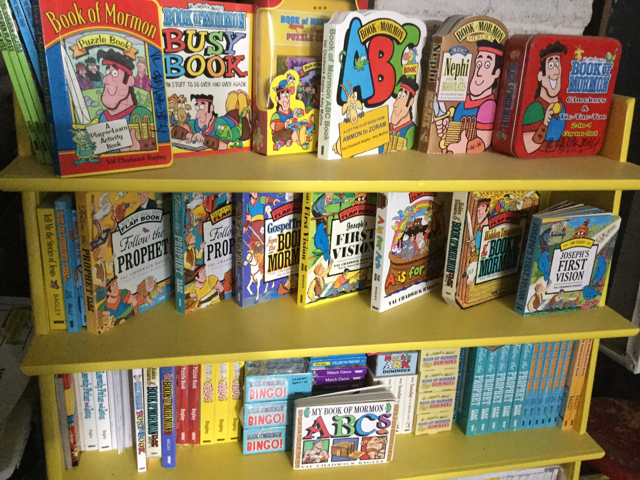
Although starting as a magazine cartoonist, Val has since published several children’s picture books on a wide variety of topics, and also card games for LDS families. He does all this from a studio set in the peaked-roof attic of his house in Wyoming, where I was privileged to visit about a year ago with my family. The walls and the ceiling are covered with pieces of his original art, both published and some in various draft stages. His drawing table faces a window that looks to the east toward the mountains; not only a source of light for his work, but inspiration for his art. His home is just as bright and cheerful as his cartoons, decorated in a vintage fifties’-era style that’s both whimsical and inviting, exactly the sort of home you’d imagine an artist to have.  

He has achieved success in his chosen field now, but after returning from his mission, he struggled to know if art—particularly cartooning—was the path he should pursue. He attempted college, but they weren’t teaching the things he wanted to learn, and his instructors encouraged him to give up and turn his attention to “serious art.” One day, while reading the Book of Mormon in the temple waiting room, he opened to Helaman 12:2:

Yea, and we may see at the very time when he doth prosper his people, yea, in the increase of their fields, their flocks and their herds, and in gold, and in silver, and in all manner of precious things of every kind and art . . .

The word “art” stood out to him, and he recognized that yes, there was a place for him and his unique talent. He had been drawing labels for cheese, but with this newfound conviction about his purpose, he approached Covenant Communications with the illustrations for a coloring book, which was published in 1992, and he continues to publish with them to this day.
I asked Brother Bagley what advice he would offer to artists hoping to break into the field. He laughed and said that he’s still trying to make it big himself and could use a little advice as well, but he offered the following tips:

  • Practice, practice, practice. “Although I’ve always loved to draw cartoons, it took years and years of practice,” he said. “I would copy other cartoons that I liked and admired (Snoopy, mostly) until I developed my own drawing style.”
  • Draw consistently. “I kept four cartoon journals on my mission (one for every six months), and that is when I really refined my drawing style.”
  • Discover your intention. “I’ve never been a ‘doodler.’ I draw with purpose. My cartoons usually are telling a story or mean something. I don’t just draw to draw.”
  • Keep going despite rejection. “I’ve illustrated/written over 100 books which have sold over 1,000,000 copies, but I still get rejected 75% of the time.”

My biggest takeaway from my time spent with Brother Bagley is the importance of seeking the Lord’s partnership whenever we undertake a piece of art meant to glorify Him or teach others about Him. Val Bagley is a humble man who speaks often of prayer as part of his creation process, and truly, when we do things in the way the Lord would have us do them, we can’t help but inspire those around us.


A headshot of Tristi Pinkston.

Tristi Pinkston

Tristi Pinkston is the mother of four, the wife of one, the author of one hundred and seventy-five, and the editor of oodles. She serves as the chairman of the board for the Bear Lake Arts Council and participates enthusiastically (if not with utmost skill) in their theatrical productions. She is currently the editor-in-chief for the resource library here on the LDSPMA website. You can learn more about her on her website.

    Filed Under: Articles, Craft Skills, Fine Art Tagged With: art, cartooning, drawing

    August 13: Authors & AI – Navigating Ethics, Benefits, and Tactics

    August 10, 2024 By Jeremy Madsen

    Scott T E Jackson

    With Scott T. E. Jackson

    Tuesday, August 13, 2024, 12:15–1:15 pm Mountain Time

    We’ll explore the transformative role of AI in the writing world. From ethical considerations to practical tactics, you’ll gain a well-rounded understanding of how to integrate AI into your writing process while maintaining your unique voice. Whether you’re curious about AI’s potential or concerned about its implications, this talk will provide you with the insights needed to make informed decisions. [Yes, this description was written with AI.]

    Bio: Scott T. E. Jackson is an author and marketing professional. Scott directs the digital advertising efforts for 18 partner businesses at Revity Marketing in American Fork, where AI and content marketing [read: “writing”] are evolving daily. Scott is passionate about writing and has published and self-published titles in fiction and creative nonfiction, most recently with Cedar Fort. He lives in Springville, Utah, with his wife and two children.

    Watch the Zoom Recording
    See Scott’s Slides

    Summary and Key Takeaways

    What is A.I.?

    • Artificial intelligence is essentially creating groups of mathematical formulas that “learn” by finding patterns in data.
      • They can identify patterns, compare patterns, and imitate patterns.

    Morals, ethics, laws

    • As we deal with A.I., we need to keep in mind (1) morals, (2) ethics, and (3) law. These overlap but have differences.
      • Morals: What you personally believe is right or wrong to do
      • Ethics: Code of acceptable behavior defined by the group you belong to
      • Laws: Systems of formal rules enforced by government entities
    • The ethics and laws around AI are in constant flux and can differ between communities or countries. We’re still figuring this all out as a society.
    • To help navigate your own morals and ethics around AI use, start with your “Why.” Why are you running your business or creating what you create? That will help govern your “how” (how you use AI) and “what” (what you use it to create)

    Issues of AI in the creative space:

    • Devaluing writing as an art or skill
    • Oversaturating the writing market with fluff and dross
    • Loss of your own creativity
    • Formulaic plots, characters, dialogue, etc.
    • Whose words is it stealing?
    • Worry about falling behind if we don’t use AI

    AI is a super power. “It’s not a super power unless it can be used for evil” (quote from Hooked by Nir Eyal)

    AI is the newest iteration of the age-old debate and tension between art and business. (Is “writing to the market” bad art? Is asking AI to “write to the market” bad art?)

    Scott’s advice about using AI in your workflow:

    • Use AI tools to support your existing creative model and workflow.
    • As a solo-preneur, there are many, many tasks that you either need to do yourself or hire someone to do. Identify tasks that you would hire someone else to do if you have the money. These are the tasks you could probably have AI help you with.
    • Don’t be rigid in your position about AI. Play around and experiment with different tools, and different ways to use those tools, before making a judgment on whether you can or should or should not use something.
    • Ethical uses of AI with writing:
      • Idea generation and brainstorming (“Give me ten concept ideas for a young adult sci-fi novel”)
      • Research assistance (“How did medieval catapults work?”)
      • Editing and proofreading (“Analysis this blog post and suggest ways to improve the tone, flow, or organization)
      • Creative problem solving (“My characters are trapped in a dungeon with their hands tied. Come up with ten ideas for how I can free them in the next chapter.”)
      • Outlining (“I want to write a post about
    • Rather than spending your efforts tweaking your prompt to be exactly right, just test and iterate with a bunch of various prompts. Test out a bunch of options. You’ll learn through iteration what works and what doesn’t.
    • What is your final goal? What do you want READERS to take away with? How do you want your work to transform them? Use that to inform how you shape your product.
    • Your output is as good as your prompt. Things you can include in your prompt:
      • Persona: Who is the AI writing as? (e.g. “You are a Latter-day Saint writer and speaker who focuses on motivating youth”)
      • Context (“You are writing a collection of daily words of affirmation meant to help Latter-day Saint youth development mindfulness, emotional resiliency, and their spiritual connection to God and Jesus Christ”)
      • Task: What do you want the AI to do? (“Generate 50 one-sentence affirmative sentences, written in first-person, that could be included in this book.”)
      • Format: How long and in what format should be the response? (“Put them in a bulleted list”)
      • Tone (“Use an enthusiastic, casual tone”)

    Specific Use Cases

    • You can use Dall-E to iterate possible images for a cover design, then hand them over to an actual artist as a comp or example of what you want.
    • After AI generates material for you, you can say “Make it 20% shorter” to have it cut out some of the fluff.
    • You can use Chat-GPT to shorten your synopsis or create an elevator pitch based on a synopsis.
    • Bookle.ai: Can create an entire book based on an outline or idea

    How do traditional publishers feel about writers who use AI?

    • Their traditional concerns are mainly about the IP rights. They don’t want to publish something that will turn out to be in the public domain because it was made by AI.

    Comments from Participants in the Chat

    Jeremy Madsen: One of the best author-related uses I’ve seen is an author feeds their lengthy book synopsis into AI and asks it to generate 10 different back cover blurbs for the book.

    Heather Pack: When I taught at BYU, I went to a training seminar on this. ChatGPT is able to create Book of Mormon verses that students didn’t realize weren’t in the BoM and used them in Sac. Mtg. talks.

    Ben Kelly: So, in relation to idea generation, I have used A.I in the past to not necessarily create ideas, but more to open avenues of possibility. For example, I’ve given A.I a synopsis of my book and asked what I could do to improve the plot. I feel like this is an ethical way to get advice for general directions to go with my work (Political scapes, possible conflict, types of problems to navigate, etc.)

    Tiffany Thomas: I use ChatGPT to help me when I get writer’s block. I feed it my book so far and ask what should happen next. Nine times out of 10, it’s really not that good, but a phrase or a concept will get my creative juices flowing again.

    Jeremy Madsen: I’ve used ChatGPT and Copilot to brainstorm possible names for characters.

    Jeremy Madsen: I find it’s useful to give the same prompt to two or three different AI tools (Chat GPT, CoPilot, Claude). The responses can be quite different.

    Filed Under: Monthly Zoom Discussion

    Unlocking Creativity Amid Trauma: Finding Inspiration on Your Hardest Days

    August 9, 2024 By Kami Pehrson 1 Comment

    Five years ago, clinical psychologist, speaker, and bestselling author Dr. Christina Hibbert—Christi to her friends—filled her schedule with speaking engagements, therapy sessions, group coaching, and writing her fourth book. Her dedication to helping others “overcome, become, and flourish” arose from a deeply personal place, but her world flipped upside down when a mammogram revealed aggressive breast cancer. Though she’d faced loss, trauma, and mental health challenges throughout her life, Christi now faced cancer treatment—a double mastectomy, reconstruction, chemotherapy, and the many complications, additional surgeries, and eventual chronic illnesses that came as a result. “Just as it seemed I would finally take off in my family life and career, it felt like, instead, I crashed.”

    While it can seem impossible to be inspired, inventive, or to produce creative work while experiencing trauma, Dr. Hibbert has gleaned valuable insights from her ongoing journey. She reminds us in her bestselling book This Is How We Grow, “when life throws you in the mud, [you can choose to] plant yourself and grow.”

    Dr. Christina Hibbert

    Accept That Life Doesn’t Always Turn Out the Way You’d Hoped

    Though her mother had been a breast cancer survivor, somehow Christi never thought it would happen to her. But after her mammogram led to an ultrasound, followed by a biopsy, she says, “I knew I was going be diagnosed with cancer before I even had the biopsy. It wasn’t the answer I wanted, but it was my answer to my fervent prayer. I immediately felt God’s reply: ‘I’m sorry, but this is going to happen; but I am with you, and you have been prepared.'” Still, she believed she would beat cancer within three to six months and return to her busy yet rich life as a wife and mom of six, pursuing a career she felt was part of her divine purpose.

    Dr. Hibbert soon realized that there was no returning to the past. “I say now that there is only BC—Before Cancer—and AD—After Diagnosis. Everything has changed.” She experienced countless complications that led to fifteen total surgeries, her last being just seven months ago. “It’s been five years straight of diagnosis after diagnosis, treatment after treatment, nonstop. Though I’ve been working on healing all along, I have learned it’s near impossible to heal the trauma while you’re still being traumatized.” She continues, “I am finally in a place where I can learn and accept my new limitations and rebuild my body, mind, relationships, and life.”

    Mental health challenges that come with trauma can make it difficult to feel inspiration. Still, Christi advises, “Whenever we can, we should try to let it all go, fall apart, and be in the mess because that is the fertile ground where we can most learn and grow. We get the big life lessons and the nuggets of wisdom that we can share in whatever creative form we want. That’s what adds beauty to us—and the world—and heals all.”

    FEEL the Emotions and Do the Work to Heal

    “To me, FEEL means: ‘Freely Experience Emotions with Love,'” she teaches. “We must allow ourselves to experience our emotions fully, in our body and mind and heart, and love ourselves through.” Processing these feelings is crucial for healing and can provide a foundation for creative expression. Christi explains, “I never wanted to be a ‘breast cancer warrior’ or to be inspiring or strong. It’s not what I set out to do in my life. But I believe that I am a warrior because [it’s] about showing up, no matter what comes your way. If you’re showing up for yourself, it’s not just to go through whatever is physically or mentally happening, but also to feel all the emotions, deal with all the thoughts, and untangle the pile of trauma and grief.” She advises: “Go to therapy and do the work. These things are so hard, and nobody wants to do them. It’s just like having surgery; nobody wants to do that either, but it can help.”

    Stop Comparing Yourself to Others

    Focus on your own journey because everyone’s experiences and creative processes are unique. Christi shares, “It’s been really hard for me, seeing so many of my colleagues and friends going above and beyond in their home, family, and career lives—having their writing published, traveling, and things like that. I feel like I’m stuck, and I haven’t ‘done anything.’ But I have survived and worked hard. I’m still dealing with trauma and grief and the mixed feelings of cancer and death anniversaries, but I am slowly, day-by-day, healing.” Remember, your recovery, healing, and growth progress is just as valuable—if not more so—as any external achievement.

    Be Completely Honest and Authentic

    Facing your struggles head-on might be difficult, but it’s essential for growth. Having shared her entire breast cancer and chronic illness journey on her blog and social media, she says, “If there’s anything I’ve done especially well these past five years, it’s being completely open, authentic, honest, and just real. I let people see the real me: ‘This is me sad, this is me happy, and this is me in pain.’ I think that’s why so many people have connected with me and my story because everybody relates.” As she states, “To me, true strength is allowing ourselves to be vulnerable enough to be wherever we are, no matter how over- or underwhelming it may seem.” Vulnerably admitting and processing what you’re going through can enrich your creativity, inspire others, and foster healing and growth.

    Make Your Trauma Your Material

    Transforming your trauma into creative material can be a powerful way to process and express your experiences, making your creative work more personal and impactful. In This Is How We Grow, she writes about her two sisters’ tragic deaths, inheriting her two nephews and going from three to six kids practically overnight, postpartum depression, and other traumas she’s experienced. She says, “I have times where I tell myself, ‘This is my time to be in it—to just be knee-deep in the muck, putting one foot in front of the other.’ Later, I can plant myself in the mud and try to grow. When we’re stuck creatively because we’re having a hard time, if we are willing and brave enough to explore our trauma, whatever we’re going to share, create, or give to the world comes in our hardest times. The message you have for the world is in the mess.”

    Use Creative Self-Expression as a Means of Healing

    Christi advises: “Journal about your experiences. Even if you don’t like writing, recording your thoughts, feelings, and even dreams can be extremely beneficial for sorting through the trauma.” She also recommends talking about it. “Whether in therapy, with a trusted friend or family member, or even sharing publicly as I’ve done, speaking and sharing our stories is healing.” Christi also uses music as an important part of her recovery. “I’m working on a few songs about my experiences, and as I share them, even with my family, music is extremely powerful in healing me on all levels.” Amid her cancer and chronic illness treatments, she also started a podcast called Like a Watered Garden centered on the Church’s “Come Follow Me” program. She says, “I never would have thought I would make a podcast while I was still struggling to not feel sick. It made no sense at the time, but it’s strengthened my faith and testimony. It’s a different kind of creativity I could do with my spiritual side, even when my physical and mental/emotional sides were overwhelmed.”

    Get Creative with Your Creativity

    When we engage in creative activities of any type—familiar or new—we help ourselves cope, understand, and make sense of all we’ve endured. Experiment with various mediums to discover what best helps you express yourself and heal. Christi says, “I would hand letter words, write poetry, or draw about how I felt, and it brought me peace. There are so many ways we can engage our creativity, even when we don’t feel like creating or we’re unable to create in the ways we used to. Pressure, on top of trauma, makes it hard for us to perform.” Exploring new creative outlets with “a beginner’s mind,” as Christi puts it, can allow you to fully appreciate the activity and state of flow instead of viewing it as a chore.

    Dr. Hibbert’s personal experience with trauma has taught her valuable lessons about using creativity as a healing tool. While it can be frustrating to find inspiration in times of stress, Christi urges: “accept your experiences, be honest and authentic, use creativity to express yourself, experiment with different mediums, and avoid putting pressure on yourself. Following these steps can channel your toughest experiences into inspiration and creative expression that can not only heal you but so many others, too.”

    Headshot of Kami Pehrson.

    Kami Pehrson

    Kami Pehrson lives with her husband and five teenage children in Stansbury Park, Utah. She recently finished her master’s degree in English and creative writing and has written three novels—but is still trying to figure out what to do with them. She loves editing, reading, and playing word games on her phone. She also enjoys listening to audiobooks while half-heartedly doing Pilates in the living room.

      Filed Under: Articles, Creativity, Faith & Mindset, Productivity Tagged With: Creativity, healing, trauma

      Top “Quali-tee”: Launching a T-Shirt Design and Printing Business

      July 26, 2024 By LDSPMA Leave a Comment

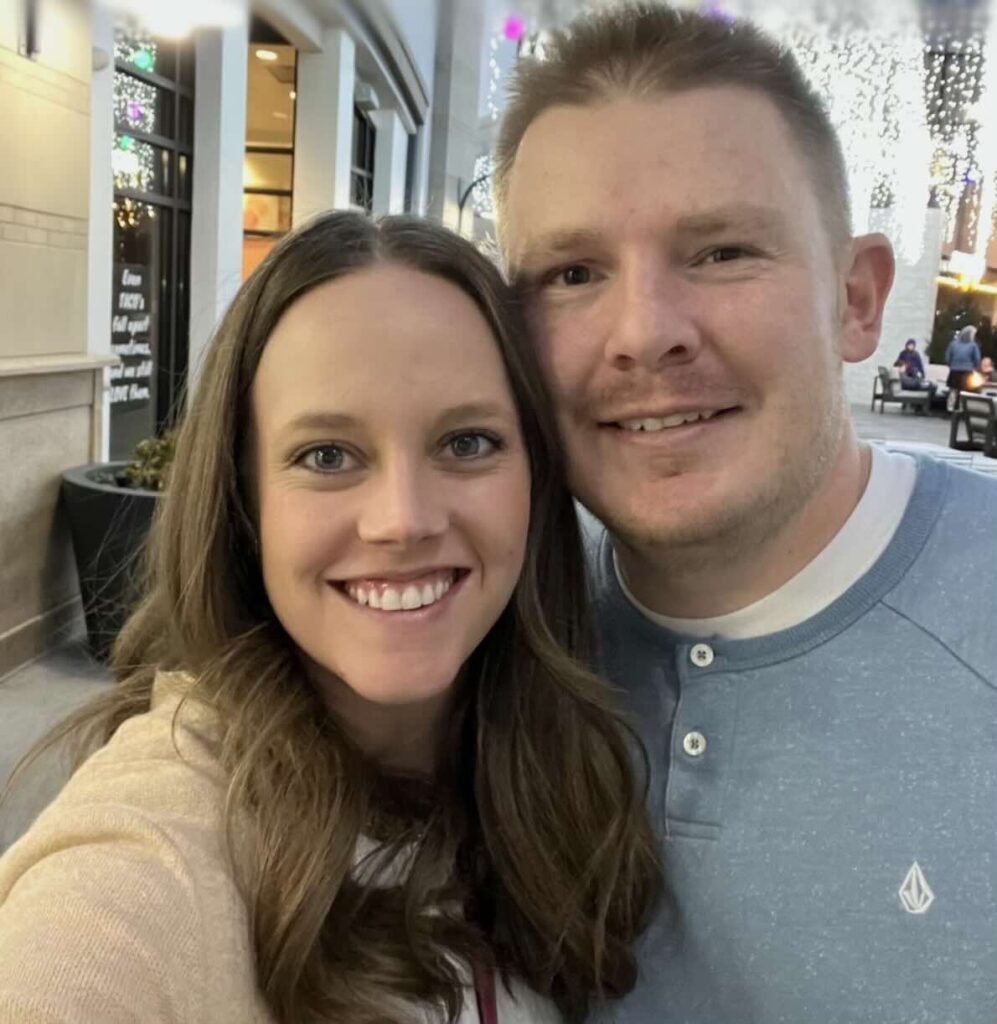
      Alexa and Eric Allred are the dynamic duo behind the hip and successful Gem Rose Design Company. As a stay-at-home mother, Alexa found herself with spare time during her children’s preschool hours. She decided to use this opportunity to learn how to make personalized T-shirts for her young family. Meanwhile, her husband, Eric, began refining his art and design skills—a passion he’d developed in college but temporarily stowed away to focus on fatherhood and a demanding career in marketing. With Alexa’s eye for detail and Eric’s artistic skills, they now run a well-oiled machine. However, their journey has not been without challenges. Through years of trial and error, they learned valuable lessons they now share with creators looking to start a T-shirt design business of their own. 

      Alexa and Eric Allred

      Hone Your Digital Design Skills

      Eric transitioned from traditional markers and paper to digital graphics using the Procreate app on an iPad, teaching himself to use the program through online tutorials and YouTubevideos. Procreate uses natural media simulation, like painting with a standard paintbrush, to create pixel-based art. This step-by-step approach helped him make a smooth transition to digital design. 

      For higher-resolution designs, Eric made the switch to vector-based graphics. Vector images can be blown up without losing quality, making them ideal for signage, logos, and T-shirt design. Vector-based art involves manipulating points and curves instead of freehand sketching. He began using a limited vector software called Vectornator (now Linearity), then moved to Adobe Illustrator. To help make the switch from traditional brushstrokes to vector shapes and lines, Eric challenged himself to copy standard designs and logos to create graphics that remain sharp on any scale. 

      Understand which files to use when saving your designs. PNG files are raster files made up of pixels. They maintain high resolution while supporting transparent backgrounds, but enlarging them can stretch and blur the image. JPEG files are also pixel-based. They are often used for images on websites and digital platforms but lack the transparency feature crucial for T-shirt printing. The image will usually print on a white square background. Lastly, SVG files are preferable for T-shirt designs, as their vector-based nature means they can be enlarged without the blocky appearance of pixelated images.

      Choose a Method to Transfer Your Image

      Vinyl: Alexa began by using a Silhouette electronic vinyl cutter to create simple designs. However, cutting and weeding (removing extra material from negative spaces) was time-consuming and impractical when fulfilling large orders.

      Heat Press: heat press transfers use a thin, paint-like medium printed onto transfer paper. The flexible material melds onto the shirt upon application via heat and pressure. However, this method requires bulk orders with a minimum quantity of shirts featuring the same design to keep costs manageable.

      Sublimation: sublimation printing offers an option that doesn’t require a minimum print run. The technique involves transferring ink onto a film that remains wet until pressed onto the shirt, resulting in a vibrant and durable design. This process is limited to 100% polyester fabric, and the T-shirt must be white or light-colored.  

      DTF: Direct-to-film printing allows for more fabric and color options. Ink is printed onto a film material coated with powder and baked, creating a protected layer pressed onto the shirt. Many different designs can be printed on a single gang sheet, a long roll of film priced based on the square inch. Alexa has found this method to be ideal.

      Devise a Marketing Plan

      Alexa first began selling T-shirts at craft fairs, where she prepared thirty designs, including seasonal/holiday themes and year-round options. She brought her heat press, along with a selection of blank shirts of various sizes. Attendees could browse the designs, choose their favorite, and select a shirt color from the available options. She would then press the design onto the shirt. While a good portion of the shirts remained unsold, selling at craft fairs helped her gain visibility in the community. Handing out business cards and engaging with attendees allowed her to spread the word about the business. 

      Additionally, personal connections played a significant role in their marketing efforts. Through word of mouth, particularly from friends, family, and acquaintances, they attracted a steady stream of custom orders. Many of these orders came from people they knew through various aspects of life, such as sports teams, dance studios, or educators. Eventually, their customer base expanded beyond personal connections.

      They now advertise their designs on social media platforms like Instagram and Facebook. They use a “drop” marketing technique, offering specific designs for a limited time. For instance, during their “Easter drop,” they provided various Easter/spring-themed designs. To order, customers left a comment under the picture of their preferred shirt and design combination. Customers who purchase a T-shirt during a drop must place their order within the week. This method allows the company to place one big supply order and finish all the T-shirts by a specific date.

      Provide Exceptional Customer Service

      Eric and Alexa work closely with clients to customize designs. This process often involves adjusting colors, sizes, or other elements to match the customer’s vision. For instance, team events frequently require custom logos or artwork to represent their theme. They collaborate with the customer to gather details about their requirements, such as preferred colors, imagery, or quotes, and incorporate the elements into the design. Then they share the design with the customer for feedback, making revisions until they are satisfied. Customers can also choose a premade digital design from online sellers. They most often purchase from Etsy, but several other platforms offer artwork in PNG or SVG files. 

      Always communicate with the customer if there are delays or other issues with their order. Explain the situation without making excuses and present solutions to fix problems quickly. Your customers will appreciate your honesty and professionalism. Be approachable, flexible, and consistent in your services. Establishing trust with customers will encourage repeat orders and boost business prospects. 

      Look for Opportunities to Use Your Talents to Bless Others

      Following the tragic loss of a young boy in their town, Eric and Alexa offered their services to design a few shirts for a fundraiser to raise money for the boy’s family. They initially expected to produce around 200 shirts but ended up creating over 800 and raising over $13,000. The experience reminded them that designing T-shirts is more than a hobby or business venture—it has the power to make a meaningful impact on the community.

      Help others on their journeys. While it may seem counterintuitive to share hard-earned knowledge, they are happy to help when people seek advice and believe there’s room for everyone to be successful. 

      Eric and Alexa find joy in working together and bonding over their projects. They love knowing their designs have made a difference in people’s lives, take pride in seeing them in the wild, and aim to inspire others who want to cultivate their creative gifts.

      Headshot of Kami Pehrson.

      Kami Pehrson

      Kami Pehrson lives with her husband and five teenage children in Stansbury Park, Utah. She recently finished her master’s degree in English and creative writing and has written three novels—but is still trying to figure out what to do with them. She loves editing, reading, and playing word games on her phone. She also enjoys listening to audiobooks while half-heartedly doing Pilates in the living room.

            Filed Under: Articles, Fine Art, Marketing Tagged With: art, graphic design, t-shirt design

            July 25: Intentional Editing

            July 18, 2024 By Jeremy Madsen

            With KayLynn Flanders

            Thursday, July 25, 2024, 1:00–2:00 pm Mountain Time

            The good news: Your story can be anything. The bad news: Your story can be anything. In this class, we’ll examine editing as permutation, and help you learn how to edit your story—with all its wonderful possibility—with intention.

            This session will also be helpful for editors editing others’ work.

            Bio: KayLynn Flanders, author of the Shielded duology, holds a degree in English language and worked as an editor for many years before turning to writing. KayLynn is a medium-adventurous foodie and spends her nonexistent spare time traveling, playing volleyball, and attempting new hobbies. She lives with her family in Utah between some mountains and a lake, but you can find her online at kaylynnflanders.com.

            Watch the recording

            Filed Under: Monthly Zoom Discussion

            A Conversation with Adassa

            July 12, 2024 By LDSPMA Leave a Comment

            From the introduction to Adassa’s podcast interview with LDSPMA: Adassa exudes a zest for life. She’s fiery and confident and speaks with a passion that makes you want to eat whatever salsa she’s eating. Above all her fame, she knows what’s important and how to stay in an eternal lane. A proud descendant of Latin ancestors who sacrificed dreams and pleasures, Adassa is a talented musician of world-class renown who is the voice of Delores in Disney’s “Encanto.” She is wildly popular for her rendition of “We Don’t Talk about Bruno.” Her creative journey is inspiring and eventful.

            Connie Sokol, the host of the “Called to Create” podcast, hosted Adassa in March 2023. Much of their conversation focused on how Adassa has kept her family at the center of her life while being called to create. Here are three ways Adassa has prioritized her family while continuing to create music for the world to enjoy.

            Remember Family Stories and Sacrifices

            Aspiring to be part of the music industry isn’t new to Adassa—both her mother and grandmother loved to sing and had dreams of being singers. Adassa herself dreamed of being a singer since she was little. Neither her mother nor her grandmother were fully able to live out their dreams—they instead went into the medical field.

            Adassa shared her family’s story when she auditioned for “Encanto” at Disney. Her parents had both made many sacrifices to be able to come to the United States. As a result, Adassa had many opportunities that she wouldn’t have had without them. She says, “If this is all they (the producers) hear of me, they’re gonna hear my father’s name… I don’t know when I will have the opportunity for their names to be remembered in the minds of these creatives.”

            Keep Family the Top Priority

            Since being signed to her first record deal at eighteen years old, Adassa has traveled the world. Her career has given her opportunities to sing with Luis Fonsi, Missy Elliott, and Pitbull, among many others. She sang at Madison Square Gardens and in the American Airlines Arena.

            Connie asked Adassa, “How did you keep your head? How did you keep grounded?”

            Adassa said, “Well, family to me is number one and has always been my first love… the first thing is to keep them together.”

            She went on to say that she wanted to be the best at the beginning of her career, so she had to study the market, follow trends, and be competitive. As a result, she became famous. She found herself pushing the line until she couldn’t go further. She was grateful for the opportunities she’d had in her music. And then she said, “I know what I believe and I know my principles, and I am unwilling to compromise my principles to go to another level.” She was comfortable, so she decided to retire. And then she was home, making bread and teaching her kids.

            Connie later asked her, “You (and your husband) both are working in the same industry, and you’re both parenting, and then there’s gotta be time for you guys. How do you navigate the shifting of gears together?”

            Adassa said, “I would say it becomes a list of priority. And for us, because our kids are first priority, we have tried to have a live-in [working style]… We kind of do it in the way that works for us.” Adassa and her husband Gabe, who is a music producer, take turns being the stay-at-home parent while they each travel, go on tour, and take advantage of the opportunities that come their way.

            Don’t Be Afraid to Turn Down Money for Moments

            Adassa’s family principles are very important to her. She has learned to say, “Thank you, but no” when an opportunity doesn’t line up with what she ultimately wants in life. She asks herself, “Does this align with my priorities and my principles?”

            Adassa recommends that other creators imagine every step, every yes, and every no to achieve a dream. She said, “Like a chess game, you gotta see the end result before you move a piece.” Otherwise, creators could feel resentment toward their family members for unrealized dreams and expectations.

            She has turned down seven- and eight-figure opportunities because they don’t align with her principles. She said, “Sometimes you have to say no to money so you can say yes to moments—and moments you can never get back.”

            Adassa went on to say that moments are priceless. She looks for opportunities to take her family of seven children with her whenever she can. They come to see her perform and go on tours with her. “No amount of millions of dollars could ever pay for that moment that I’m gonna miss.”

            This article is based on the Called to Create podcast featured during Season 3, Episode 5. You can listen to the full podcast here.

            Filed Under: Articles, Called to Create Conversations Tagged With: family, musicians

            A Conversation with J. Scott Savage

            June 19, 2024 By LDSPMA Leave a Comment

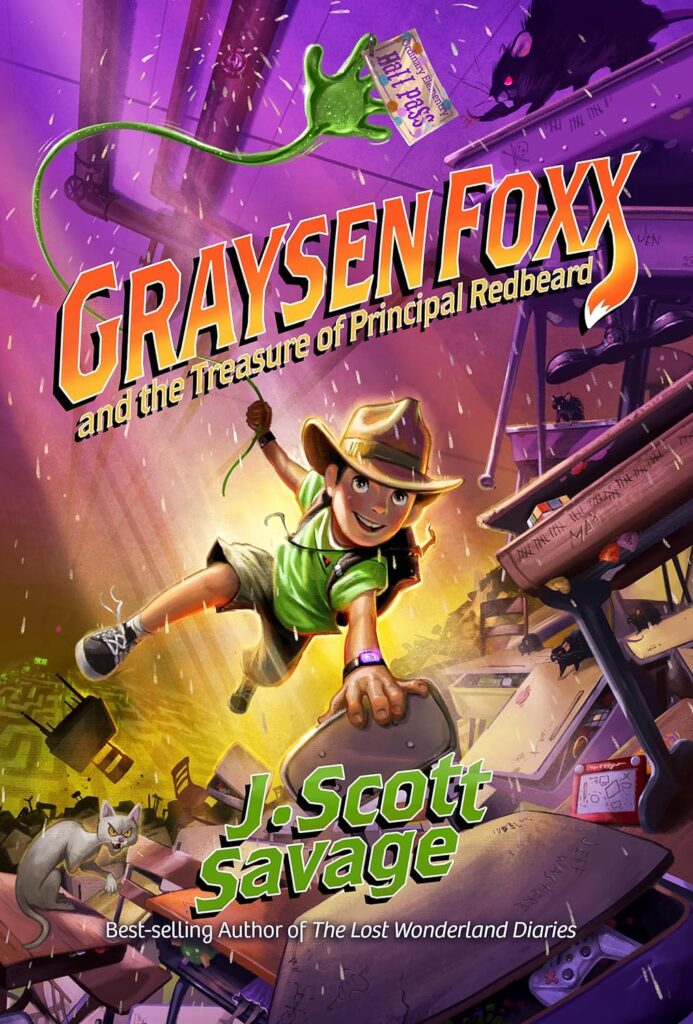
            Tech executive J. Scott Savage had always dreamed of becoming an author; however, it wasn’t until the collapse of a $100-million deal to sell his internet company that he turned to writing to relieve stress. He explains, “I would write a few chapters, and my sister, DeAnne, would read it and go, ‘Hey, this is great. You’re going to write more.'” Encouraged by his sister’s positive feedback, he sent his high-tech thriller to Covenant Communications, a small Utah publisher. Six months later, they offered to publish his book. Looking back at his first novel, J. Scott says, “There are a lot of things that I would have done differently with that story now… But at the time, because there were no aspirations of getting it published, I didn’t know enough to know what I was doing wrong.” Despite facing numerous rejections after his first acceptance, he continued working toward his dream of writing books. He says the obstacles are all part of the process, and making mistakes helped him learn what he knows now.

            Initially, he thought, “Okay, that’s it. I’m an author. I’m going to quit the high-tech world. I’m going to go buy a cabin by the lake, and then I saw my first royalties, and I was like, oh no, I guess I won’t do that.” If he had depended on the income from being a writer during the first two decades of his writing career, he would have likely given up. Instead, he realized that creators must engage in creative endeavors out of love for their art rather than financial gain. “You never want to tell someone, hey, you can’t make a living at this, because you can make a living at any creative endeavor. But you’ve got to start doing it because you love it because most creative people are not making enough money to live off it. And oftentimes, it’s combining it with something else or a different approach.”

            Later, J. Scott transitioned into writing middle-grade fantasy books. He recalls, “So, I started writing adult books, didn’t think I could write kids’ books, but I eventually discovered that [writing middle-grade books] was… my calling, and my very first middle-grade book came out literally within months of… another recession.” He used the severance pay from his tech job to embark on a school tour to promote his debut middle-grade book. His efforts to promote the book weren’t successful in the way he had hoped, but he loved inspiring children to read and write. He recalls, “Looking back, though, what felt like a failure was where I really learned to do what I do now.”

            J. Scott highlights the importance of treating young readers respectfully instead of talking down to them. When he visits schools, he shares stories from his own childhood that kids can relate to, like growing up with ADHD, wearing an eye patch, and going to speech therapy. He says, “As a writer myself, I think it’s valuable to know that someone who has published numerous books believes that others can do the same. My message to aspiring writers is to find their unique voice, make an impact, and celebrate their differences.”

            In a world filled with countless distractions for children, J. Scott aims to provide opportunities for kids to learn to express themselves through writing. “Sharing stories can help us understand each other’s perspectives and appreciate our differences.” His two goals for nurturing empathy in young writers are to show them that reading and writing are fun and safe. “I tell them there is no wrong answer. I’ve had some somewhat questionable things that we come up with, whether a butt monster or a farting unicorn or whatever, but the thing is that once they know that there’s no wrong answer, that it’s not a right and wrong test, it changes things.”

            Teachers verify that his teaching technique works, citing instances where children previously hesitant to write were inspired to craft engaging narratives, such as a story about a farting chipmunk. In the past, the teachers would have rejected this idea for being inappropriate, but because of his advice, “literally, by the end of the day, [the students] had put together a five-page story.”

            By fostering a love for books in school-age children, J. Scott has been able to instill within them a desire to read that lasts throughout their lives. He is often approached by young adults who say, “I know you don’t remember, but when I was in fifth or sixth grade, you came to my school. I hadn’t read anything, but after your assembly, I wanted to read that, and I finished that book, and I told my mom I wanted to read more. I just wanted to come and thank you… it’s because of you coming and visiting my school that I love reading now and that I’ve continued to read.”

            J. Scott’s life lessons and personal triumphs echo through the pages of his books. His narratives, replete with compelling characters navigating challenges, inspire readers embarking on their personal journeys. According to him, reading about characters in challenging situations triggers the release of specific chemicals in the brain. When young readers immerse themselves in books, the same chemical reactions occur. This phenomenon has a transformative power. Readers see their favorite characters triumph over adversity and think, “I can do that too!”

            The positive messages J. Scott gets from readers and teachers help keep him motivated when the business of writing becomes discouraging. He points out that the goal isn’t necessarily to write the next bestseller, but to sell enough books to keep writing more. Despite facing times when he doubts himself and money is tight, he finds strength in moments when people tell him that his stories or classes made a difference in their lives. He shares a story about a friend who wrote a book that didn’t sell well. He assured her that it wasn’t her fault—it’s just how the publishing world works sometimes.

            J. Scott encourages new authors to involve loved ones in their writing journey, seek local mentors and organizations, and use the internet to connect with like-minded individuals. He emphasizes that the gift of writing is a calling from God to impact lives positively. “Whether you’re writing your first book or your twentieth book or whether you’re selling a lot of books or not, whether you’re touring or whatever—I feel like you’ve been given that talent as a calling, and magnifying your calling doesn’t guarantee you’re going to make a lot of money or be famous, but it does guarantee that you’re taking those talents and you’re doing something with them.”

            This article is based on the Called to Create podcast featured during Season 3, Episode 8. You can listen to the full podcast here.

            Filed Under: Articles, Called to Create Conversations Tagged With: Author, middle grade, young adult

            June 27: Mental and Emotional Health

            June 14, 2024 By Jeremy Madsen

            With Dr. Iesha Gibbons

            Thursday, June 27, 2024, 1:00–2:00 pm Mountain Time

            Emotions are a necessary and never-ending part of our journey as people, which is why I want to focus on emotions, what they are, why we feel them, and what they can teach us.

            Bio: Dr. Iesha Gibbons is a licensed marriage and family therapist who works at Redwood Family Therapy in Saratoga Springs, Utah. She received both her masters and doctoral degrees from BYU after completing her undergraduate degree in Florida. She specializes in couples, focusing on communication, healing from affairs, and sexual health. Dr. Gibbons lives in Utah with her husband, two beautiful children, and a grumpy cat. She loves and misses the beach and enjoys watching movies, reading, and dancing in her free time.

            Watch the Recording

            Summary of Takeaways

            What is the purpose of emotions?

            • It’s part of what makes us human
            • Emotions help tell us what’s important in the world around us. They help us focus on problems or highlights.
            • Each emotion plays a role. Fear protects us from dangerous situations. Happiness gives us guidance and direction. Anxiety drives us to prepare for situations or resolve issues. Guilt helps us know we did something wrong.

            How do we manage our emotions?

            1. Listen to your body. What is your phisiological state telling you about your emotional state?
            2. Talk OUT LOUD to yourself about your emotions and why you’re feeling them. (According to Iesha, we need to talk out loud to ourselves a lot more!) Name your emotions out loud. “Hey, sadness. I know that you’re here. Why are you here?”
            3. Accept the fact that you’re feeling an emotion. Acknowledge it. Only then can you do what it takes to manage that emotion.
            4. Listen to what your emotion is trying to tell you. When you listen to an emotion and give it your attention, it will usually then go away or at least become more manageable. If you listen, your emotions will give you the information that you need.
            5. Strive to be emotionally present in your current moment. If an emotion from another part of your life is trying to distract you from your current situation, set it aside—and then come back to it later and listen to it. Don’t just ignore it forever.
            6. Challenge the negative thoughts that are behind your emotions. Verbalize them. Then question the assumptions that they are built upon. We change our emotions by changing our thoughts.
            7. Question and reset your expectations. You may be expecting unreasonable outcomes from yourself or those around you.
            8. Make sure you’re meeting your physical needs (through proper nutrition, regular exercise, and adequate sleep).

            How can we use our voices (our books, music, platforms, etc.) to help people be emotionally healthy?

            1. Show that emotions are a necessary and integral part of the human experience. Show that emotions, even hard ones, can be beautiful.
            2. Show that it takes strength to be vulnerable. Vulnerability is not a weakness.
            3. Normalize therapy. From Iesha: “I think every person needs therapy, just like how everyone needs a primary doctor.”
            4. Normalize talking to others about your emotions
            5. Don’t disparage or discount people’s emotions as real and valid (especially those on the other side of an issue than you or with different lived experience from you)

            Additional insights:

            • Procrastination is an emotional response. It often comes because we’re avoiding an emotion that we would feel if we worked on the thing we’re procrastinating.
            • Anger is a secondary emotion. It is a powerful emotion that protects us from other emotions, such as being vulnerable, or feeling hurt, or stressed. When we experience anger, our job is to unveil and manage the underlying emotion that anger is trying to mask.
            • About boundaries. Cutting a relationship off after having an issue with them is not setting “boundaries.” It’s being reactive. Boundaries shouldn’t “punish” someone else. That’s abuse. Nor should boundaries just seek to avoid conflicts. That’s selfish and short-sighted. Boundaries should help a relationship work better. Talk to the person you’re having problems with and establish some ground rules for behavior or communication that you will mutually expect from each other moving forward.
            • Guilt helps us know when we did something wrong. Shame tells us that WE are wrong. Work to decrease shame, but pay attention to guilt.

            Filed Under: Monthly Zoom Discussion

            • « Go to Previous Page
            • Page 1
            • Interim pages omitted …
            • Page 5
            • Page 6
            • Page 7
            • Page 8
            • Page 9
            • Interim pages omitted …
            • Page 32
            • Go to Next Page »

            Footer

            • Email
            • Facebook
            • Instagram
            • LinkedIn
            • YouTube

            Copyright © 2026 LDSPMA. All Rights Reserved. LDSPMA is not endorsed by nor affiliated with The Church of Jesus Christ of Latter-day Saints.