• Skip to main content
  • Skip to primary sidebar
  • Skip to footer

LDSPMA

Empowering Latter-day Saints to spread light and truth by connecting them at the intersection of faith, creativity, and professional skill

  • Conference
    • 2026 LDSPMA Anthology Submissions
    • Theme Contests
    • FAQs
    • Exhibitors & Sponsors
    • Volunteer at the LDSPMA Conference
    • Past Conferences
      • 2025 Conference
        • Sessions
        • Workshops
        • Awards Gala
        • Internship Fair
        • LDSPMA’s Got (Secret) Talent!
      • 2024 Conference
        • Sessions
        • Workshops
        • ZIFF Networking Dinner
        • Schedule
  • Membership
    • Email Sign Up (Free)
    • LDSPMA NextGen
    • University Chapters
    • Facebook Group
  • Programs
    • Mentoring Program
    • Monthly Zoom Discussions (Free)
    • Master Classes (2026)
  • Podcast
    • Watch
    • Listen
      • Listen on Apple Podcasts
      • Listen on Spotify
      • Listen on Buzzsprout
    • Called to Create Conversations
  • Articles
    • All Articles
    • Faith & Mindset
      • Gospel Principles
      • Creativity
      • Productivity
    • Craft Skills
      • Writing
      • Media, Film & Theater
      • Podcasting & Speaking
      • Music
      • Fine Art
    • Professional Skills
      • Editing
      • Publishing
      • Business
      • Cultural Diversity
      • Marketing
  • Awards
    • 2026 Award Nominations
    • Praiseworthy Awards
    • Spark Awards
    • Lifetime Achievement Awards
    • Past Award Winners
    • Apply to Be an Awards Judge
  • About
    • Mission
      • LDSPMA in the Media
      • Success Stories
      • Viewpoint on LDSPMA
    • LDSPMA Leadership
    • Volunteers
      • Volunteer Year-Round
      • Volunteer at the LDSPMA Conference
      • Apply to Be a Presenter
      • Apply to Be an Awards Judge
      • Resources for Current Volunteers
    • Policies
    • Contact US
  • Support LDSPMA
    • Donate
    • Volunteer

Called to Create Conversations

A Conversation with J. Scott Savage

June 19, 2024 By LDSPMA Leave a Comment

Tech executive J. Scott Savage had always dreamed of becoming an author; however, it wasn’t until the collapse of a $100-million deal to sell his internet company that he turned to writing to relieve stress. He explains, “I would write a few chapters, and my sister, DeAnne, would read it and go, ‘Hey, this is great. You’re going to write more.'” Encouraged by his sister’s positive feedback, he sent his high-tech thriller to Covenant Communications, a small Utah publisher. Six months later, they offered to publish his book. Looking back at his first novel, J. Scott says, “There are a lot of things that I would have done differently with that story now… But at the time, because there were no aspirations of getting it published, I didn’t know enough to know what I was doing wrong.” Despite facing numerous rejections after his first acceptance, he continued working toward his dream of writing books. He says the obstacles are all part of the process, and making mistakes helped him learn what he knows now.

Initially, he thought, “Okay, that’s it. I’m an author. I’m going to quit the high-tech world. I’m going to go buy a cabin by the lake, and then I saw my first royalties, and I was like, oh no, I guess I won’t do that.” If he had depended on the income from being a writer during the first two decades of his writing career, he would have likely given up. Instead, he realized that creators must engage in creative endeavors out of love for their art rather than financial gain. “You never want to tell someone, hey, you can’t make a living at this, because you can make a living at any creative endeavor. But you’ve got to start doing it because you love it because most creative people are not making enough money to live off it. And oftentimes, it’s combining it with something else or a different approach.”

Later, J. Scott transitioned into writing middle-grade fantasy books. He recalls, “So, I started writing adult books, didn’t think I could write kids’ books, but I eventually discovered that [writing middle-grade books] was… my calling, and my very first middle-grade book came out literally within months of… another recession.” He used the severance pay from his tech job to embark on a school tour to promote his debut middle-grade book. His efforts to promote the book weren’t successful in the way he had hoped, but he loved inspiring children to read and write. He recalls, “Looking back, though, what felt like a failure was where I really learned to do what I do now.”

J. Scott highlights the importance of treating young readers respectfully instead of talking down to them. When he visits schools, he shares stories from his own childhood that kids can relate to, like growing up with ADHD, wearing an eye patch, and going to speech therapy. He says, “As a writer myself, I think it’s valuable to know that someone who has published numerous books believes that others can do the same. My message to aspiring writers is to find their unique voice, make an impact, and celebrate their differences.”

In a world filled with countless distractions for children, J. Scott aims to provide opportunities for kids to learn to express themselves through writing. “Sharing stories can help us understand each other’s perspectives and appreciate our differences.” His two goals for nurturing empathy in young writers are to show them that reading and writing are fun and safe. “I tell them there is no wrong answer. I’ve had some somewhat questionable things that we come up with, whether a butt monster or a farting unicorn or whatever, but the thing is that once they know that there’s no wrong answer, that it’s not a right and wrong test, it changes things.”

Teachers verify that his teaching technique works, citing instances where children previously hesitant to write were inspired to craft engaging narratives, such as a story about a farting chipmunk. In the past, the teachers would have rejected this idea for being inappropriate, but because of his advice, “literally, by the end of the day, [the students] had put together a five-page story.”

By fostering a love for books in school-age children, J. Scott has been able to instill within them a desire to read that lasts throughout their lives. He is often approached by young adults who say, “I know you don’t remember, but when I was in fifth or sixth grade, you came to my school. I hadn’t read anything, but after your assembly, I wanted to read that, and I finished that book, and I told my mom I wanted to read more. I just wanted to come and thank you… it’s because of you coming and visiting my school that I love reading now and that I’ve continued to read.”
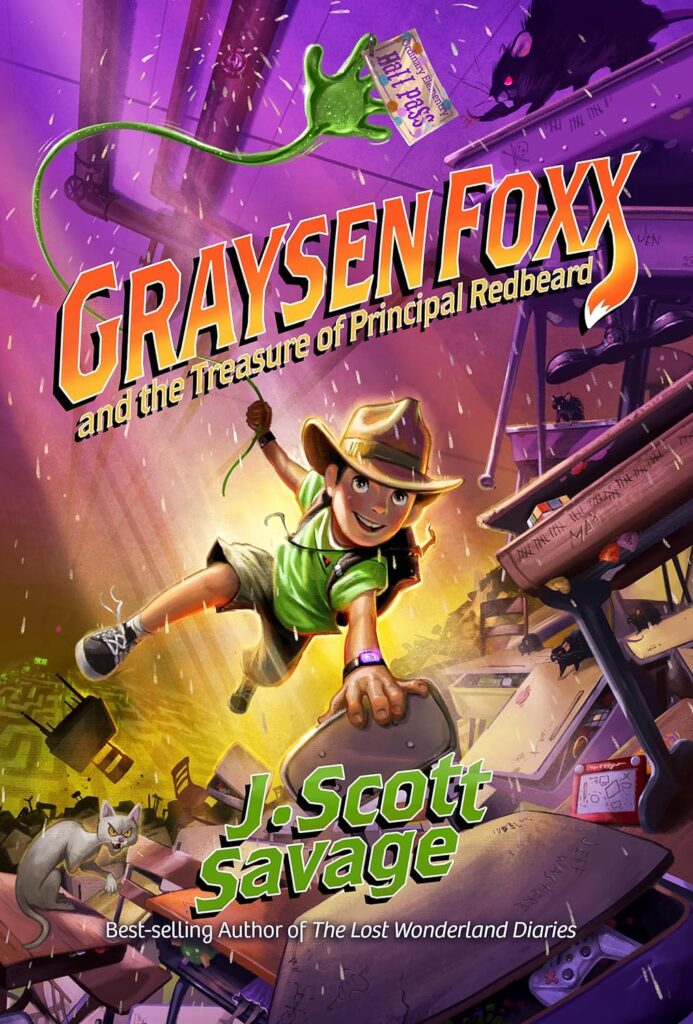
J. Scott’s life lessons and personal triumphs echo through the pages of his books. His narratives, replete with compelling characters navigating challenges, inspire readers embarking on their personal journeys. According to him, reading about characters in challenging situations triggers the release of specific chemicals in the brain. When young readers immerse themselves in books, the same chemical reactions occur. This phenomenon has a transformative power. Readers see their favorite characters triumph over adversity and think, “I can do that too!”

The positive messages J. Scott gets from readers and teachers help keep him motivated when the business of writing becomes discouraging. He points out that the goal isn’t necessarily to write the next bestseller, but to sell enough books to keep writing more. Despite facing times when he doubts himself and money is tight, he finds strength in moments when people tell him that his stories or classes made a difference in their lives. He shares a story about a friend who wrote a book that didn’t sell well. He assured her that it wasn’t her fault—it’s just how the publishing world works sometimes.

J. Scott encourages new authors to involve loved ones in their writing journey, seek local mentors and organizations, and use the internet to connect with like-minded individuals. He emphasizes that the gift of writing is a calling from God to impact lives positively. “Whether you’re writing your first book or your twentieth book or whether you’re selling a lot of books or not, whether you’re touring or whatever—I feel like you’ve been given that talent as a calling, and magnifying your calling doesn’t guarantee you’re going to make a lot of money or be famous, but it does guarantee that you’re taking those talents and you’re doing something with them.”

This article is based on the Called to Create podcast featured during Season 3, Episode 8. You can listen to the full podcast here.

Filed Under: Articles, Called to Create Conversations Tagged With: Author, middle grade, young adult

A Conversation with Jane Clayson Johnson

May 3, 2024 By LDSPMA 2 Comments

Jane Clayson Johnson is a renowned journalist, author, public speaker, wife and mother, and member of The Church of Jesus Christ of Latter-day Saints. Jane uses her platform to advocate for issues like motherhood and mental health by drawing on personal experiences and helping others share their stories.

Jane’s love for storytelling and conveying information began when she was young. She recalls, “In high school, I devoured Time magazine from cover to cover every week. I just got lost in the stories of journalists in faraway places telling sometimes difficult and sometimes heartwarming stories. And I just thought it was such an interesting venue to share storytelling, get facts, tell the truth, and share that in a meaningful and informative way.”

After receiving a violin performance scholarship, Jane began her college career at Brigham Young University. However, she soon realized she wanted to pursue music as a hobby rather than a profession. She then shifted her focus to journalism and gained experience by writing news cut-ins for the campus TV station KBYU.

While leaving the Harris Fine Arts Center, she stumbled upon an internship opportunity at KSL TV. Despite the tight deadline, she drove to Salt Lake City to submit her application and secured the internship. She eventually transitioned from a part-time position at the station to a full-time role upon graduation.

Jane worked with the KSL Nightbeat newscast team, including Dick Nourse, Shelly Thomas, and Bruce Lindsay, who “took her under their wing.” She learned “to work hard and to be the first one in the door and the last one out,” “to be humble,” and to “respect everyone’s job and to learn from everyone because everyone has something to offer and something to teach you.”

Although Jane was happy working at KSL and had no plans to leave, her perspective shifted when an agent from New York contacted her about an interview opportunity with ABC News. Within a couple of months, she had moved to Los Angeles to work as a correspondent for affiliates around the country. She later became a network correspondent on World News Tonight with Peter Jennings. Her career took her all over the world, including assignments in Kosovo and Macedonia, where she reported on the refugee crisis after the NATO airstrikes. She also covered high-profile cases such as the O.J. Simpson trial and the fall of the Soto government in Jakarta, Indonesia.

Jane prevailed over tough competition when CBS launched a campaign to find Bryant Gumbel’s new morning cohost. Describing the role as a once-in-a-lifetime opportunity, she acknowledges the demanding schedule that required her to be up by 3:30 a.m., arrive at the studio by 4:00 a.m. to read newspapers and meet with producers, then present the news from 7-9:00 a.m. on air before providing updates for the West Coast two hours later. Despite the demands, Jane is grateful for the unforgettable opportunities, including covering major events like 9/11 and interviewing prominent figures such as presidents and First Ladies. She credits this experience for preparing her for the diverse seasons of her life that followed.

When asked how she maintains her composure during difficult broadcasts, like her coverage of 9/11, Jane reveals that she feels deeply and tends to over-empathize with her interview subjects. However, she realizes that a reporter is not the story but a conduit for the story. She adds, “I think in the days of kind of showmanship journalism, where lots of folks are trying to . . . be at the center of it all, I think we have to remember to have humility and to try to understand what another person is going through and to help them describe it.”

Jane relied on her faith to anchor her amidst the shifting responsibilities and challenges of high-profile journalism. In an environment where most people had never met members of the Church, Jane recalls, “I had to . . . stand up for my beliefs, and I always tried to do my best. I always felt like I was a representative for the Church and wanted to be seen as someone who lived the gospel in its purest form, which is to be an example of the Savior.” Jane regards her ability to believe as one of her spiritual gifts, which she attributes to her upbringing. She expresses gratitude for her parents, who taught her gospel principles while allowing her to make her own decisions. Once she developed her own testimony, she says, “I realized how precious it was and I didn’t ever want to do anything that would detract from living a life that would. . . allow me to feel the Spirit.”

Jane chose to transition to a new season of life when she met her future husband. Despite receiving a lucrative offer to return to ABC, Jane, then 36, decided to leave the fast-paced world of network news to start a family. Although this choice was met with skepticism from others, and the transition was difficult, Jane knew the decision was right for her. Reflecting on her journey, she emphasizes that individual circumstances and desires are crucial in life choices. She explains, “After working (at) quite a high level for a lot of years, I knew that I wanted to have a family, and I personally didn’t see how it was going to work to be able to do both. I know a lot of women do, but for me, this was the choice that I made.” She relocated to Boston, and within two and a half years, she and her husband welcomed two children.

While Jane had never planned to be an author, an idea for a book came to her in the early morning hours when she was caring for her newborn. She jotted down her thoughts on a yellow notepad. Before she knew it, a book had taken shape. Of the creative process, Jane says, “Each of us has experiences that we can translate into lessons for others.” Her book I Am a Mother challenges the notion that being a stay-at-home mom is not a meaningful or essential role. Hearing many moms say, “Oh, I’m just a mom,” prompted Jane’s desire to help women recognize the value and significance of their role. Drawing from personal experiences and those shared by other women, she sheds light on the often overlooked but essential role of motherhood.

In her second book, Silent Souls Weeping, Jane delves into her personal experience with debilitating clinical depression. Her struggle to navigate the darkness and isolation of mental illness inspired her to embark on a new journey to catalog stories of over 150 individuals who struggle with depression. As Jane notes, “We all have a weakness. We all have times in our lives where we need help, and we need to acknowledge that we need help.”

Despite initial apprehension about sharing such raw and vulnerable experiences, the overwhelming response from readers reaffirmed Jane’s conviction that openness and understanding are essential in combating the stigma surrounding mental illness. She recalls, “We . . . created a community and a conversation within our faith that hadn’t been had before.”

Jane Clayson Johnson’s remarkable journey can inspire us to have faith in our own creative paths and believe that we are being guided to what we should be doing. She admonishes, “No one should discount the experiences that they’re having, whether they be difficult. Whatever they are, they’re preparing you for the journey ahead.”

This article is based on the Called to Create podcast featured during Season 3, Episode 7. You can listen to the full episode here.

Filed Under: Called to Create Conversations Tagged With: broadcasting, journalism, motherhood

A Conversation with Reyna Aburto

March 8, 2024 By LDSPMA Leave a Comment

Connie Sokol hosted Sister Reyna Aburto on the Called to Create podcast to discuss the beautiful ways the Lord works in our lives. Reyna shared how her experiences have shaped her and given her the personal strength to create.

Emigrating to the US wasn’t easy for Sister Aburto. Reyna said, “I think that the key when we go through those hard times is to just live one day at a time…do one little thing at a time. And I think that’s what I try to do, just concentrate on one little thing, line by line, precept by precept.” [4:40–5:10]

Connie agreed and said, “[W]e can feel like we’re constantly learning and in this limbo of.…I don’t know if this is what the Lord exactly wants me to do. When we feel uncertain so much of the time, …we have to draw on those gospel basics whether we realize them or not… Sometimes we negate that this experience is exactly what we need in order to more effectively share what the Lord wants us to share.” [5:18–5:38 and 13:20–13:33]

They then talked about how important it is to have a community of people to strengthen us. Sister Eubank was part of Reyna’s community when Reyna was serving as the second counselor in the Relief Society General Presidency. Reyna was writing her general conference address and expressed to Sister Eubank that she was trying to sound like other women who had spoken in general conference.

Sister Eubank told her, “You don’t need to sound like them. You need to find your own voice. The Lord wants you to have your own voice.”

Reyna knew Sister Eubank was right. She didn’t need to sound like anyone else. [17:45–18:03]

Reyna went on to say, “We just need to find and develop and increase those gifts that we have been given… And we all have them even if we want to be humble and not…acknowledge them…[W]e also have been given experiences that have shaped us, that give us empathy towards other people. So let’s just use those things that the Lord has given us… I think that if we are trying to glorify our Father in Heaven and our Savior, they will allow us to grow and to learn even more.” [18:11–18:55]

Reyna and Connie stressed how important it is to support others as well. Reyna said, “Life is worth living. And…we need to just rally around each other and to try to support each other… Every interaction that we have with a human being is an opportunity to build a bridge, to connect, to support, to listen, to love, and we have those opportunities every day of our life.”  [26:48–27:16]

Connie and Reyna then talked about the importance of vulnerability in creativity. Reyna said, “When we have gone through hard experiences and we are trying to decide if we want to be vulnerable or not, we all have a different pace. And we should not force ourselves to be vulnerable. We need to be ready.” [20:35–20:50]

Connie and Reyna discussed how the Lord helps us heal through hard experiences. Connie said, “He always is layered. And in the process of you going through these experiences, He gives you opportunities to serve, which helps you heal from those experiences, and then share so that other people can heal from those experiences. The way the Lord works is so gorgeous.” [27:25–27:56]

In a Relief Society lesson in Connie’s ward, the sisters openly discussed Sister Aburto’s talk “Thru Cloud and Sunshine, Lord, Abide with Me” (October 2019). Connie said, “We were able to open up and connect, and hearts were knitted together in love, just like the scriptures say, because we were able to get real about those experiences and stories in a way that really hadn’t been done on that level yet.” [28:13–28:54]

Connie said to “Keep showing up, [and] keep taking the next right step.” [6:00–6:03] Connie then asked Sister Aburto if there are any tips she’d share for showing up during hard experiences.

Reyna said, “I think that prayer is very important… Every day of our life. Because we never know what is gonna come our way… We can start our day with a prayer asking Heavenly Father to protect us and to help us create that day in a way that is pleasing for Him. And then we can also have a prayer in our heart as we go through our days… But also, I think that looking at every experience that we have as a learning experience, even when things don’t go the way we expected. We should not look at them as failures. We should look at them as a learning experience, something that you’re learning that is preparing you for something else… We are always preparing for something else. It doesn’t matter how hard a situation is or an experience is, we can always learn from that and it will always make us stronger.” [29:58–32:32]

Connie said, “It’s in the daily doing. And it’s the living. The experiences that we’re having and seeing the beauty of it and seeing the purpose in it that then we can turn around and we can channel that and utilize it for good… It’s preparing you to be a more effective instrument…. You’re doing this for him! And it doesn’t matter what part you are, what step you are on that journey, …he’s gonna use it for good. So you don’t have to stress that, you just have to keep showing up for him.” [33:42–35:05]

Finally, Reyna shared some questions to help creatives learn from their tough experiences. She asked, “What am I learning from this? How is this going to help me in the future? How can I get closer to God with this experience? How can I connect with others? How can I use this experience to fill my heart with empathy toward other people?”

Reyna then reminded creatives, “[U]se those experiences to make you a better person, to make you a better disciple of Christ, and to glorify God who is in heaven because of all the miracles that you’ve had in your life.” [32:35–33:00]

This article is based on the Called to Create podcast featured during Season 3, Episode 21. You can listen to the full episode here.

A headshot of Sister Reyna Aburto.

Reyna Aburto

Reyna Aburto was born in Nicaragua and studied Industrial Engineering there. She holds a degree in Computer Science from Utah Valley University and has worked in the language industry for more than 30 years. Reyna and her husband own a translation business. She has served as Relief Society General Presidency Second Counselor and as a member of the Primary General Board for The Church of Jesus Christ of Latter-day Saints. She currently serves on the Correlation Committee in Church Headquarters. She is the author of Reaching for the Savior (Acudamos al Salvador, in Spanish), and co-host of the Consecrating Your Life podcast (@consecratingpod) with her daughter Elena.

    Filed Under: Articles, Called to Create Conversations

    • « Go to Previous Page
    • Page 1
    • Page 2

    Primary Sidebar

    Write for Us

    Would you like to see your article featured here on LDSPMA?

    We are currently seeking article submissions. Learn what you need to know and submit your article here. 

    Recent Articles

    Margaret Blair Young and the Power of Stories that Matter

    “Pray about what kind of work might bring good into the world, then begin. Be open to anything. Trust that when you start doing something that is truly meant to edify and bring greater light into the world, it will be sustained.” -Margaret Blair Young

    A human hand and a robotic hand reaching toward one another.

    Why and How to Recognize AI Writing

    “At the end of the day, readers love, value, cherish, connect with, and pay for books written by humans.” -Amy Guan

    Three agents, two male, one female, applaud a pitch.

    Networking and Pitching to Agents (Even When You’re Scared to Death)

    “We can act out of character for work we really love. But we should do it mindfully and then restore afterward. …Break the shell, then give yourself a break.” -Sabine Berlin

    Search the Articles Archive

    Article Topics

    Recent Podcast Episodes

    Footer

    • Email
    • Facebook
    • Instagram
    • LinkedIn
    • YouTube

    Copyright © 2026 LDSPMA. All Rights Reserved. LDSPMA is not endorsed by nor affiliated with The Church of Jesus Christ of Latter-day Saints.